

This article is an excerpt from The Fourth Branch: How State Government Can Save Our Union.
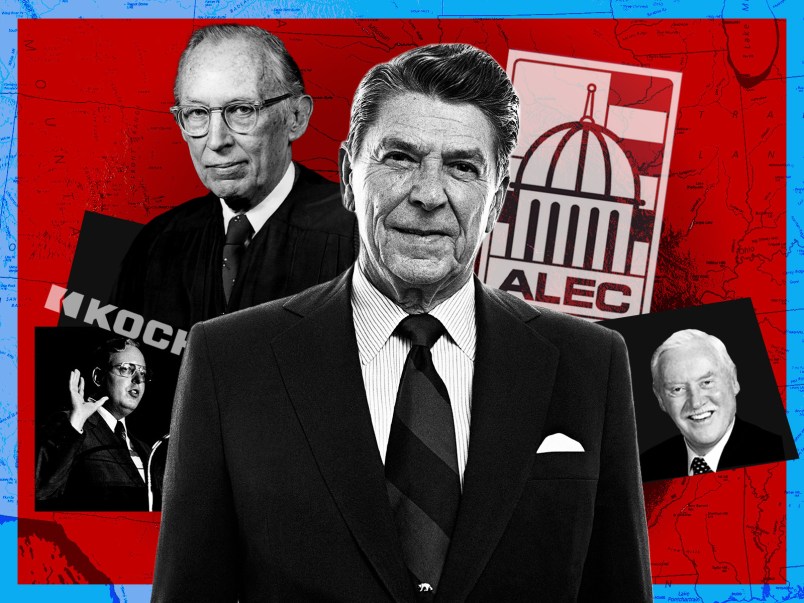
President Reagan entered to a standing ovation. It was the last year of his presidency, and he was feeling, as he often did, nostalgic. “I’m not joking when I say that every one of the eight times I’ve met with you these eight years, I’ve wished more like you were in our Congress,” the president said to his audience of state lawmakers from each state in the country. They were part of a group most Americans had never heard of, the American Legislative Exchange Council, or ALEC for short.
“And yet I’m also glad you’re where you are: leading our conservative revolution in the state legislatures of America,” he continued. “Already you’re leading not only the states but the federal government as well in an agenda of hope for the future. In areas like tort reform, drug legislation, AIDS testing and research, welfare reform, privatization, and education reform, you’ve been way out in front of the pack.”
Following the president’s dulcet tones, a lanky man with an impressive mustache stepped behind the presidential seal. This was New York state senator Owen Johnson. “Mr. President, we’re very honored that you’ve met with us again as you have in the past,” intoned Senator Johnson, every syllable dripping with his hometown of Babylon on the south shore of Long Island. “We’re grateful for your longstanding support which you’ve rendered to ALEC. We’d like to take this opportunity today to present you with a token of our appreciation.”

When I entered the New York state senate’s new Democratic majority in 2009, Owen Johnson was still serving. It was the only time in his 40 years that he suffered the indignities of the minority. He was 50 years my senior and treated by his Republican colleagues like a legend; they all called him “OJ” without irony, as though he was the most famous American with that nickname. For years, “OJ” had served as the chairman of the important Finance Committee, which oversees New York’s gargantuan budget.
Though we were colleagues, he was playing the power game at a different level than I had even considered. I would have been shocked to learn that “OJ” had spoken on a program with the president as part of an annual trip to the White House. And I wouldn’t have understood that the role he was playing there, as chair of ALEC, made him even more powerful outside of our chamber than he was within it.
President Reagan understood exactly why it was so important. His politics depended on his vision of states’ rights — a federalism steeped in specific symbolism.
During his successful campaign for the White House, when he’d delivered a major campaign speech laying out this vision for states’ rights, among the country’s 3,000 counties he’d coincidentally chosen Neshoba County, Mississippi — by chance, the place where three young civil rights activists had been murdered during the Mississippi Freedom Summer 16 years earlier, in 1964.
He called upon the same vision of state power to justify his administration’s effort to unravel the effective and popular government programs built from Franklin Roosevelt’s New Deal to Lyndon Johnson’s Great Society — the “reforms” and privatization for which he thanked the ALEC lawmakers. Arguing for states’ rights was more popular than arguing against clean air to breathe and water to drink; affordable healthcare for parents and their kids; a country connected by dependable highway, aviation, and communications networks; and plentiful opportunities for dignified work with good wages and conditions.
“When we talk about federalism here in Washington, we’re really talking about putting the states more and more in charge,” he said to “OJ” and the ALEC lawmakers. “And that means that if what we conservatives believe in, if the principles that we stand for, are to succeed and prevail, we will need more conservatives like you in our state legislatures.”
Though Reagan drew on a symbolic connection between the power of states and his right-wing vision, the idea that these two goals were inexorably linked was a myth. There was nothing inevitable about it.
Linking state power with a certain ideology wasn’t the goal of the people who literally wrote the book on federalism: Alexander Hamilton, John Jay, and James Madison didn’t collaborate to write the 85 essays of The Federalist Papers with any partisan goal. Ideologically, they didn’t agree with each other on most things. But one of Madison’s conclusions in the papers has become particularly complicated: “The first and most natural attachment of the people will be to the governments of their respective States,” he claimed, which was a good argument to make to state politicians.
The three federal branches are not considered to be inherently more ideologically conservative or liberal. … The fourth branch of the system our founders created — the states — can be just as fervently contested.
But throughout the country’s history, whether, why, and where people’s primary attachment was to their state’s identity and politics became inextricably linked to the Constitution’s original sin. Though The Federalist Papers barely referenced slavery explicitly, the Constitution left this fundamental issue of morality and humanity to the states. In the ongoing conflict that resulted, claiming an “attachment” to states’ rights became the foundation of the argument to expand slavery, start the Civil War, and defend the racial supremacy laws that persisted in rebel states for a century afterward.
The relative power of state government came to be seen as a partisan question, steeped in specific symbolism that seemed to connect it to conservative ideologies. By the time Ronald Reagan ran for office, the conservative movement had been practicing how to wield this symbolism for more than a century.
But like the legislative, judicial, and executive branches, states are an ideologically neutral part of the constitutional system. The three federal branches are not considered to be inherently more ideologically conservative or liberal. Everyone knows that passionately contesting the worldviews that control Congress, the presidency, and the courts is what defines our politics. The fourth branch of the system our founders created — the states — can be just as fervently contested.
In The Federalist Papers, Madison’s goal was not to convince his audience of the rightness of state power compared to federal power — or the opposite. He was arguing that states would retain power for themselves. For Reagan, putting states “more and more in charge” was an argument to repeal popular federal programs, privatize core public services at every level of government, and neuter post–Civil War constitutional amendments guaranteeing equal protection under the law and the right to vote regardless of race.
But the myth Reagan articulated offered a palatable framework to justify unraveling government’s capacity to improve people’s lives — just as it had justified the Civil War and Jim Crow. That framework powered the right-wing revolution. And, as President Reagan himself said, ALEC — the leading right-wing effort focused on states — was a core pillar of that revolution. That’s why it was founded.
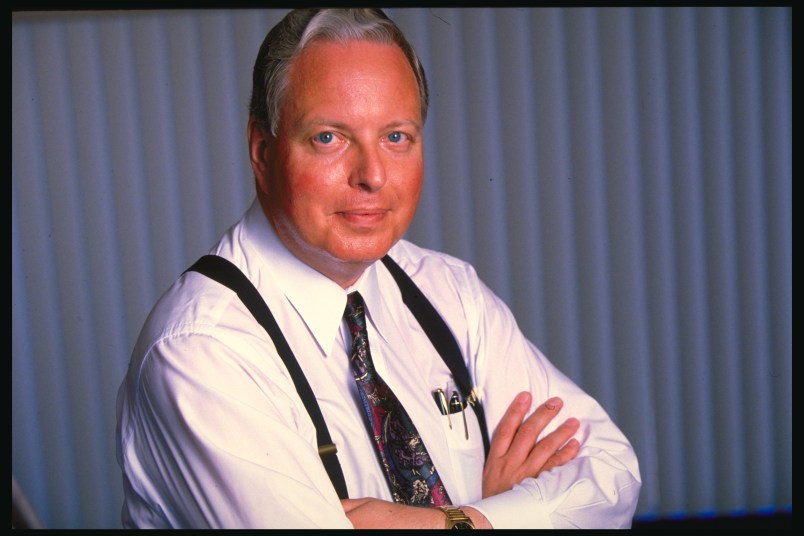
In 1969, Paul Weyrich had a flash of genius. He was an idealistic and ambitious Republican political operative in his late 20s, representing his boss at a meeting of the Civil Rights Coalition.
“I sat there and I watched all these people interact with each other. And I said, ‘that’s how they do it!’ All of a sudden I was granted the opportunity to see the mechanics,” he described years later, ailing and toward the end of his life. “From that day forward, I was insufferable. Wherever I went, I said we have to do something about this. We have to have our own organizations.”
While Weyrich’s Colorado Republican boss was ideologically flexible enough to send a staffer to the Civil Rights Coalition meeting, Weyrich was not. His worldview had been forged over 24 months in 1964 and 1965 at the nexus of three events — one political, one legislative, and one religious.
First, he’d worked on Barry Goldwater’s failed 1964 presidential campaign. Goldwater wanted to wash away the civil rights protections, social security checks, and increasingly, healthcare that the New Deal consensus delivered. But the Arizona senator was crushed, just as every candidate who has argued directly for those parts of the conservative agenda has been since 1945.
Second, Weyrich mourned the enactment of the Voting Rights Act of 1965. In perhaps his most famous statement, during Ronald Reagan’s first campaign, Weyrich said, “I don’t want everybody to vote. Elections are not won by a majority of people. They never have been from the beginning of our country, and they are not now. As a matter of fact, our leverage in the elections quite candidly goes up as the voting populace goes down.”
Finally, and perhaps most surprising in the context of this political account, Weyrich felt his religion had been stolen from him by Vatican II, the papal initiative concluded in 1965 that sought to modernize the Catholic Church for the 20th century.
With his religion lost to the forces of mid-60s modernism and liberalism, just as his politics and his country had been, Weyrich went searching. Before long, he converted to the Eastern Orthodox Church.
Weyrich wanted to revive what had been lost within the movements he was part of — politically, nationally, and religiously. With traditional structures under attack by humanists and communists, he believed that a strong nation required the moral clarity of religious traditions and the wisdom of elite benefactors; therefore, government should be controlled by those who will follow those benefactors to resurrect traditional religious and social values.
He considered his own Roman Catholic Church the problem in religion; so, too, he considered his Republican Party the problem in politics — a loose-leaf coalition of convenience without a coherent ideological or intellectual basis.
So, as he had done with Catholicism, he gave up on the institutions of the mainstream Republican Party. But in politics, instead of finding a new institution to join, he would take what he had learned at the Civil Rights Coalition meeting and start new ones, built on the core worldview he’d forged during those searing 18 months in 1964 and 1965.
First, he started the Heritage Foundation, which aimed to be a politically supercharged counterweight to existing Washington institutions like the American Enterprise Institute and the Brookings Institution. It would innovate the role of the think tank, providing members of Congress with more timely and actionable “information relating to public policy” than the established institutions did.
Almost simultaneously, Weyrich also helped start the American Legislative Exchange Council —ALEC — whose members Reagan would welcome so warmly each year he was in office. Originally housed at the American Conservative Union, ALEC aimed to do for state lawmakers the same thing Heritage did for members of Congress: give them an actionable road map to drive the country toward its right-wing vision.
Weyrich’s founding of ALEC wasn’t a sign that the Republican Party was focused on building state political power — but rather a result of the fact that it wasn’t. The ideological institutions Weyrich started were designed to attack the Republican Party establishment, not strengthen it. The 50 state capitals where ALEC was organizing a network of lawmakers and disseminating policies to propel its worldview were power centers that establishment Republicans were not attending to sufficiently.
Weyrich’s combination of ideological clarity and obsession with delivering the most actionable, timely possible information for elected officials made his creations even more potent than the loose collection of liberal interests sitting around the Civil Rights Coalition room that had inspired him. His insight that relevance was built by being useful to policymakers quickly made Heritage’s radically conservative framework potent in the world of Washington think tanks. By 1981, it was setting the agenda for the Reagan administration with its first Mandate for Leadership — the 9th edition of this Heritage playbook was called Project 2025. Meanwhile, even as ALEC operated in the much less developed world of state legislative policy, its work and influence became just as significant as anything happening in DC.
While Weyrich was converting his epiphany into action, future Supreme Court Justice Lewis Powell was writing a memo for his neighbor, a former state lawmaker who was in charge of advocacy for the U.S. Chamber of Commerce. Powell argued that there had been a “destructive” decades-long trend by big business to leave governing to the government. He believed that corporate and business interests that created wealth were under attack by leftists and the bureaucracy they controlled, that a strong nation required the free hand of the market guided by corporate autonomy, and that, therefore, government should be organized to support and protect big business.
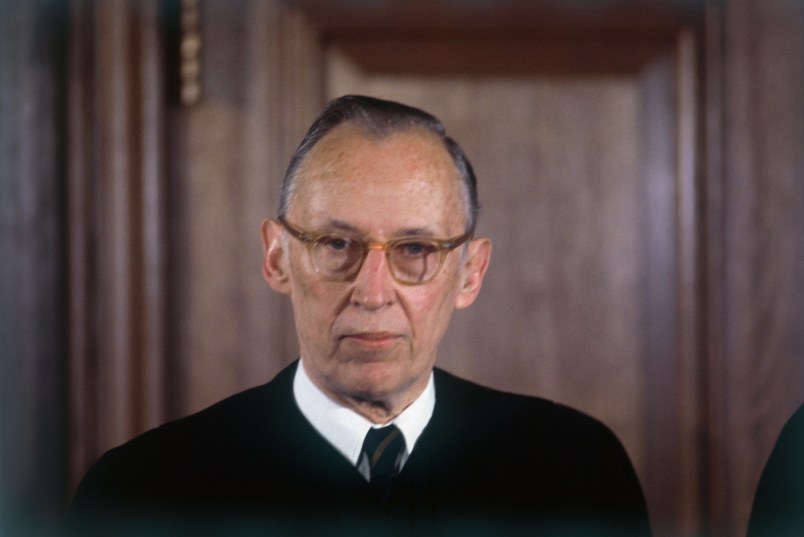
Powell argued that big business should be more actively involved in the political process at all levels of government — specifically highlighting the importance of state and local activism. Almost immediately, his proposals began to take shape in the political activities of the Chamber of Commerce.
Like Lewis Powell and Paul Weyrich, in the early 1970s Charles and David Koch also had an ideological problem with the Republican Party: They considered it to be insufficiently libertarian. So the Kochs founded their own think tank, the Cato Institute, to support their cause in contrast with mainline Republican Party doctrine. David Koch went so far as to run as the Libertarian Party vice-presidential candidate against Ronald Reagan’s ticket in 1980!
The fight for the ideological soul and structural control of the Republican Party in the 1970s can be easily overlooked. But it was an existential battle in which the combatants competed for every possible advantage — relative to the establishment and each other. With so much on the line, they did not merely play the prestige game in Washington, DC; they struggled to build power in the states, where it mattered.
Over time, the Republican Party evolved to find the balance between Weyrich’s cultural and religious conservatism on the one hand and the corporate policies and donors Powell and the Kochs prioritized on the other (leaving the GOP’s less ideological establishment members behind in the process).
By the time my old colleague “OJ” was welcomed to the White House at the end of President Reagan’s term, these streams had come together to solidify the Republican Party’s advantage in states. Conservative activists had been joined by corporations — including the Kochs’ own — as dues-paying members of ALEC. Around the time that “OJ” got his ALEC Lifetime Achievement Award in the mid-nineties, the Kochs partnered with the R. J. Reynolds tobacco company to provide a much-needed loan to keep the group going.
In the succeeding decades, the intellectual descendants of these movements have run with Reagan’s euphemism about putting states in charge, hiding behind the smokescreen of states’ rights while they also wipe away the authority for any level of government to govern.
This alliance between cultural conservatives — who opposed the civil rights movement and supported religion in government — and corporatists and libertarians — who wanted to dismantle government — has contributed to the false understanding of states’ rights. Supporting strong state governments is considered synonymous with wanting a conservative and weak government overall, which doesn’t actually make any sense if you think about it. Nothing about state power inherently allows racist laws, prioritizes one religious tradition over others in government policies, protects corporations from paying for the consequences of their actions, or wipes away government capacity to spur abundance.
Federalism is structural, not ideological. It can be used for different ends. The New Deal ideas that Labor Secretary Frances Perkins brought to FDR’s Cabinet had first been tested in New York. Obamacare was based on earlier expansions of government healthcare options in Hawaii and Massachusetts (under Republican Governor Mitt Romney, no less!). Each day’s newspaper are full of examples of states taking action to protect life, liberty, and the pursuit of happiness for citizens.
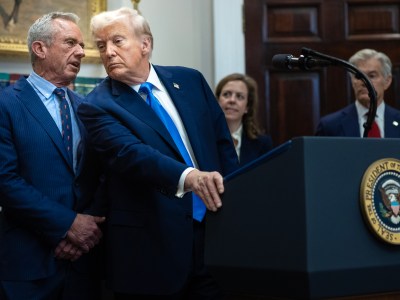
While I was writing this, Robert F. Kennedy Jr.’s Centers for Disease Control cut monitoring of disease outbreaks, limited vaccine availability, removed barriers to drug companies raising prices, and defunded research. Almost immediately, multiple groups of states came together to do their own outbreak monitoring, issue vaccine guidance, negotiate with drug companies, and even fund research. These groups of states together made up the world’s third-largest economy, greater than Germany and Japan combined.
And states can be much more active. Imagine them acting together to create cheap high-speed rail from DC to Boston; reduce energy costs and poisonous emissions through an energy collective from the mountain west to the Pacific coast; crack down on interstate corporate tax cheats; or agree that whoever wins the national popular vote in an election will earn the needed electoral votes to win the presidency. That’s not so different than how states passing marriage equality changed the federal reality.
Meanwhile, the federal government can be used as a tool to undermine democracy and civil rights. Just ask Donald Trump. In 2025, with his party in control of the three federal branches of the government — and enjoying a structural advantage in the US Senate and the electoral college — Trump suddenly asserted the dominance of the federal government in federal elections. “The States are merely an ‘agent’ for the Federal Government in counting and tabulating the votes,” he posted. “They must do what the Federal Government, as represented by the President of the United States, tells them, FOR THE GOOD OF OUR COUNTRY, to do.”
It will surprise a total of no one that Ronald Reagan made the opposite point about states. “This country is as free as it is — you as individuals owe much of your freedom to this very unique thing about our country — that it was set up by the Constitution to be a federation of sovereign states, not administrative districts of a Federal Government that retained all the power itself,” he asserted.
He had a point.





Great article.
Paul Weyrich’s name had been in the back of my mind for a long time, but this really explains who he was and what his goals were and what he actually accomplished.
And here we are today.
More proof that Saint Ronnie was a huckster, little more than a beaming used car salesman unloading a piece of junk with egg in the radiator, sawdust in the transmission and water in the oil and calling it “like new.”