

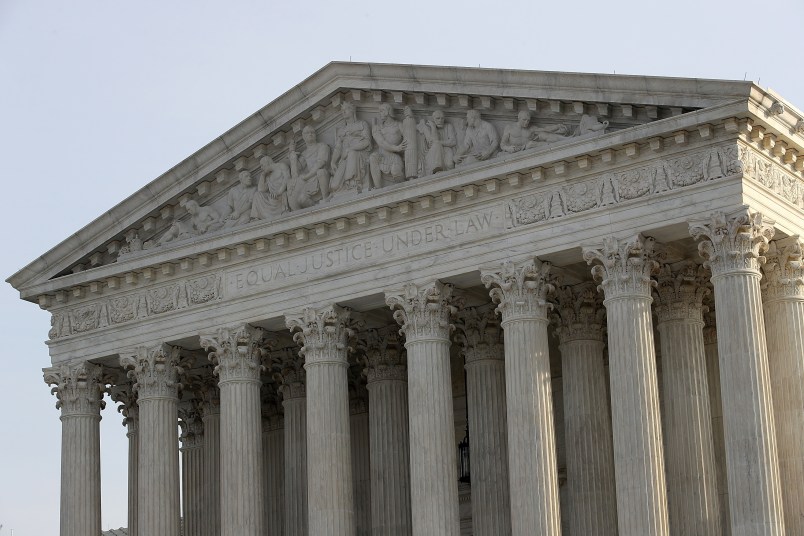
WASHINGTON (AP) — The coming battle over a Supreme Court nominee promises to be a bruising one.
Republicans are eager for conservatives to gain a firm majority on the court.
Democrats are voicing alarm about what the new justice could mean for charged issues such as abortion rights and gay rights. The stakes are enormous, and advocacy groups that don’t have to unveil their donors are spending heavily to shape the fight.
President Donald Trump’s top contenders for the vacancy appear to be federal appeals judges Amy Coney Barrett, Thomas Hardiman, Brett Kavanaugh and Raymond Kethledge.
Trump planned to announce his pick Monday night. Regardless of his choice, it’s likely that the closely divided Senate will be holding a momentous confirmation vote just weeks before the midterm election.
A look at what to expect:
___
FINDING THE VOTES
Republicans may have a narrower margin for error than they did when the Senate confirmed Trump’s first Supreme Court nominee, Neil Gorsuch, by a vote of 54-45 in April 2017.
Democratic Sen. Doug Jones of Alabama has replaced Republican Sen. Luther Strange, cutting the GOP’s Senate majority to 51-49. Meanwhile, Republican Sen. John McCain of Arizona is battling brain cancer and has not been back to the Capitol since December.
That increases the focus on two Republicans — Sen. Susan Collins of Maine and Lisa Murkowski of Alaska. Both support a woman’s right to have an abortion and will be looking for assurances that the nominee would not overturn the Roe v Wade decision establishing abortion rights. Trump pledged in 2016 that he would be “putting pro-life justices on the court.”
On the Democratic side, the focus will be on Sens. Heidi Heitkamp of North Dakota, Joe Donnelly of Indiana and Joe Manchin of West Virginia. All three voted to confirm Gorsuch and are up for re-election in states that Trump won handily. Whatever they decide will upset a large group of voters in their home states.
If Collins and Murkowski vote “no” and Democrats all vote “no,” the nomination would be blocked. If McCain were to miss the vote, only one GOP defection would be needed to block the nomination if all Democrats were opposed.
___
OLD WOUNDS
Democrats are still stinging from Republicans refusing to even grant a hearing to President Barack Obama’s choice to serve on the Supreme Court, Merrick Garland.
They are calling on Senate Majority Leader Mitch McConnell, R-Ky., to wait until after the November election to schedule a hearing and vote. McConnell has rejected that possibility, saying the decision to not fill the vacancy under Obama was prefaced on it being a presidential election year.
Democrats say McConnell is being hypocritical in moving forward with the nomination. While that argument won’t sway Republicans, their strategy could stiffen Democratic resolve to oppose the nominee. Liberal advocacy groups are challenging Minority Leader Chuck Schumer, D-N.Y., to keep the Democrats united.
___
SENATE RELATIONS
Much of the groundwork for a successful confirmation comes in private meetings that the nominee will have with individual senators in the coming weeks. For lawmakers who are not on the Judiciary Committee, it may be their only chance to talk with the nominee personally before a final vote. Gorsuch met with nearly three-quarters of the Senate in advance of his hearings.
The process is arduous, with the private meetings giving way to days of testimony before the Senate Judiciary Committee, which has 11 Republicans and 10 Democrats.
Hearings for the most recent nominees to the Supreme Court have lasted four or five days, though there were 11 days of hearings for Robert Bork’s nomination in 1987.
On average, for Supreme Court nominees who have received hearings, the hearing occurred 39 days after the nomination was formally submitted, according to the Congressional Research Service.
The Judiciary Committee need not approve the nomination for it to advance. A negative recommendation or no recommendation merely alerts the Senate that a substantial number of committee members have reservations.
___
THE FIGHT OUTSIDE THE CAPITOL
Before the president has even made his announcement, advocacy groups are making clear they will play an important role in the coming fight.
Groups that support abortion rights are planning a “Day of Action” for August 26, the anniversary of the 1920 adoption of the 19th Amendment giving women the right to vote.
The liberal advocacy group Demand Justice will spend $5 million on ads through September and began airing spots Thursday in Maine and Alaska aimed at pressuring Collins and Murkowski. “Why won’t she rule out voting for Trump’s anti-choice picks?” both ads ask.
It also plans to run ads next week in Manchin’s, Donnelly’s and Heitkamp’s home states with a softer tone, asking them to continue protecting people with pre-existing health conditions by opposing a nominee who’d threaten that.
Meanwhile, the conservative Judicial Crisis Network is targeting vulnerable Democratic incumbents in its ad campaigns. The deep-pocketed group advertised against Senate confirmation of Garland and spent millions more advocating for Gorsuch.







I hate to say it, but this is probably a losing battle. You can’t count on Collins and Murkowski to do the right thing and the three Dems mentioned will probably also cave. We have to play the long game by getting control of more state governments. I think that the long term impact of what is happening with SCOTUS will be the movement of educated individuals and businesses that need well-trained workers from red to blue states. The US will become two countries. We live in NC and are considering moving to a blue state if the state politics don’t turn around even though we love the area where we live and the cost of living is generally higher in blue states.
“Sen. Susan Collins of Maine and Lisa Murkowski of Alaska. Both support a
woman’s right to have an abortion and will be looking for assurances
that the nominee would not overturn the Roe v Wade decision establishing
abortion rights.”
Thing is, there’s no story here if they are in fact not looking for those assurances. And Collins recently said she wouldn’t support someone who “demonstrably has hostility” toward Roe v. Wade. That’s a far cry from “looking for assurances they won’t overturn it.” This little semantic game points toward the Republican habit of “look at me!” followed by party-line vote. There really isn’t a “battle.”
No it doesn’t. We didn’t have a bruising battle over Gorsuch, whose seat was a stolen one and absolutely ripe for a battle, and we won’t have a bruising battle here. The current argument being advanced by our electeds seems to be that the McConnell rule applies and there should be no confirmation ahead of the November midterms. That won’t inflict the slightest contusion on the Republicans. They have the votes, we have an argument that adds no value to the Democratic brand and inflicts no damage on the Republican cause.
We’ve already lost this Supreme Court seat. The best tack forward is to (1) insist that McConnell rule does not apply, because it’s a fraud on the constitution and on the Supreme Court; (2) this nomination is illegitimate, since by virtue of the Garland stolen seat it will confer an illegitimate and extremist Republican majority on the SC. On that footing–illegitimacy, not on the footing of Roe v Wade or any other policy concern–Jones, Heitkamp etc can vote against the nominee.
Also, Democrats should take this opportunity to put pressure on the one possible chink in the Republican hegemony–Roberts. If the Democratic narrative is that the “Trump-Roberts Court” no longer commands the trust of half the country, in particular after the shocking Kennedy revelations (which I see the Dems have, as per usual, shown zero spine about), then Roberts may well understand that a complete partisan domination of the court is not consistent with the institutional interests of which he’s the trustee, and may well think more carefully about his decision-making. “Trump-Roberts Court” should be the new name for the “Supreme Court” used by every Dem. This current mob have forfeiting the right to be called a “Supreme Court.”