

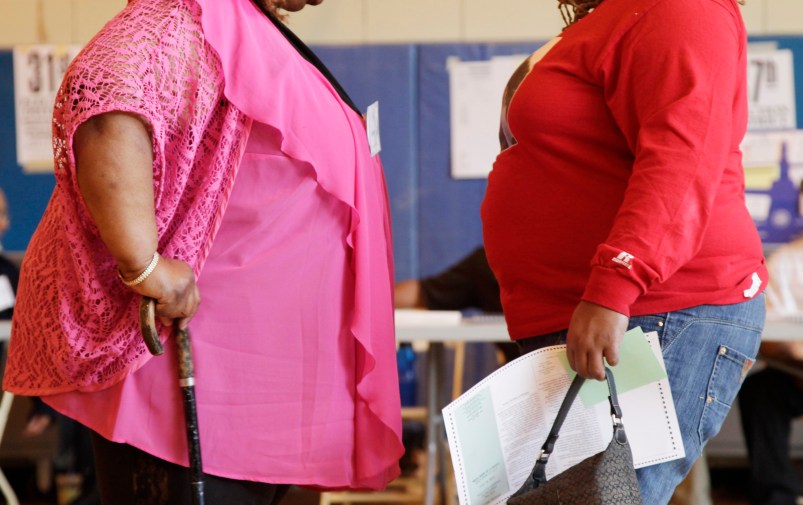
NEW YORK (AP) — The nation’s obesity epidemic continues to grow, led by an alarming increase among women. For the first time, more than 4 in 10 U.S. women are obese, according to new government health statistics.
Obesity rates for men and women in the U.S. had been roughly the same for about a decade. But in recent years, women have surged ahead and now just over 40 percent of women are obese, compared to 35 percent of men.
The percentages were reported by the Centers for Disease Control and Prevention, in two articles published online Tuesday by the Journal of the American Medical Association. The numbers are based on small government survey that is considered the best measure of the nation’s obesity problem.
Though it is not altogether surprising to health researchers because the nation has long been growing more obese, it is “scary” that the statistic has reached 40 percent for women, said Dana Hunnes, a dietitian who sees obese patients at Ronald Reagan UCLA Medical Center in Los Angeles.
“It’s a really alarming figure, and it’s alarming that it’s continuing to go up despite government calls to action on weight loss and healthy eating,” she said.
Why the problem is getting worse for women faster than for men remains somewhat of a mystery to health researchers. “I don’t know if anyone truly knows for sure,” Hunnes said. Experts say there are a range of possible explanations, including that many women are satisfied with a larger body size.
The rate of obesity in women is also higher than in men across the world, although far lower overall than in the U.S. According to the World Health Organization, 15 percent of women worldwide and 11 percent of men are obese.
Obesity, which means not merely overweight, but seriously overweight, is considered one of the nation’s leading public health problems because it can trigger diabetes and lead to heart disease and other serious health problems. Until the early 1980s, only about 1 in 6 adults were obese.
The problem is not increasing as dramatically as it was, but the new numbers show it is clearly not improving, said Dr. Felipe Lobelo, an Emory University researcher who focuses on obesity and physical activity.
Researchers looked at obesity rates among different age groups and along racial lines and found wide disparities, mainly ones that have persisted for years.
Obesity continues to be most common among black women. About 57 percent of black women are obese. In contrast, about 47 percent of Hispanic women, 38 percent of white women, and 12 percent of Asian women are obese.
Among men of different races, obesity rates cluster much closer together — at 35 to 38 percent for blacks, Hispanics, and whites.
The researchers also found:
—About 38 percent of all adults are obese.
—About 17 percent of children are obese, which is the same as earlier reports.
—Obesity rates have been steadily increasing in adolescents since 1988 and now are at 21 percent, but have been stable in kids ages 6 to 11 in recent years at 20 percent.
Obesity is calculated by dividing a person’s weight by their height to produce a number called the body mass index , or BMI. A BMI of 25 or greater is considered overweight, and a BMI of 30 and above is obese. A person who is 5 foot 4, the average height for U.S. women, is considered obese at a weight of 174 pounds or more. A person who is 5 foot 9, about the average height for men, is deemed obese at 203 pounds.
The findings are from a regular government survey of about 5,000 Americans every two years who are weighed and measured. The new figures are from surveys done in 2013 and 2014. Last fall, the CDC released an obesity report using some of the same data, but the new reports provide more detailed look at obesity numbers through time, including slightly higher prevalence figures for adult men and women.
___
Online:
JAMA: http://jama.ama-assn.org
Copyright 2016 The Associated Press. All rights reserved. This material may not be published, broadcast, rewritten or redistributed.







Whoops, I’m in the wrong place. I thought this was the Renee Ellmers - Barbara Sandrock article…
Many women would be considered “obese” if they couldn’t fit into the size 4 clothes that all models wear for advertising. Obesity can be a state of mind and if everything you read, see and are told through your whole life says that you are already “fat” you think of yourself as “fat” and know you will never have a chance of being “normal” as seen everywhere. Just like Fox News brainwashing in politics, what we used to call Madison Avenue advertising has brain washed women, little girls and men looking at women that in order to be anyone you have to be model thin.
After while you just get tire and give up, even though the choices in clothes for “fat” women make us look like clowns. It is more than just eating too much and exercising too little. There is a book called “Thin is a state of mind” well “fat” has become that subliminal chant the many of us hear every time we open our mouths.
Some days I just want to give up the fight, there never seems to be an end in sight where I will be considered 'exceptable" in the weight category and I have lost 50 pounds in the last year.