

WASHINGTON (AP) — Republicans intent on scrapping Barack Obama’s Affordable Care Act have a budget problem.
As it turns out, repealing and replacing the law they hate so much won’t save nearly as much money as getting rid of it entirely, the goal they’ve been campaigning on for seven years. That means trouble for the federal deficit and for Congress’ fiscal conservatives who repeatedly warn about leaving their children and grandchildren worse off financially.
President Donald Trump and other GOP leaders know they can’t just get rid of the law; instead they’ve vowed to “repeal and replace” it. So they’ve come up with a bill that would fix Obama’s “disaster” and insist it would give Americans more choices on health coverage.
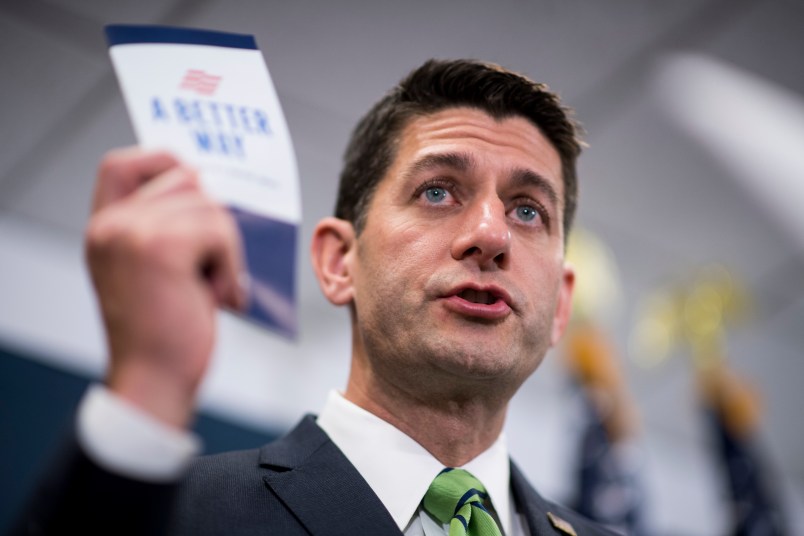
But it only reduces the deficit by $337 billion over a decade and doesn’t move the federal budget much closer to being balanced, if at all. That’s one big reason many budget-conscious Republicans have joined Democrats in opposing the repeal-and-replace version pushed by the White House and House Speaker Paul Ryan, R-Wis.
In proposing his 2018 budget on Thursday, Trump called for spending billions more on defense while slashing domestic programs. He vowed during the campaign to leave the costly mandatory programs such as Medicare and Social Security untouched, and he won’t raise taxes. That budget plan guarantees large deficits.
“Our military is more important to me than a balanced budget,” Trump said in a Fox News interview in January.
The initial Republican plan to completely scuttle the 2010 health care law promised a cut of more than $2 trillion from the deficit over 10 years.
The GOP health care bill cuts the deficit by much less.
“Now that (health care repeal) is actually going to happen, they’ve changed their priorities greatly so that they’re not actually trying to generate any significant savings,” said Maya MacGuineas, president of Committee for a Responsible Federal Budget, a Washington-based advocacy group for budget discipline. “And there’s no sign what they can fill it in with.”
A senior member of the House Budget Committee, Rep. Tom Cole, R-Okla., says: “Oh yeah, there’s no question. It’s much tougher, much tougher” to balance the budget after repealing and replacing the health care law.
What would be left behind, according to the Congressional Budget Office, is $9 trillion in projected deficits over the coming decade and fewer ways for Trump and Republicans controlling Congress to cut.
The worsening deficit creates a huge problem for other critical pieces of Trump’s agenda, including tax reform, a big infusion of infrastructure spending or helping people with the costs of child care.
First, swelling deficits mean less money for such legislation.
The deepening debt hole also means problems when Republicans try to pass a budget outline this spring, since some tea party Republicans and deficit hard-liners will insist on promising to balance the budget even though the math no longer works. More realistic lawmakers will resist that.
Under the arcane congressional budget process, the yearly budget blueprint doesn’t by itself make any changes to government programs, but it makes it easier to enact follow-up legislation like tax reform, which is the top GOP priority after dealing with health care.
But if they can’t pass a budget, Republicans can’t pass tax reform — at least without help from Senate Democrats — because of Senate rules.
The fiscal picture, meanwhile, has another complication. If Republicans can successfully pass their health care repeal and replacement they will have used up their opportunity to cut Medicaid to generate savings toward a balanced budget. The health measure promises an enormous $880 billion cut from Medicaid over 10 years and it’s not credible to say Republicans could claim more in subsequent legislation.
“They’ve taken (Medicaid) off the table,” said Douglas Holtz-Eakin, a conservative economist and former Congressional Budget Office director.
“The math doesn’t work,” said Sen. Chris Van Hollen, D-Md. “Just nothing that they’re doing adds up right now.”
How big is the problem? According to calculations by the Committee for a Responsible Federal Budget, if House Republicans were to simply plug their health repeal and replace bill into last year’s budget resolution, they would fall $350 billion short of balance by the end of their 10-year goal. And if further Medicaid savings are taken off the table, the gap is more like $500 billion.
“It’s going to be extremely difficult,” admitted budget panel member Cole.
Copyright 2017 The Associated Press. All rights reserved. This material may not be published, broadcast, rewritten or redistributed.






Trump: In words of The Great Cheney, who I deeply admire, Deficit doesn’t matter if a Republican is POTUS. We all know that, so does the media and all Amerikans.
They want to continue to lower already low taxes on the wealthy and corporations, while claiming to wanting to balance the budget and increase military spending. If this can even be done, it would have to be on the backs of the poor and middle classes.
No wonder they’re into a revisionist Jesus, as Eric Erickson tried yesterday.
I saw that Erickson quote. Wow.
Good thing I’m not a Christian, or I might be in trouble for wishing that he had actually died when he had serious stress-related health problems recently.
Yeah, it sure does.
I have trouble reconciling “The health measure promises an enormous $880 billion cut from Medicaid” with “They’ve taken (Medicaid) off the table” to generate savings toward a balanced budget. Only in GOPer land can a conservative economist and former Congressional Budget Office director say that making major cuts to government spending takes away your ability to make major cuts to government spending. It’s now up to policy wonk and budgetary expert Speaker Ryan to explain the role of magic asterisks and dynamic scoring in the MAGA Balanced Budget Act.