

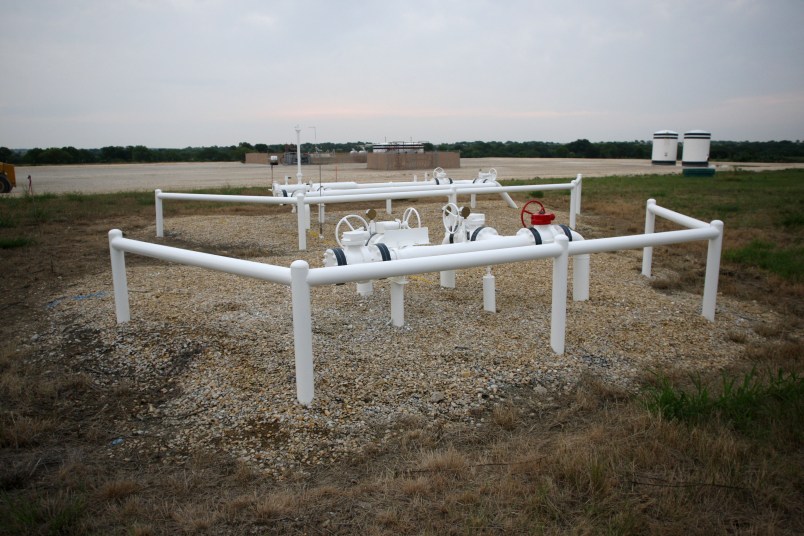
WASHINGTON (AP) — With real-time monitors, scientists have linked a swarm of small earthquakes west of Fort Worth, Texas, to nearby natural gas wells and wastewater injection.
In 84 days from November 2013 to January 2014, the area around Azle, Texas, shook with 27 magnitude 2 or greater earthquakes, while scientists at Southern Methodist University and the U.S. Geological Survey monitored the shaking. It’s an area that had no recorded quakes for 150 years on faults that “have been inactive for hundreds of millions of years,” said SMU geophysicist Matthew Hornbach.
When the volume of injections decreased significantly, so did the shaking.
The scientists concluded that removing saltwater from the wells in the gas production process and then injecting that wastewater back underground “represent the most likely cause” for the swarm of quakes, according to a study published Tuesday in the journal Nature Communications.
The scientists determined this based on where and when the earthquakes happened; computer models that track pressure changes; and company data from nearby wells. Hornbach said the timing and location of the quakes correlates better to the drilling and injection than any other possible reason.
“There appears to be little doubt about the conclusion that the earthquakes were in fact induced,” USGS seismologist Susan Hough, who wasn’t part of the study team, said in an email. “There’s almost an abundance of smoking guns in this case.”
This adds to other studies that linked injecting wastewater from energy wells to a tremendous jump in earthquakes in Oklahoma and southern Kansas, where there have been more than 950 magnitude 2 or higher quakes so far this year, according to the USGS.
In the past, studies have linked quakes to the injection of wastewater after the drilling process This study is different because it also sees a secondary link in another part of the drilling process, when massive amounts of brine is taking out of the ground with the gas, said study co-author William Ellsworth of the USGS. Removing the saltwater changes the underground pressure, Hornbach said.
But the deep injection of the wastes still is the principle culprit, Ellsworth said. The controversial method of hydraulic fracturing or fracking, even though that may be used in the drilling, is not physically causing the shakes, he said.
___
Online:
Nature Communications: www.nature.com/naturecommunications
___
Seth Borenstein can be followed at http://twitter.com/borenbears
Copyright 2015 The Associated Press. All rights reserved. This material may not be published, broadcast, rewritten or redistributed.







Oh brother, here it comes…
Besides,
What kind of bogus standard is THAT?
La-dee-dah, I’m a “geophysicist”, I work at a university and you don’t, and all that means I get to tell all YOU dumb clucks that hundreds of millions of years without measurable seismic activity on a massive elevated plateau that’s one’s on the most dominant features of the southern reach of the one of the only 4 great plains, prairies & steppe formations on this planet somehow MEANS something. Like, zero earthquakes going all the way back to when Jeebus rode dinosaurs, followed by a teensy slice of 100 years or so of basically unrestrained drilling and fracking, followed by MEASURABLE EARTHQUAKES isn’t totally random.
In reality world, this activity is toadily inexplicable unless there are decades of studies and then every single person who claims to be a scientist or to know one or have heard or read about them agrees otherwise.
Texas: come for the crazy, stay for gigantic and ominous rumblings, soon host not only to the Texas Super Collier hole in the ground, but thousands upon thousands of daily earthquekes and sinkholes.