

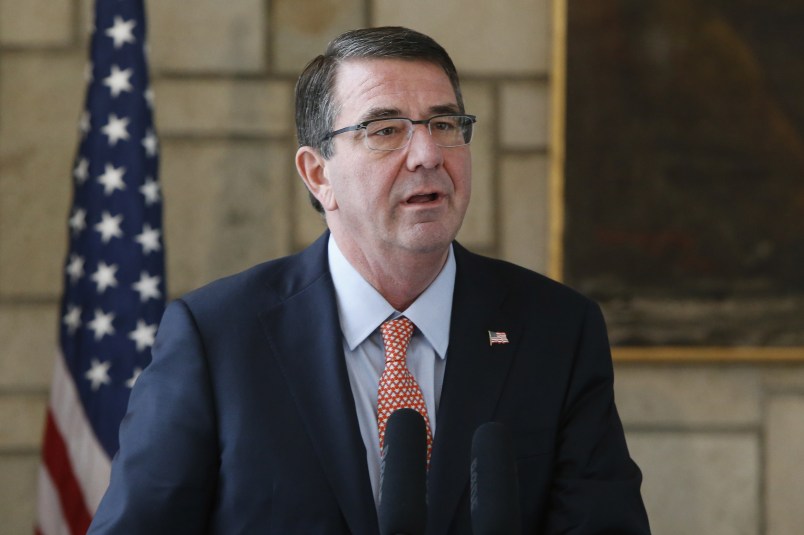
KABUL, Afghanistan (AP) — The United States is considering slowing its military exit from Afghanistan by keeping a larger-than-planned troop presence this year and next because the new Afghan government is proving to be a more reliable partner, U.S. Defense Secretary Ash Carter said Saturday.
Carter, on his first overseas trip since starting the Pentagon job Tuesday, also said the Obama administration is “rethinking” the counterterrorism mission in Afghanistan, although he did not elaborate.
No decisions have been made, but President Barack Obama will discuss a range of options for slowing the U.S. military withdrawal when Afghan president Ashraf Ghani visits the White House next month, Carter said at a news conference with Ghani. The presidents also plan to talk about the future of the counterterrorism fight in Afghanistan, he said.
Carter did not say Obama was considering keeping U.S. troops in Afghanistan beyond 2016, only that the president was rethinking the pace of troop withdrawals for 2015 and 2016.
There are about 10,000 U.S. troops in Afghanistan, down from a peak of 100,000 as recently as 2010-11.
While the White House recently acknowledged it was reconsidering the exit plan, Carter’s remarks were the most direct explanation by a Pentagon official amid criticism from opposition Republicans that the Democratic commander in chief is beating a hasty and risky retreat.
On Feb. 11, the White House said Ghani had requested “some flexibility in the troop drawdown timeline” and that the administration was “actively considering” that. A day later, Gen. John Campbell, the top U.S. commander in Afghanistan, told the U.S. Senate Armed Services Committee that he had presented U.S. leaders with several options that would allow him to better continue training and advising Afghan forces, particularly through this summer’s peak fighting season.
The “common denominator” in the new thinking about the U.S. military mission is a belief in Washington that the formation of a unity government in Kabul last year has opened new possibilities for progress on both the political and security fronts, Carter said.
The unity government of Ashraf and Chief Executive Abdullah Abdullah offers new promise for a more effective partnership in stabilizing the country, Carter said.
U.S. officials had grown grew impatient with former President Hamid Karzai, who sometimes publicly criticized the U.S. military and took a dimmer view of partnering with the Americans.
“That’s a major change,” Carter said, something “that just a few months ago we couldn’t have planned on.”
Obama’s current plan calls for troop levels to drop by half from 10,000 by the end of this year and be at nearly zero by the end of 2016. The U.S. would maintain a security cooperation office in Kabul. Ghani has made it known he thinks that should be slowed down in order to better support Afghan forces battling a resilient Taliban insurgency.
Carter did not describe in detail what changes Obama is considering in the U.S. military presence. But he said could include slowing the withdrawal pace and changing the timing and sequencing of U.S. base closures.
He said Obama also was “rethinking the details” of the U.S. counterterrorism mission in Afghanistan, where there are remnants of al-Qaida as well as signs that the Islamic State militant group is seeking to make inroads here in addition to Iraq and Syria.
In his remarks to reporters, Ghani thanked Obama for being flexible and showing a willingness to consider “the realities on the ground.” Using similar phrasing, Carter said that when he returns to Washington he will work up recommendations to Obama, in advance of the March talks, that “reflect reality on the ground.”
Carter lauded the progress that Afghanistan has made during the 13 years since U.S. forces invaded and toppled the Taliban rule. Obama’s goal, he said, is to “make sure this progress sticks” so that Afghanistan does not again become a launching pad for terrorist attacks on the U.S.
Carter also met in the Afghan capital with Campbell and Gen. Lloyd Austin, the commander of U.S. Central Command, which has responsibility for U.S. operations in Afghanistan and across the Middle East.
Copyright 2015 The Associated Press. All rights reserved. This material may not be published, broadcast, rewritten or redistributed.



More madness from The Best and the Brightest.
And rethinking, and rethinking, and rethinking some more. Since little thought is what got us entangled in this desert quicksand, a hell of a lot of thought and readjustment of that thought is needed to get out.
Afghanistan may be the least of our problems at this point. The bush’s invasions stirred up a sleeping giant of hatred in the Arab world. Getting out of Afghanistan or going back in makes no difference in Syria or Iraq or to the terrorist opportunists that need a Holy war to survive.
The real WMD, was the go it from the gut instinct of the last Republican President Puppet Fool and his willingness to listen to all the wrong people. Will the Iraqi’s ever forget, how could they when the quagmire is still fresh? Do Afghanistani’s realize that they were used? Probably.
Counterterrorim is a fluid situation and a base in Afghanistan is only the launch pad just as it was for bush the dumber’s original crusade.
Counterterrorism is just as effective if we don’t give them targets, Americans IOW, and keep the fight alive. Which is playing into the terrorists mission.
Brute force vs. heartless evil is a lose/lose. Excluding the war hawks and war profiteers, we are smarter than this.
Yes, you would think we were “smarter than this” but as terrorists opportunists need a Holy war so do the war profiteers here at home. The U.S. Defense Industry and Arms Sales account for about 1% (2001) of our GDP. Lockheed Martin, Northrop Grumman and Boeing are the three top arms-producing and military servicing companies in the world. Eight of the top ten are American companies (2010). So yes, it will take a lot of rethinking.
To me it’s all madness. We invaded and occupied two sovereign nations - and still do today a dozen years later. “Mr. President, why are we in Iraq” was the standard question to the Village Idiot from Helen Thomas as she sat up front during a Bush presser. All the alpha males sitting behind her would snicker. It’s still a valid question today. Time to come home. I experienced this first hand in Vietnam where the Harvard rookies thought they had the answers but they didn’t even know the questions. And they couldn’t let it go. It’s the same today.
BTW that wasn’t your post, it was Lib538 who told me to team up with ISIS. My apologies.
I’m sure you gave him reason to. Since you play bad Darcy-good Darcy after you get called out, which is pretty damned often. You must enjoy it?
Go back and note that on the thread that you claimed/lied it on and you might look like less of a liar.
And yeah, you basically just expanded on my idea which I personally see no need to get all in depth about because the MIC is fricking huge and this Middle East adventurism promises to keep them in business for many decades to come. Holy Wars last centuries and dumbass bush just had to cowboy it up and go into the lion’s den. Now, we are stuck fighting the enemy that he created and there just isn’t any easy way out.
I’m sure you’ll say that there is so I’ll disagree before you get going.