


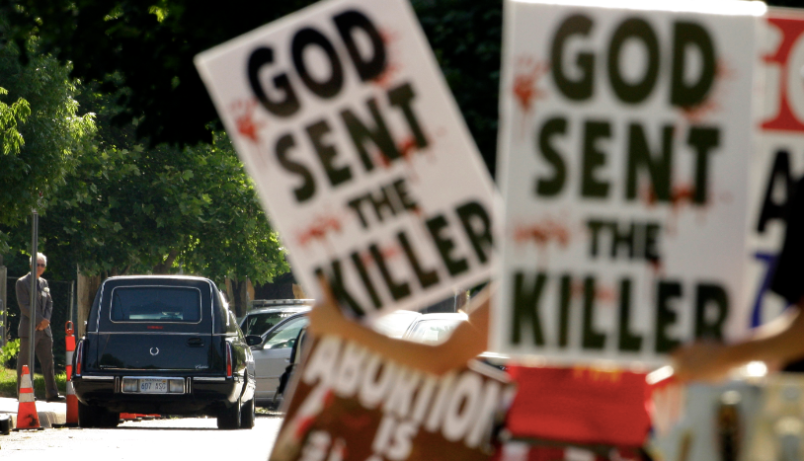
It was entirely predictable that those in the “police can do no wrong” camp would blame the tragic murder of NYPD officers Wenjian Liu and Rafael Ramos, at the hands of Ismaaiyl Abdullah Brinsley, on the recent protests against police violence. But it was just as predictable that other, more clever rightwing sorts would use liberals denying that linkage as cover to excuse any and all rightwing terrorism, past or present, by blurring the distinctions between what Brinsley did and what other, more clearly ideological killers do.
The award for that move goes to Jesse Walker at Reason, who draws a false equivalence between Brinsley’s actions and those of rightwing terrorist Scott Roeder, who killed abortion provider George Tiller in 2009. “Responsibility for a crime lies with the criminal,” he says, suggesting that people who point to incendiary rhetoric that precedes a bout of violence will create a situation where “we aren’t supposed to criticize anyone at all.”
It’s an understandable urge. After all, many anti-choice people vehemently disagree with Scott Roeder’s choice, both because it was wrong and because terrorism makes them all look bad. It’s easy to see why conservatives would want a complete embargo on blaming larger political movements for seemingly ideological violence, particularly as most domestic political violence, from anti-choice violence to the threats coming from Cliven Bundy’s ad hoc militia, is coming from the right. But the fact remains that sometimes larger political forces do bear responsibility for what individuals choose to do, and that is far more true of Roeder than of Brinsley.
It’s telling that Walker ignores the biggest debate over the relationship between rhetoric and violence, namely whether or not to blame Islam for the actions of Islamic terrorism. Perhaps this is because considering this issue would show that it’s not black-and-white. After all, it’s both true that most Muslims have no interest in terroristic violence, but also that Islam-inflected rhetoric drives some to terrorism. Which, in turn, suggests that there isn’t a simple rule to apply to all situations. Instead, to understand the relationship between rhetoric and violence, we have to look at, ugh, context.
Once you do that, it is clear that Roeder and Brinsley’s situations are very different. Brinsley’s past and his choices during his killing spree—including shooting his ex-girlfriend—suggests less a political terrorist and more a spree killer, which is to say motivated by the desire to go out in a blaze of glory more than a political obsession. Some spree killers, like Anders Behring Breivik, graft some kind of ideology to their justifications and some, such as the Columbine killers, just admit all they want to do is wreak havoc. But they aren’t actually trying to effect political change through violence, which is what terrorism is all about.
By that measure, Roeder was a terrorist. He spent years in the anti-abortion movement, focused on shutting down Dr. Tiller’s clinic, and only chose murder when it became clear that legal harassment wouldn’t work. He continues to justify his decision by saying, correctly I’ll point out, that the fear of violence scares doctors away from abortion. Roeder was also working with a movement that stalks doctors, protests outside their offices and homes, and publishes their addresses, all of which are as close to begging someone to shoot a doctor as you can get while still skirting the laws against death threats. And there is no disputing that Roeder’s actions worked. There is no legal late term abortion provider left in Kansas now.
There’s no evidence that Brinsley had a coherent political goal. His goal appeared to be getting attention—and invoking Eric Garner was a way to do it. Nor is there any indication he was working with anti-police violence protesters. There’s no suggestion that he thought his decision would actually do anything to stop police violence against civilians.
If we step away from the political point-scoring and look at history, we can tell the difference between a political terrorist and a mentally ill person doing a violent thing. The assassination of Abraham Lincoln was an act of political terrorism, performed by a Confederate loyalist. The Confederate hatred of Lincoln was inarguably not just a factor, but the entire reason for that murder. In contrast, the man who shot Ronald Reagan was a mentally ill man trying to get attention, which he admitted openly when caught. The fact that a lot of people hated Reagan wasn’t a factor, something even the biggest Reagan fans have to admit.
We can accept that Brinsley’s actions were not primarily political, despite what he may have said in his final hours, without conceding to the right the desire to write off all rightwing Christian terrorism as little more than the actions of a few bad apples. All it takes is a little context.
Amanda Marcotte is a freelance journalist who writes frequently about liberal politics, the religious right and reproductive health care. She’s a prolific Twitter villian who can be followed @amandamarcotte.



Boy, that was a lot of words to make a pretty simple point: The guy who shot the abortion doc was directly involved in the anti-abortion movement, so it was an act of political terrorism. Meanwhile, the guy who shot the NYPD officers was not involved in the protest movement and had a troubled history, so it was the act of a lone nut.
Even simpler translation: Don’t blame our side, we’re the good guys.
What I find to be most dispiriting about this debate is an unwillingness on both sides to address objective facts. How can you possibly know whether Brinsley was influenced by some of the heated, false rhetoric some of the protesters are throwing around?
The award for that move goes to Jesse Walker at Reason, who draws a false equivalence between Brinsley’s actions and those of rightwing terrorist Scott Roeder, who killed abortion provider George Tiller in 2009. “Responsibility for a crime lies with the criminal,” he says, suggesting that people who point to incendiary rhetoric that precedes a bout of violence will create a situation where “we aren’t supposed to criticize anyone at all.”
I just clicked on the link to Jesse Walker’s article and read it. The mention of Scott Roeder plays a very small role in an article that is far better written, reasoned and argued than this one.
For better or worse, we live in a society where people are allowed to engage in strong, even heated rhetoric, but are not allowed to commit a crime in furtherance of that rhetoric. People who can’t grasp that distinction, regardless of political beliefs, deserve to be punished for their crimes.
I think there are two recent events that make for better comparison. In June Jerad and Amanda Miller murdered two police offices and several other people in Las Vegas. They were at the Bundy ranch protests and were asked to leave because of conduct issues or perhaps because Jerad had a police record. The connection was reported across many news outlets but there wasn’t any outrage that Bundy and the militias were responsible. Instead they were allowed to defend their actions and claim by asking Jerad and Amanda to leave it shows the militias were not responsible. No outrage on the right about the hatred from Bundy ranch. Second is the case of Eric Frein who claimed he was on a mission to kill cops and reclaim liberty. His obsession with war and guns. His notions of our liberty being taken are almost verbatim right wing talking points yet almost no politician who talks about resisting government tyranny is asked to comment on this.
What rhetoric was false in Eric Garner’s story? What was false rhetoric in Tamil Rice’s story? Is anyone defending this cop killer?
As society continues to break down, income inequality expands and blatant injustices and the powerful go unpunished while the powerless get stopped and frisked, shaken down and tossed into jail for minor infractions I believe it’s inevitable that mentally unstable and even mentally stable people will turn to violence to fight back.
What will be interesting is to see how the state responds. Will they ease the bounds ever so slightly on the powerless? Will incomes finally be allowed to rise just enough to stave off anarchy? Will there be some powerful people forced to pay for their crimes?
Or will the trend in Ferguson continue? Legitimate gripes with government met with the military grade power of the state indiscriminately used against its own citizens. I hope not.
I tend to agree that this black man’s actions resemble many unstable white men that have come before. But the FEAR of the black man is so ingrained, it will be interesting to see the long term response. The reason that we had gun control in the first place was because of the fear of the Black Panthers.
Maybe the FEAR of more black men taking up arms and fighting back coupled with the FEAR of the populists will be enough to get the masters of the universe to make some concrete changes to forestall a further breakdown of society and government. I am doubtful, but self-interest can be redirected.