

It can be hard to be in love. At first, things are intoxicatingly new. Your object of desire changes everything about your life—you go on to everyone you know about how your life is fundamentally altered, about how you think that this time might really be the one.
And then you stop just flirting and take the plunge, and things are really intense for a while, and you reap all sorts of exciting rewards that come with getting serious. Except then, one morning, the tests come back, and you find out that love has consequences. That all that steamy affection also commits you to a lifetime of responsibility.
Yes, it can be tough to be a Republican supporter of the Common Core State Standards. At the moment of conception, they were just a lighthearted and obscure education policy fling. But then things got so complicated, and the first few checkups showed that the standards might be set up for a tough delivery, and suddenly you wake up one morning to find your life — your presidential plans! — on hold.
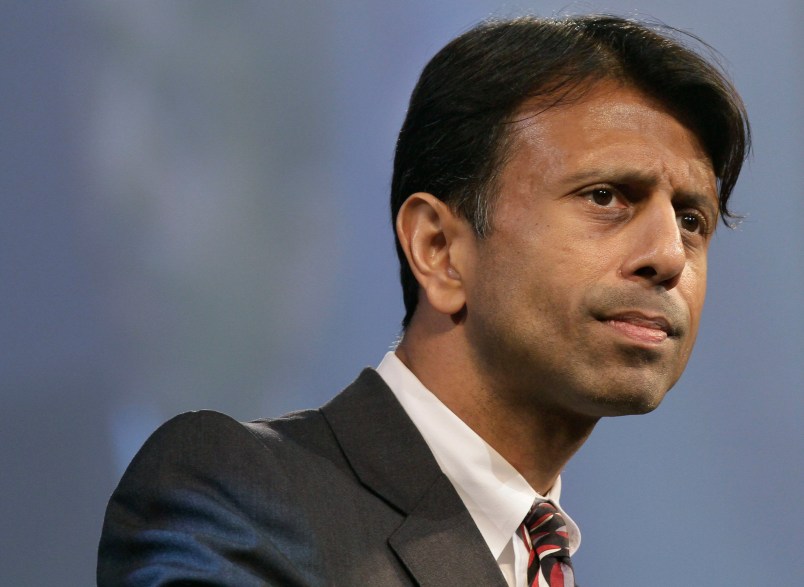
And it’s particularly tough if you’re Louisiana Governor Bobby Jindal — a one-time supporter of the standards who, just two years ago, touted them as a critical way to “raise expectations for every child.” Those were the halcyon days, when many conservative politicians believed that strong, state-developed standards could give them a better idea of how their states’ education systems were performing—and, by extension, be used to hold schools accountable. But once grassroots opposition began to grow on the right (and beyond), ambitious Republicans like Jindal realized that their youthful enthusiasm for the standards could force them into tough, adult decisions before they were ready.
That’s why it’s understandable — though certainly not admirable — that Governor Jindal tried to terminate Louisiana’s implementation of the standards back in June. Unfortunately, like so many feckless, irresponsible politicians before him, Jindal discovered that his state’s laws prohibited the standards’ abortion so late in their implementation process. Stubborn opponents charged him with putting his personal political interests ahead of the needs of Louisiana’s children. So the romance gave way to cool detachment, and, as Jindal’s attempts to extricate himself from the whole affair grew more desperate, collapsing into open hostility. Eventually, he sunk to the level of attacking the character, intentions, and conduct of other adults with a stake in the Common Core’s arrival in Louisiana.
I don’t mean to be a scold. I don’t like to sound callous. I know that it must be hard for Jindal to live with his choices—especially as he’s stuck watching his unencumbered peers gallivanting about trumpeting their freedom from the Common Core. But the truth is the truth: the only 100 percent certain method for avoiding career-ending controversy in education politics is to abstain from them entirely.
Sure, there are other prophylactics: politicians stuck with an unpopular education policy can delegate blame. They can tell angry voters that under normal conditions, they never would have adopted Common Core standards, but they were just a bit tipsy on the prospect of federal funds. One thing led to another, and before they knew it, they were staring down a long, difficult road of responsibly bringing the standards up to maturity. Others, like Texas, simply ignore the educational inequity of their states’ education systems and skate along blithely with the status quo.
Also: some politicians try to hide their progeny — Indiana leaders officially pulled out of the Common Core, only to show up in public soon afterwards with “new” standards that looked suspiciously similar.
But none of those measures are foolproof. So that leaves desperate, ashamed, quondam education reformers like Jindal stuck trying to convince the courts to help them escape the consequences of their actions. Interestingly, he’s just another sad example of the broad decay of our national education discourse. The American “education wars” are too polarizing for our legislative institutions to reform and too controversial for our governors (and the Department of Education) to implement consistently. So fights over school funding, teacher tenure, and basic educational services all head to the courts. If that sounds like other hotly-disputed political issues (reproductive rights, perhaps?), that’s no more a coincidence than it is a welcome development.
Conor P. Williams, PhD is a Senior Researcher in New America’s Early Education Initiative. Follow him on Twitter: @conorpwilliams. Follow him on Facebook.





Jindall prime example of dumb constituents mistakes.
Bobby Jindal is a loser. He doesn’t know it.
Why is Jindal even a governor?
He clearly is in the wrong party. Fighting hard for no reason. His bio is impressive but Dems did that.
Yes, Bobby Jindal is terrible in every conceivable way and doesn’t care about America’s youth – but don’t fool yourself, neither does Conor P. Williams, author of this article. He couldn’t, not when he’s constantly perpetuating the idea that the Common Core is something to be supported, especially when you see how it’s corporations that have led to the CCSS getting as much traction as it has. PR spinners like Williams and Campbell Brown and previously Michelle Rhee are well-compensated to smear public education for the sake of promoting charter schools and the so-called improvements said schools are making to American education.
As an educator, and knowing many who have worked at charters, it’s almost universally agreed that they’re harmful to our students and certainly to our educators, who are underpaid and overworked, demeaned and beaten down by a machine-like approach to pedagogy, as well as literally insulted in front of their students by administrators who are under pressure to show results.
Williams has sold his soul. I will respond to every post with a call to react to his views with great skepticism. It’s a shame TPM operates with such a binary, if he’s against them he’s for us, mentality when it comes to the opinion pieces it publishes. Just because Williams calls out a noted Republican d-bag does not make him a friend to people who support social equity.