

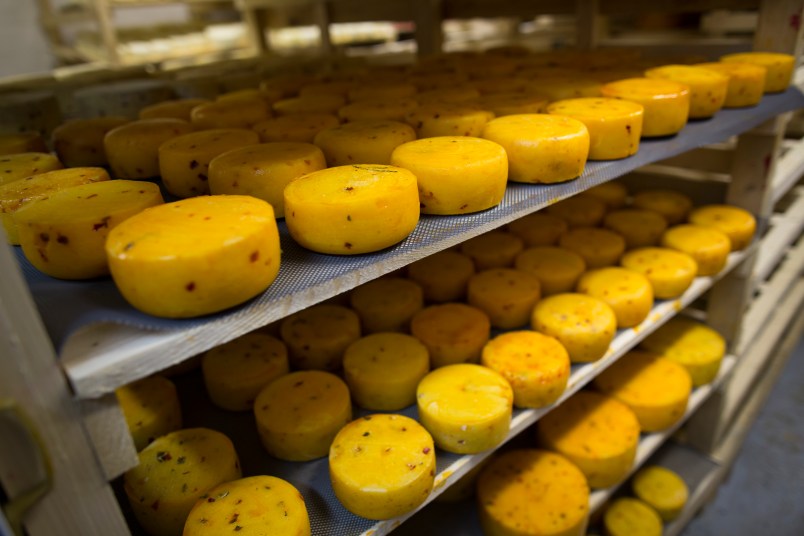
MOSCOW (AP) — The Russian government was steamrollering tons of contraband cheese and destroying fruit with tractors Thursday in a public display of its commitment to its one-year-old ban on Western foods.
The move, however, has raised protests, with people signing a petition urging the government to instead donate the food to the poor suffering through the country’s vicious recession.
Coupled with the ruble’s sharp depreciation, the ban on Western food has helped drive consumer prices up, pushing an increasing number of Russians below the poverty line.
The Kremlin, hoping to stem the flow of banned products by raising the costs for those involved in contraband, has ignored the public outcry. President Vladimir Putin’s order to destroy the food underlines the Kremlin’s determination to enforce the ban amid continuing tensions with Europe and the U.S. over the Ukrainian crisis.
The national agricultural oversight agency, Rosselkhznadzor, said several shipments of banned imported products will be destroyed Thursday in the Orenburg region in the Ural Mountains, Belgorod and Smolensk near Russia’s Western border and elsewhere.
It took a steamroller about an hour to crush 9 metric tons of contraband cheese in the Belgorod region. Officials in St. Petersburg were preparing to burn 20 metric tons of cheese in incinerators, while authorities in Smolensk will use tractors to destroy some 60 metric tons of peaches and tomatoes.
Russia slapped a ban on many Western agricultural products, including meat, milk products, vegetables and fruit on Aug. 6, 2014 in retaliation to the U.S. and EU sanctions over Moscow’s annexation of Crimea and support for pro-Russian insurgents in Ukraine. Last month, the Kremlin extended the ban for a year following the EU’s decision to prolong its sanctions through January.
Russian importers found various loopholes to bypass the ban. Neighboring Belarus has become a major conduit for the banned items, making food out of European meat and other products, or simply repackaging banned European food to change the country of origin.
Whisking products into Russia on fake documents has also reportedly taken place. Some smugglers provide documents purporting that a shipment of European food from Belarus is bound for Kazakhstan, another member of a free trade pact with Russia, while in truth it’s intended for Russia.
Defending the ban, Putin said it helped create incentives for local agricultural producers. Many farmers have lauded the move, hoping to fill the niche previously held by imports.
“Major distributors, who in the past bought from Holland and Italy now feel this will last,” said John Kopiski, a British-born farmer who produces cheese and meat in Krutovo, about 220 kilometers (some 140 miles) east of Moscow. “Generally, my opinion and our family’s opinion about the sanctions is that we are grateful for them, because maybe they will shake up businessmen and shake us to the roots and we will start doing it ourselves.”
Experts warn, however, that while some local farmers thrived, it would take years for Russia to reach self-sufficiency on food and prices will rise, hurting the population.
The ban also pinched Russian restaurant owners, who have struggled to find a local replacement for imported products. “We use basic food items, which are produced in Moscow region, and switch on our imagination and work with various additives,” said Elena Rakova, managing director of Jean-Jacques Cafe in Moscow.
___
Victoria Buravchenko contributed to this report.
Copyright 2015 The Associated Press. All rights reserved. This material may not be published, broadcast, rewritten or redistributed.



Or maybe they are just making giant fruit blintzes – yum!
PS
Actual Steamrollers haven’t been around for years, but in Russia – who knows?
Well, in fairness to Putin, that stuff was probably Velveeta. Could be considered chemical warfare.
Estimated probability that the ban has been extended because Friends of Putin are profiting from illegal trade in Western agricultural products: 0.998
Tea partiers will point to Russia and claim (even while reacting to Putin the way they reacted to Bush on the aircraft carrier) that it shows what happens when liberals run the government and use it to control everybody’s lives.
What Russia actually shows is that, if you let the billionaires run the country, it won’t be run like some mythically efficient business, but instead will be run like an organized crime syndicate by the most ruthless billionaire.
Unlikely. The rest of the world operates a blockade around the United States to prevent export of the substance for human consumption. Some of the absurd TSA practices and policies in place at US airports are there to carry out the US government’s agreements to cooperate with the ban. Surprised at the TSA role? Most people are, but that is partly due to a massive government coverup that uses anti-government conspiracy sites to send people down the wrong path when they start to doubt the “official” government line that TSA is there to maintain national security.
Export of Velveeta is allowed for use as fishing bait (trout love it) and French repellent.
Russia is a dying state. Why bother even trading with them? The sooner Russia withers away, the better for the rest of us. Here’s hoping for a Chinese melt down as well.