

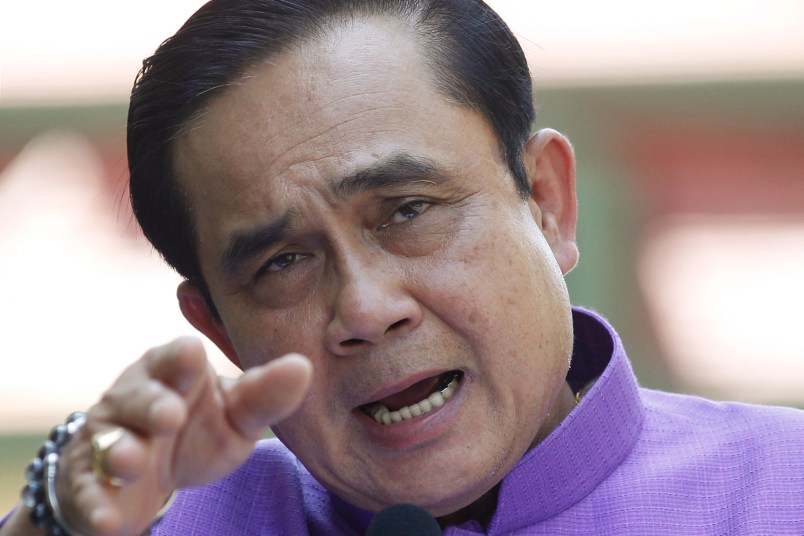
BANGKOK (AP) — Thailand is about to lift martial law. But make no mistake — 10 months after staging a coup, a military junta is still ruling the country, essentially with absolute power, and made clear this week it’s not easing up yet.
On Tuesday, the military-installed prime minister, Prayuth Chan-ocha, said he plans to lift martial law — a move his deputy said was “a response to calls from foreign countries.” He gave no immediate timeline.
Martial law made Thailand look bad, and the junta faced growing pressure from foreign governments, human rights groups and particularly its own business community to remove it. Although it wasn’t generally visible in everyday life — there were few soldiers in the streets — it scared off foreign investors and hurt tourism, which accounts for nearly 10 percent of the GDP. Tour operators called it a tourist deterrent — partly because many insurance companies won’t cover travelers to countries under martial law.
But scrapping martial law doesn’t mean that Thailand is any closer to civilian rule.
In its place, Prayuth said he will invoke a special security measure in the junta-imposed interim constitution called Article 44. Critics say it gives Prayuth unchecked authority over all three branches of government and absolves him of any legal responsibility for his actions.
“From the outside, the lifting of martial law is good news for business and tourism,” said Thitinan Pongsudhirak, a political scientist and director of the Institute of Security and International Studies at Bangkok’s Chulalongkorn University.
“But from the inside, we’re functionally in the same boat,” he said about Article 44. “Similar restrictions are still in place. And where there are pockets of dissent and political expression it is likely to be more draconian.”
Under Article 44, Prayuth has the power to make any order in the name of national security. Some Thai media have referred to it as “the dictator law.” Under a similar law in the 1960s, a Thai dictator carried out summary executions.
Human Rights Watch said the move “will mark Thailand’s deepening descent into dictatorship.”
“Thailand’s friends abroad should not be fooled by this obvious sleight of hand by the junta leader to replace martial law with a constitutional provision that effectively provides unlimited and unaccountable powers,” said Brad Adams, the group’s Asia director.
The main difference between the two measures is that martial law is very specific and Article 44 is very vague.
Martial law puts the military in charge of public security and clearly defines its uses in a seven-page document originally enacted in 1907 and amended over the years. It allows arrests without warrants, trials of suspects in military courts, bans on public gatherings and censorship in the name of preserving order.
Article 44 is a single vaguely worded paragraph in the interim constitution which gives the junta leader the power to override any branch of government in the name of national security.
Thailand’s military has a history of intervening in politics, having seized power 12 times since the end of absolute monarchy in 1932.
Prayuth imposed martial law on May 20, 2014, when he was the country’s army chief. A few days later on May 22, he led a coup that toppled the elected civilian government after months of sometimes-violent street protests.
Stability was restored but at a steep price. Thailand’s democratic institutions were dismantled, and the country’s authoritarian rulers have crushed dissent.
Critics say the coup leaders’ real goal is to eliminate the political influence of former Prime Minister Thaksin Shinawatra, who was overthrown in a 2006 coup. His sister, Yingluck Shinawatra, was ousted by a court ruling just days before last year’s coup and later barred from holding office for five years.
The coup was part of a societal schism that in broad terms pits the majority rural poor, who back the Shinawatras against an urban-based elite that is supported by the army and staunch royalists, who see the Shinawatras as a threat to the traditional structures of power.
Since the coup, the junta has moved to consolidate power. In July, the military adopted the interim 48-article constitution and formed a junta-appointed legislature. In August, the legislature appointed Prayuth as prime minister — a post he said he will retain until elections, though no date has been set. Polls were initially promised for this year, then pushed to sometime in 2016.
Prayuth sought to downplay concerns about Article 44, saying nobody had made much fuss about it until now.
“Article 44 will be exercised constructively,” Prayuth said. “Don’t worry, if you’re not doing anything wrong, there’s no need to be afraid.”
___
Associated Press writers Thanyarat Doksone and Grant Peck contributed to this report.
Copyright 2015 The Associated Press. All rights reserved. This material may not be published, broadcast, rewritten or redistributed.



DRACONIAN implementation of Article 44 replacing Martial Law, read and weep.
Here is a summarised version of the 14-point Order on Maintaining Public Order and National Security, issued on Wednesday night by Prime Minister and National Council for Peace and Order head General Prayut Chan-o-cha, to replace martial law.
Item 1: This order shall come into force from the date of its publication in the Government Gazette.
Item 2: A “peace and order-maintaining officer” refers to a military officer with the rank of sub-lieutenant and a pilot officer or above appointed by the NCPO head to act in accordance with this order. An “assistant peace and order-maintaining officer” refers to a military officer of a lower rank than sub-lieutenant or a pilot officer appointed by the NCPO head to act in accordance with this order.
Item 3: Peace and order-maintaining officers shall act swiftly to prevent and suppress offences against the monarchy and state security, and offences under the laws on weapons and announcements or orders by the NCPO.
Item 4: Peace and order-maintaining officers have the power to summon persons and documents, make arrests, help or take part in investigations of offences under Item 3, conduct searches, seize or freeze assets, and carry out other acts assigned by the NCPO.
Item 5: Peace and order maintaining officers are empowered to issue orders prohibiting the distribution of news, publications and other media deemed to cause fear, contain distorted facts, or likely cause public misunderstanding that affects national security or public order.
Item 6: Peace and order-maintaining officers are empowered to detain suspected violators summoned for questioning for no more than seven days. Such detention must be carried out on premises other than police stations, detention facilities, or prisons, and the detainee shall not be treated as an accused person.
Item 7: Assistant peace and order-maintaining officers shall perform duties as ordered or assigned by peace and order-maintaining officers.
Item 8: Peace and order-maintaining officers and their assistants shall be regarded as authorised officers under the Penal Code, and as administrative officers or police officers under the Code of Criminal Procedure.
Item 9: Any person who contravenes or fails to comply with orders issued by a peace and order-maintaining officer or an assistant on duty shall be punished with imprisonment not exceeding one year or a fine of no more than Bt20,000, or both.
Item 10: Any person who resists or obstructs a peace and order-maintaining officer or an assistant on duty shall be punished with imprisonment not exceeding one year or a fine of no more than Bt20,000, or both.
Item 11: Peace and order-maintaining officers may allow the release of individuals detained under this order, with or without conditions. Conditions for release include not leaving the country. Those who fail to comply with conditions of release shall be punished with imprisonment not exceeding one year or a fine of no more than Bt20,000, or both.
Item 12: Political gatherings of five or more persons shall be punished with imprisonment not exceeding six months or a fine of no more than Bt10,000, or both, unless permission has been granted by the NCPO head or an authorised representative. Offenders who voluntarily agree to receive corrective training for no more than seven days may be released with or without conditions. Those who fail to comply with the conditions of release shall be punished with imprisonment not exceeding six months or a fine of no more than Bt10,000, or both.
Item 13: Actions under this order are not subject to the laws on administrative procedures and the Law on the Establishment of the Administrative Court and the Administrative Procedures Code.
Item 14: Peace and order-maintaining officers and assistants shall be protected under the 2005 Decree on Public Administration in Emergency Situations, although a damaged party still has the right to seek compensation.