


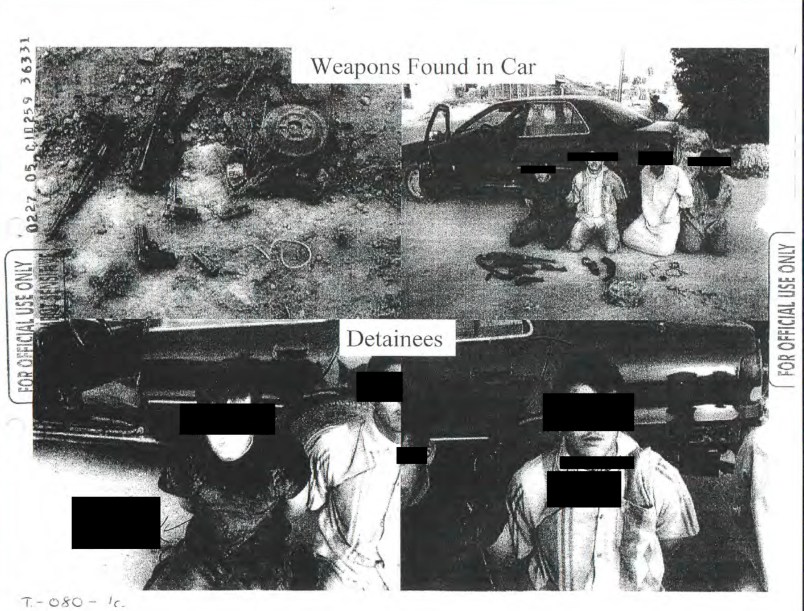
WASHINGTON (AP) — The Pentagon on Friday released nearly 200 photographs of detainees in Iraq and Afghanistan, taken mostly between 2004 and 2006, involving 56 cases of alleged abuse by U.S. forces.
The often dark, blurry and grainy pictures are mainly of detainees’ arms and legs, revealing bruises and cuts, and they appear far less dramatic than those released more than a decade ago during allegations of torture at Iraq’s Abu Ghraib prison. Those now-infamous Abu Ghraib photos included images of naked detainees stacked in a human pyramid or of a soldier holding a naked detainee by a dog collar and leash.
The Pentagon said that criminal investigations substantiated abuse in 14 of the cases linked to the 198 newly released photos, and determined that 42 allegations were not valid. Sixty-five service members were disciplined in connection with the cases.
The photos were released in response to a Freedom of Information request from the American Civil Liberties Union. The Pentagon said that Defense Secretary Ash Carter and other military leaders reviewed a number of unreleased photos and determined that 198 could be made public.
The reviews are required every three years. According to the ACLU there are as many as 2,000 photographs that the government has not released.
“The disclosure of these photos is long overdue, but more important than the disclosure is the fact that hundreds of photographs are still being withheld,” said ACLU deputy legal director Jameel Jaffer. “The still-secret pictures are the best evidence of the serious abuses that took place in military detention centers. The government’s selective disclosure risks misleading the public about the true extent of the abuse.”
Allegations of physical and sexual abuse of detainees at Abu Ghraib prison in Baghdad erupted in 2003, spawning a series of investigations and studies to determine the extent of the problem.
Pentagon officials said that the photos released Friday do not involve incidents at Abu Ghraib or at the U.S. detention facility at Guantanamo Bay, Cuba.
Copyright 2016 The Associated Press. All rights reserved. This material may not be published, broadcast, rewritten or redistributed.






You cannot convince the people of a country you are “on their side” if you are doing this. and you must be “on their side” to win. No “exceptional nation” does this and no “professional military” condones it. But for fucks sake folks…can we lean from our mistakes? I saw this shit being done in Vietnam…another loss…and we all know it contributed to our failure there. So we do it again…fail again…?
A bigger story than the abuse photos released today by the Pentagon: the ones that are missing.
Warning: Graphic Imagery
A 73-year-old Iraqi woman detained and allegedly sexually abused and assaulted by U.S. soldiers. According to the Army report detailing the incident, the soldiers forced her to "crawl around on all-fours as a ‘large man rode’ on her,” striking her with a stick and calling her an animal.
An Iraqi teenager bound and standing in the headlights of a truck immediately after his mock execution staged by U.S. soldiers.
Another shows the body of Muhamad Husain Kadir, an Iraqi farmer, shot dead at point-blank range by an American soldier while handcuffed.
The Pentagon still has not given a name to the Iraqi war. Somehow ‘Operation Re-elect Bush’ doesn’t seem to be popular.
Until Cheney, Bush & Rumsfeld are brought to testify before the Hague, we will never heal.
Maybe I’m naive, but one would think that basic training and even AIT (advanced infantry training) would include modules on war crimes. I recall lectures and films telling us that crimes against civilians were punishable by prison or even death.
i, for one, certainly internalized that part of the training.
Ditto for officers and noncoms. I’ve got to believe that men doing these things believe they have implicit permission for the behavior. Were there no officers or noncoms around to stop the abuse? Did not the presence of photographers inhibit this behavior.
As I said, maybe I’m naive. Maybe it can’t be stopped altogether, but maybe we can reduce the incidence of it.
Some other familiar names mentioned: Gonazales, Yoo, Addington, Bybee