

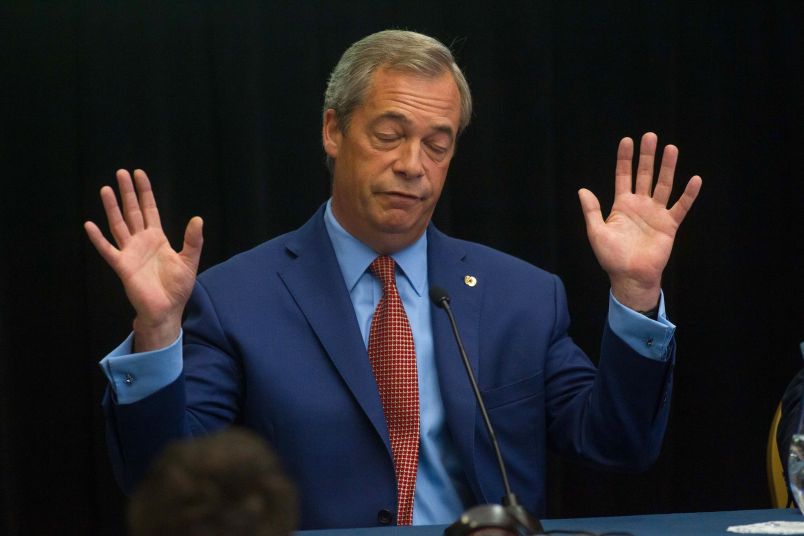
LONDON (AP) — Britain’s Conservative prime minister is stepping down. The Labour Party leader is barely clinging to power. And now the head of the U.K. Independence Party, a key architect of the dramatic vote to leave the European Union, has resigned as well.
It has left the country with a power vacuum just as someone needs to step up and own the talks on how Britain will exit the EU.
The June 23 referendum results have ripped through British politics like a buzz saw, and it will likely be weeks before some clarity emerges.
The new Conservative Party leader will be chosen Sept. 9 and will become prime minister. The contenders are talking in general terms about “Brexit” plans, but their words aren’t yet backed by any authority.
UKIP leader Nigel Farage said Monday he is leaving his party post because he wants his life back after years of political intrigue. But observers note he’s keeping his seat in the European Parliament and may well be hoping for a formal role when the new prime minister takes power and, most likely, starts Brexit talks with EU leaders.
“There’s always a chance of him returning, but his future relies on other people supporting him and asking him to do something,” said George Jones, government professor emeritus at the London School of Economics. “He goes out on a high as the man who caused this.”
On top of Prime Minister David Cameron’s and Farage’s departures, Labour Party leader Jeremy Corbyn is clinging to office despite having lost a confidence vote by his party’s lawmakers.
Jones said Britain is gripped by a power vacuum at the top.
“There isn’t any leadership, there can’t be, but in an emergency Cameron can take decisions,” he said. “It’s a strange situation. All the parties are in disarray. The unexpected has happened. It’s first of all necessary to set up a government that can act, and there’s a timetable set for that.”
The Conservative Party leadership race will offer some clarity, since the winner of the party contest will become prime minister and presumably take responsibility for key Brexit decisions.
The race has been shaped by the virulent feud between leading “leave” campaigners ex-London Mayor Boris Johnson and Justice Secretary Michael Gove, who torpedoed Johnson’s bid for the top spot with his own last minute entry.
There are five contenders, including Gove, with Conservative lawmakers set to start voting on their favorites Tuesday.
Media attention has focused on Home Secretary Theresa May — who opposed Brexit during the referendum campaign, but now backs it — and Energy Minister Andrea Leadsom, who made her first major speech Monday.
She cast herself as a passionate supporter of the Brexit cause, although she opposed it as recently as 2013, promising negotiations would be relatively quick and effective in terms of giving Britain the power to control how many immigrants will move to the U.K.
“Freedom of movement will end, and the British Parliament will decide how many people enter our country each year to live, work and contribute to our national life,” she said.
Leadsom is one of the least-known among the five candidates to replace Cameron, but gained attention as one of the strongest voices for a vote to leave the EU.
Earlier, Treasury chief George Osborne announced plans to cut U.K. corporation tax to less than 15 percent to encourage companies to invest and ease business concerns about the country’s vote to leave the EU.
Osborne says the cut is meant to underscore that Britain is “still open for business,” despite the referendum result. A cut of about 5 percentage points brings Britain in line with Ireland’s 12.5 percent rate.
He is urging the Bank of England to use its powers to avoid “a contraction of credit in the economy.”
Some London-based businesses are considering leaving for other cities like Dublin, Amsterdam, Frankfurt or Paris to benefit from the large EU common market.
Amid the uncertainty, a prominent law firm says it may go to court to force a vote in Parliament on the referendum. The law firm Mishcon de Reya, acting on behalf of a group of anonymous clients, argues that the referendum wasn’t legally binding and that it is up to Parliament to have their say before the next prime minister invokes Article 50, triggering the start of negotiations for a U.K. departure from the EU.
Cameron has insisted that it will be up to the next prime minister to trigger Article 50.
It is far from clear what arrangements will emerge between Britain and other EU countries. Britain’s immigration minister said Monday he can’t guarantee that EU citizens who live in the U.K. will be able to stay after the country leaves the 28-nation bloc.
James Brokenshire told the House of Commons that “EU nationals continue to be welcome here” and “their right to enter, work, study and live in the U.K. remains unchanged” since the referendum.
But he said a guarantee that they would be allowed to remain after Britain negotiates its EU exit “would be unwise without a parallel assurance” from other EU countries that British citizens can continue to live there.
A final split from the EU is likely several years away. Opposition politicians are demanding that the government ease the uncertainty of around 3 million EU citizens by guaranteeing they can stay.
___
Associated Press writer Jill Lawless contributed to this report.
Copyright 2016 The Associated Press. All rights reserved. This material may not be published, broadcast, rewritten or redistributed.




A huckster. What is his end game?
COWARD,set Britan on fire now you are running away.You were only kidding RIGHT ???
In reports around the world pundits are proclaiming Brexit as a shot across the bow to globalism. Trade agreements are out, economic nationalism is in.
Brexiters won Round One, but what is to come?
The day after the vote, Donald Trump hailed the “victory” of the Brexiters and said America is feeling the same wave and also wants to “take their country back” from political elites.
And again Trump used fear to appeal to people’s base instincts, scapegoating Mexico and China instead of trying to promote greater understanding of the issues and the nature of trade agreements and internationalism.
But as someone whose branded merchandise is made in foreign countries, who used imported steel and labor to build his buildings and staff his hotels, and who recently opened a golf course in Scotland, Trump hardly seems an opponent of globalism. Rather, he is a demagogue, a free-market fundamentalist who uses inflammatory pseudo-populist and anti-establishment rhetoric to pander to the disenfranchised members of both the political Right and Left.
He has proposed unilateral measures that include imposing trade tariffs on imports that would increase prices on consumer goods, lead to retaliatory moves overseas, and possibly trigger a trade war. A recent analysis of his economic platform forecasts a recession that would cost America three million jobs.
And somewhat ominously, Russian President Vladimir Putin — hardly a supporter of a strong and united Europe, as it imposed economic sanctions on Russia at President Obama’s urging in response to its incursion into Ukraine — congratulated the UK on its vote.
And Senator Bernie Sanders, a populist firebrand and ideological opponent of trade agreements who recently lost the Democratic presidential nomination to former Secretary of State Hillary Clinton, commented that the Brexit vote bodes poorly for globalism.
But if the English pound continues to take a beating, if capital leaves the UK, and economic stagnation sets in, Brexit will be seen not as a success but as a setback for British workers and a triumph of demagoguery, and the prospect of repeating that in the U.S. becomes extremely worrisome. Because Brexit will be seen as a self-defeating retreat from a successful and hard-fought community of interests and a destructive lashing out in misplaced anger.
Consider the prospect of the UK attempting over the next few years the arduous task of renegotiating trade deals, debts to the EU, and other agreements they were a party to while an EU member, while wary outside investors postpone making investments in the UK with all this uncertainty swirling about.
I hope that such an impulse or scenario does not play out in the U.S.
Brexit could serve to discredit some of the inchoate anti-establishment fervor currently in fashion. Because if a government opts out of international affairs, multi-party treaties and trade agreements, and sets up barriers between other countries, it will only give additional incentive and leverage to the vast unaccountable economic forces in the private sector to pit countries seeking economic development against each other.
Business today is international in scope and has been for some time. For there to be an optimum balance between private gain and the public good, there need to be standards for fair business practices that ensure that worker’s rights, the ability to organize into unions, and the environment are protected. Otherwise, in the absence of enforceable standards, there will be a race to the bottom, where businesses seek out countries with low wages and minimal regulations, and set poor and developed countries against each other in competition for jobs.
Governments need to assert their role in the economy in ways that ensure that opportunity is broad-based and shared — not to retreat from the international arena, but to engage the business sector and partner governments to ensure standards that are designed to level the playing field are established and enforced.
The electoral success of Brexit represents economic anxiety over globalism and the missed opportunities of expanded trade, but also provides an opportunity for a new approach to globalism, one that champions worker rights, environmental protections and workplace safety.
I support the Trans-Pacific Partnership (TPP) and its European counterpart the Trans-Atlantic Trade and Investment Partnership (TTIP) initiatives championed by President Obama because I feel they represent an opportunity for us to renegotiate NAFTA — NAFTA partners Canada and Mexico are also TPP partners — and reduce the incentives to outsource jobs from high-wage developed nations to low-wage corporate havens in the developing world.
And I believe we have the leverage to shape the challenge of globalism to our benefit and to the benefit of workers in the partner nations.
And when speaking of leverage, let’s remember what happened in the aftermath of the 2008 financial collapse, which devastated economies globally. The U.S., pursuing a fiscal policy of economic stimulus and an accommodative monetary policy, has recovered from the crisis better than any other developed economy and has created more private sector jobs than all other developed economies combined.
In contrast, the UK and the European Union responded to the financial and economic collapse by tightening the noose on their citizens by cutting government spending and pursuing other austerity policies — to their detriment, as their economies are still coping with high unemployment and struggling to emerge from recession.
If anything, Brits and Europeans should be just as angry about the ravages of austerity policies as they are by a globalism that did not provide for many of them.
China in recent decades rose to economic superpower status through a model featuring cheap labor and credit, foreign investment, and cheap exports, but when the Great Recession reduced the demand for its exports, China turned inward and resorted to stimulative measures involving large-scale land development projects as part of an effort to preserve jobs.
However, as we’ve seen the past two years, China’s meteoric rise has slowed down from its previous era of double-digit annual growth, and since last year’s near-meltdown of its stock markets, and the current turbulence of its bond market, we are witnessing the Chinese government’s uncertain attempts to contain this crisis and to stem rising debt levels and ongoing capital flight — an estimated $300 billion the past six months — that have investors wary.
As a result of the progress the U.S. has made in comparison to other nations, and amid concerns about how China is managing its markets, today the U.S. has emerged as the prime destination for foreign capital and investment.
Critics of trade deals point to the unrealized promises made by proponents of NAFTA. Indeed, NAFTA was flawed in not adequately addressing concerns about labor rights or environmental protection. TPP and TTIP will address both of these concerns with enforceable standards for worker rights, workplace safety and environmental protections — standards that typically are not championed by the free trade advocates and have not been enforced in past agreements.
China is not a party to the TPP or TTIP, so this trade agreement represents part of President Obama’s geopolitical strategic “pivot” to Asia, which also includes new defense exercises with Japan and the Philippines and provisions designed to liberalize countries, such as requiring free, open and unrestricted Internet access and opposing human trafficking and child labor.
And by including Brunei, Malaysia and Vietnam — countries that can serve as a buffer against China’s ongoing campaign to “annex” and assert de facto territorial control of the South China Sea by building artificial islands in it — TPP represents a pointed strategic attempt to uphold freedom of navigation for a vital international body of water, through which trillions of dollars of cargo traverse.
If these trade agreements are ratified, we and our trading partners as a coalition perhaps can also prevail upon China to address their violations of agreements they made as a party to the World Trade Organization, such as using their state-subsidized industries to dump steel under cost onto world markets and manipulating their currency to achieve a competitive price advantage for their exports.
In addition, with these two trade agreements we can form a trade and strategic bloc that upholds worker rights and environmental protections while undercutting China’s influence and putting pressure on them to raise their own standards as a price of doing business.
Through these trade initiatives, President Obama is promoting opportunities for expanded overseas trade that wean multi-national firms from reliance on cheap labor, lax regulations and China’s now-shrinking expansionist window, and “globalize” worker and human rights and environmental protections.
So, besides an attempt to expand trade relations with a fast-growing region, and strategically engage nations that might otherwise fall into China’s sphere of influence, TPP also represents an attempt to institutionalize worker and human rights and environmental protections by offering favorable trade conditions to nations that uphold these values — which could also reduce the incentives to outsource American jobs to developing nations, and serve to apply “soft” pressure on repressive governments and strengthen the hands of those liberal forces and constituents advocating for human rights, higher wages, and safer working conditions.
But the politics of TPP and TTIP have become complicated by anti-globalism and election-year politics, and a number of factors need to be in place to enhance their chances of passage.
First, government needs to take an active role in a major job-creating initiative focused on rebuilding and modernizing the nation’s infrastructure. A Republican-led Congress, however, is unlikely to approve a tax increase or a massive deficit-financed appropriation to fund this initiative, and so methods of creative financing, including an infrastructure bank seeded with expatriated foreign profits of U.S. multinationals, investments from pension funds — a huge institutional investor — and public-private partnerships that can serve as a haven for capital outflows from other nations, could overcome the objections of deficit hawks.
Some of this money could be utilized under the Trade Adjustment Assistance Act, a companion bill to the TPP passed in 2015 to provide job training and address job losses that could result from trade agreements.
In 1964, the U.S. spent four percent of GDP on infrastructure, but budget constraints in recent decades have halved that number. The nation needs to spend $3.32 trillion to keep its ports, highways, bridges, trains, water and electric facilities up to date, so there is plenty of work that needs to be done to create jobs while improving our public works and making our capital improvements more efficient.
And a massive public works project that employed millions could provide the political space for a trade agreement that can expand overseas markets and create jobs by reducing trade barriers to American exports, in exchange for terms that are similarly favorable to our partners.
And negotiations that successfully lead to American multinationals agreeing to return their profits earned and held by their foreign divisions — to be taxed to fund a 21st Century new New Deal — could address the anxieties surrounding globalism and outsourcing by “bringing American dollars home to fund American jobs.”
Perhaps we can also co-opt Republicans by reframing two pet causes of theirs — entitlement reform and deficit reduction — in our favor. By allowing Medicare to negotiate for prescription drug prices, we can cut billions of dollars from our healthcare budget and strike a blow against abusive pricing practices of pharmaceutical companies, which increasingly are becoming multinational in this age of mergers, conversions and industry consolidation.
As a former community organizer, President Obama believes in the power of consensus, of leadership that works to solve problems and bring people together to work toward shared interests and mutually beneficial goals. In the interests of upholding Ukrainian sovereignty, he enlisted a skittish energy-dependent Europe to support imposing sanctions on Russia. He also brought the world’s powers together to hammer out the landmark agreement that limits Iran’s nuclear program to peaceful uses, and more recently he successfully forged an historic global agreement among almost 200 countries — including China, the world’s largest carbon polluter — to address climate change.
In announcing the successful conclusion of negotiations that led to the Iran nuclear agreement, President Obama said, “We are stronger not when we are alone, but when we bring the world together.”
As such he supports communities of interests such as the EU, NATO, the Organization of American States, and the Association of Southeast Asian Nations.
This, in contrast to Trump’s stated intent to unilaterally build a wall on our southern border and make Mexico pay for it, to expel an estimated 11 million undocumented immigrants in what would surely be a new Trail of Tears, to block Muslims from entering the country, and impose American economic hegemony under the threat of protectionism. He has also stated his admiration for Putin and other authoritarian leaders, said that NATO might be obsolete, that perhaps Japan, South Korea, and Saudi Arabia might be better off with their own nuclear weapons, and that he would not rule out nuking Europe to combat ISIS.
We face a choice between two competing visions and sets of values. One calls for us to work within and strengthen a community of nations, and to coexist and resolve problems peacefully without a desire to dominate another people. The other calls for us to look to other nations with suspicion, to enact policies that provide additional benefits and privileges to the richest and most powerful among us, and act as the ‘muscle’ behind a new global colonialism driven by moneyed interests and unaccountable dealmakers loyal to no country’s flag.
The entire global economy is in the doldrums, and much of the world is looking for American leadership. And since our economy is on an upswing, with growth outpacing other advanced nations, and with much of the developed world experiencing declining growth rates at best or scrambling to avoid another recession, we have an opportunity — and the leverage — to reject a politics based on fear, resentment and hatred of the Other and execute an advantageous trade agreement, champion American interests here and abroad, and uphold — and export — American values.
Damn, I guess you really do have to be careful what you wish for.
Love your reply, but man, you really, really need to switch to decaf !!