

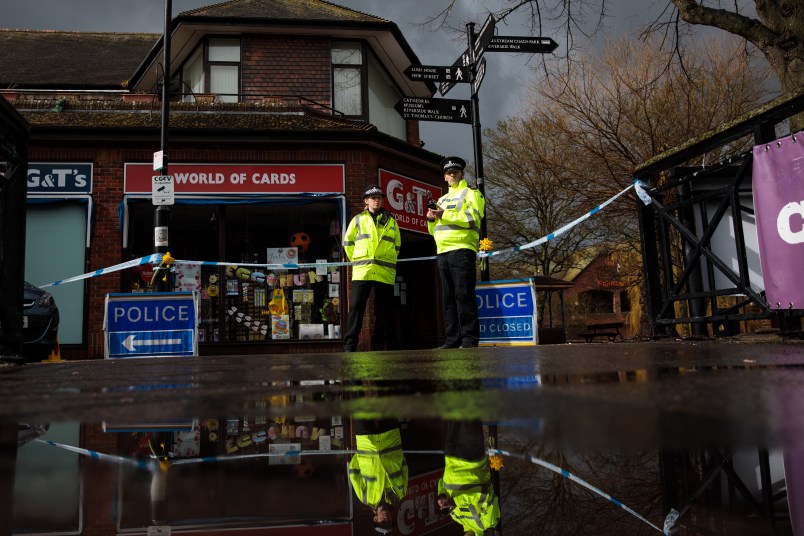
LONDON (AP) — The nerve agent used on former Russian spy Sergei Skripal and his daughter Yulia was delivered in liquid form, British officials said Tuesday, as they revealed it will take months to clean up the toxic trail the poison left around the city of Salisbury.
The U.K. Environment Department said nine sites need “specialist cleaning,” including a restaurant visited by the Skripals on March 4, the day they were found unconscious on a park bench in the city in southwest England.
About 190 specially trained troops are assisting environmental, health and defense officials with the cleanup, it said.
“Work to clean each site will involve a process of testing, removal of items which may have been contaminated, chemical cleaning and retesting,” the agency said in a statement, adding the effort will take “a number of months.”
British officials say the Skripals were poisoned with a military-grade nerve agent that was smeared on a door handle at Sergei Skripal’s house.
Father and daughter were hospitalized for weeks in critical condition. Yulia Skripal was released last week from Salisbury District Hospital, where her father continues to be treated.
British officials say the Russian government was behind the attack using a Soviet-developed type of nerve agent known as Novichok. The international chemical weapons watchdog, the OPCW, has confirmed that a Novichok agent “of high purity” was used, although it has not identified where it was made.
Russia denies involvement in the attack and has accused Britain of failing to share its evidence.
The poisoning has sparked a Cold War-style diplomatic crisis between Russia and the West, including the expulsion of hundreds of diplomats from the two sides.




Is there a way of determining unambiguously where the material was made? Contaminants or byproducts or isotope signatures or something? Or is the statement that they can’t prove where it was made just “water is wet”?
(At the very least, I would think you’d need samples from potential synthesis sites.)
Why are all options including overt or cover military operations not on the table as a response to this brazen Russian chemical weapons attack with a lethal nerve agent on civilians in Britain, our closest NATO ally. Our responsibilities to come to Britain’s aid under NATO are more formal and important than our responsibilities to the Saudis and the Israelis. Our response – a diplomatic crisis? That’s sad. Why is our military doing nothing about it? Why are we so afraid of Russia?
Nuclear weapons?
The United States military has the best arsenal of nuclear and chemical weapons. Our military can deal with Russia, whose “economy is smaller than California’s, smaller than Texas’, smaller than New York state. Russia is barely larger than Florida, Illinois, and Pennsylvania”. (https://alfinnextlevel.wordpress.com/2016/06/13/us-states-vs-rest-of-world-3-states-w-larger-economies-than-russia/).
The Russian habit of assassinating citizens whom it deems traitorous is despicable.
We would never do that. Ahmed Farouq? Ahmed Al Awaki? Adam Gadahn?
Oh, we would and we do.
We also endorse the Israeli assassination of various Palestinian and Iranians without a whimper and have ourselves “rendered” numerous suspects without process or trial, torturing some to death.
The Russians are not the only things on the block.