


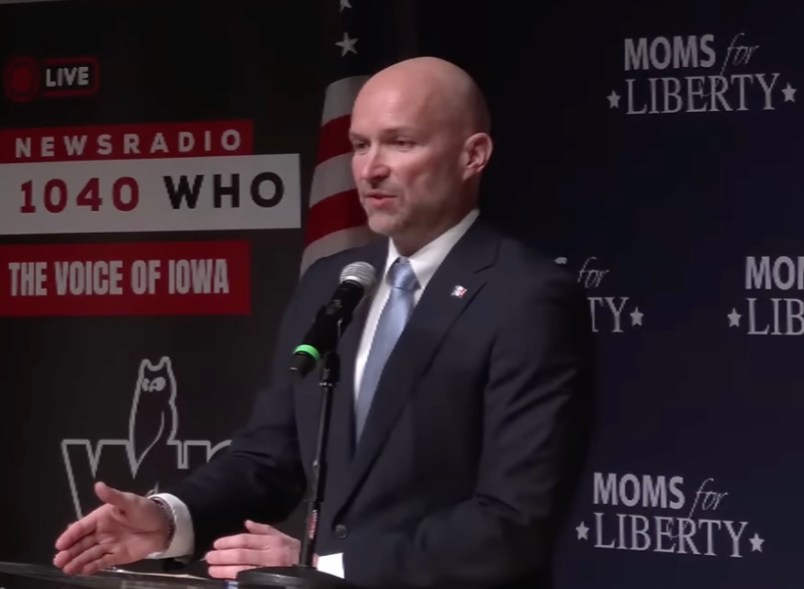
About an hour into the Republican gubernatorial debate in Iowa earlier this year, Adam Steen, who is one of the leading candidates in the primary, made an eye-popping claim.
“We need to decimate the chemical abortions,” Steen said. “You talk about water quality, what’s happening in our water because of that, those chemical abortions that are coming through there.”
The comment received relatively little notice apart from a few mentions on social media. However, Steen’s claim was notable both as an indication of how far to the right the GOP gubernatorial hopefuls are running in a state that already bans most abortions after six weeks and because it is part of a national push from anti-abortion groups to make speculative and far fetched environmental concerns a core part of their messaging. The effort to frame abortion medication as a threat to the water supply is one such claim, and lacks any concrete scientific basis.
Steen, the state’s former director of the Department of Administrative Services, is one of the leading candidates in a crowded Republican primary field after winning a series of grassroots straw polls. His comments about “chemical abortions” and “water quality” came during a Jan. 27 debate hosted by the right-wing group Moms For Liberty. The candidates were responding to the question, “when does life begin?”
After declaring “life begins at conception” and calling that point “the most important issue of this entire gubernatorial race,” Steen launched into his remarks connecting water safety, which is an especially pertinent issue in Iowa, with the right-wing cause of limiting access to abortion.
TPM reached out to Steen’s campaign this week to ask what he was referring to when he claimed “chemical abortions” were a “water quality” issue. A spokesperson said Steen was “referencing” a white paper titled “Abortion In Our Water” that was produced by the group Liberty Counsel Action last year. The report claims “our waterways are being contaminated by chemical abortion drugs and human remains as American women — left alone at home to endure the agonizing process of expelling their pregnancy — are often instructed by abortion providers to dispose of their aborted child’s remains down the toilet.”
Liberty Counsel Action shares some leadership with Liberty Counsel, which has been labeled a hate group by the Southern Poverty Law Center. The group is a legal organization closely affiliated with the evangelical Liberty University. Liberty Counsel is heavily focused on advocating for anti-LGBTQ and anti-abortion policies.
“Abortion In Our Water” is part of a wave of claims and documentation that has been prepared by right-wing groups making an environmental case for restricting abortion rights. Anti-abortion activists have described the approach as “the next innovation” as they move toward targeting the abortion medication mifepristone, seeking to further restrict abortion following the Supreme Court’s 2022 decision dismantling Roe vs. Wade. This strategy has been supported by Republican state legislators and U.S. senators who have pressed the federal Environmental Protection Agency to take action on their concerns.
Mifepristone, which is often referred to as the “abortion pill,” is used to terminate pregnancies within the first nine weeks. It can also be used to help women who have had miscarriages pass pregnancy tissue.
While the “Abortion In Our Water” report is focused on mifepristone and human remains from pregnancies, it consistently cited general research and concerns about sewer blockages and all manner of pharmaceuticals in the water supply. It does not muster convincing evidence that this particular drug or terminated pregnancies pose a unique risk. And water quality experts do not subscribe to anti-abortion activists’ argument that mifepristone poses a special environmental threat.
Water quality is a serious issue in Iowa, said Prof. David Cwiertny, an engineer and wastewater expert who is the director of the University of Iowa’s Center for Health Effects of Environmental Contamination. However, unlike Steen, he did not attribute the problem to abortion.
“Our biggest issue is nitrate levels — which is a regulated contaminant — are high, and many communities are having to seek out other sources that are not contaminated by nitrate,” Cwiertny explained.
Iowa is a center for farming and meat processing. Agricultural runoff contains nitrates from manure and fertilizer. Nitrates have been linked to high rates of cancer in the state.
While Cwiertny said the water quality discussion should be broadened to encompass other chemicals like pesticides and fungicides as well as some widely used medicines, he does not see mifepristone as a high priority area of concern.
“There probably needs to be a larger discussion, but I would put mifepristone pretty far down that list. I would think about some of the other things we use in industry and agriculture,” he said, later adding, “If you’re going to make this case about this chemical, then you should be making it about a bunch of other chemicals that are probably more problematic due to their widespread use.”
The push from right-wing groups and Republican politicians to cast mifepristone as an environmental issue has provoked some action from the administration of President Donald Trump. However, the main step so far has consisted of the EPA saying it will try to identify methods that could find the drug in the water supply. That step is illustrative of the fact the supposed research from Liberty Counsel and other right-wing groups has not involved actually measuring the specific drug’s prevalence in the water supply, much less establishing it as especially dangerous.
Cwiertny noted that mifepristone is only used by “a subset of the population that’s a subset of the population.” As such, he questioned whether it would even be identifiable in water systems.
“I can see why this one gets attention because it’s got a very particular politically controversial use and it does have potent bioactivity. But I imagine, if you stack its use up compared to some of the other chemicals that we use for any other number of therapeutic applications or in animal agriculture, it may not reach the level of use that makes it likely to easily find it in the environment,” Cwiertny said.
Similarly, Cwiertny suggested Liberty Counsel’s concerns about human remains from terminated pregnancies in the water supply were overblown.
“In that report, they talk about 30 to 40 tons of hazardous medical waste — including human remains — being flushed into the water systems. 30 to 40 tons. I don’t know if that’s on an annual basis, I’m assuming it is, because they’re talking about the number of chemical abortions per year,” said Cwiertny. “For perspective, publicly owned treatment works generate over 13.8 million tons of dry weight sludge. So it’s a matter of scale. If we’re producing, you know, 14 million tons of solids from human waste after it’s been dewatered, focusing on 30 to 40 is — that’s, like, not even a drop in the bucket.”
In general, while Cwiertny said experts should be addressing issues of more widely used chemicals in the water supply, he also noted that modern treatment systems are robust. They can accommodate medicines and human waste from medical procedures.
“We put human waste down sewers. That is just what they’re there for, and they are designed to handle relatively large masses of human waste flushed down toilets daily,” Cwiertny said. “The system is designed that way. And we do have advanced treatment these days, and more and more water systems are turning to them to produce water coming out of wastewater that is as pure as you can find.”
The questionable efforts to use water quality to target reproductive health medicines are just one element of the strident anti-abortion politics that have been displayed by the Republican gubernatorial candidates in Iowa. This year’s election opened up last year after the state’s current governor, Kim Reynolds, announced she would not seek another term. Under Reynolds, the state adopted a six-week abortion ban, which is among the most restrictive anti-abortion laws in the country. Many of the Republicans running to replace her want to go even further.
Rep. Randy Feenstra (R-IA), who, prior to Steen’s recent grassroots surge, was widely seen as the frontrunner in the race, did not participate in the Moms For Liberty debate. However, Feenstra is among the candidates in the primary field who back a so-called “personhood” law that declares life begins at conception and would result in an even more restrictive, near-total abortion ban. In Congress, Feenstra has repeatedly cosponsored the Life At Conception Act, which aims to define “personhood” as beginning at conception and would confer constitutional rights on embryos immediately after fertilization. Democrats and reproductive rights advocates have pointed out “personhood” legislation could also outlaw certain necessary medical procedures and fertility treatments including in-vitro fertilization. On the national level, Trump has claimed he strongly supports IVF, despite the fact his party’s support for fetal personhood ideology has jeopardized the treatment.
In a statement to TPM, Steen reiterated his support for a “personhood” law while also expressing support for IVF.
“I believe life begins at conception. That’s not just a political position for me, it’s a moral conviction. Every child, from the very beginning, is worthy of protection, and as governor I will always fight to defend life from conception to natural death,” the statement from Steen read.
“At the same time, I have tremendous compassion for couples who are walking through the heartbreak of infertility. I support IVF and the families who have been blessed through that process. Wanting a child and praying for a child is a beautiful thing, and we should never dismiss that,” Steen continued.
Steen’s comments on “water quality” weren’t the only dramatic statement that came as the Iowa candidates sought to burnish their anti-abortion credentials at the Moms For Liberty debate. Entrepreneur Zach Lahn, who also supports a “personhood” law, answered the question about when life begins with a stunning claim that he had been “banned for life” from a fertility clinic.
“Life is one of those things that you can’t fudge on. I don’t tell the story often and I’ll be very brief about it, but my wife and I went through a process and we were at a fertility clinic,” Lahn said. “We are now banned for life from that clinic because we refused to discard the embryos. And the ones we refused turned into our youngest son, Fritz. So that’s how far you have to go with this.”
Fertility clinics typically offer couples the option to preserve viable embryos so the potential parents can later choose whether to implant them. TPM reached out to Lahn and his campaign to clarify what happened and how he was banned. He did not respond or offer any explanation.
Update (March 30): While Liberty Counsel Action did not initially respond to a request for comment, spokesperson John Stemberger reached out to TPM following publication of this story and referred us to a document prepared by the group that addressed criticism of the “Abortion In Our Water” report. The document insisted it was based on “irrefutable data” and suggested the criticism was an effort to “whitewash the reality that aborted babies, related medical waste, and active abortion pill contaminants are daily being flushed into our water systems.”







And Pig Shit (the kind from hogs) is not an issue?
And let’s not mention the chemicals sprayed on farms.
Water quality issue…sheesh, now they claim abortion is poisoning our precious bodily fluids.
Wackadoodle on the cray cray they are.
RoundUp, though, is cool.
I vaguely remember reading about cities finding trace amounts of antidepressants and other drugs in the water supply, so I wonder how much Cialis and Viagra pass through the kidneys.
I’d be happy if my incompetent officials could keep our water within standards. It’s about time for another arsenic alert.
People in the story are only on this bandwagon because they think that they can get something out of it. Totally the opposite of any sort of integrity. Apparently bible-thumping Iowa Republicans don’t want to be out-done by the increase of the craziness in Texas.
Western Iowa Republicans: Tell me you’re part of a cult without actually telling me that you’re part of a cult