

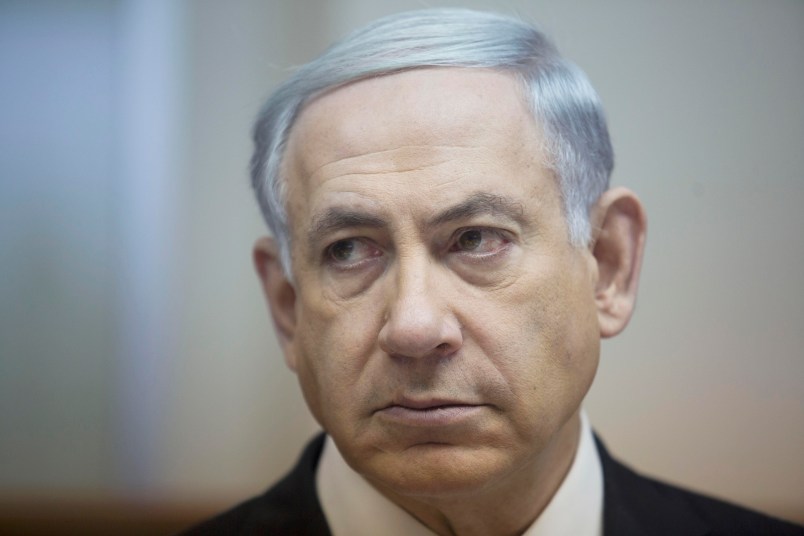
JERUSALEM (AP) — Deeply divided and foul of mood, Israelis are headed toward what seems like a referendum on their long-serving, silver-tongued prime minister, the hard-line Benjamin Netanyahu.
But with so many of them having despaired of peace talks with the Palestinians, the focus is mostly on Netanyahu’s personality, his expense scandals and the soaring cost of living.
And as no candidate is likely to win big in the wild jumble of Israel’s political landscape, the outcome of the March 17 election could well be a joint government between Netanyahu and his moderate challenger Isaac Herzog. It’s an irony, because the animosities are overwhelming.
Much has changed in the world since Netanyahu first became prime minister in 1996, but Israel remains stuck with the question of what to do with the highly strategic, biblically resonant, Palestinian-populated lands it captured almost a half-century ago.
Israelis know it is their existential issue, but it seems almost too complex for a democracy. After decades of failed peace talks under every sort of government, the whole festering thing has become such a vexation that politicians seem to fear it, and voters look away.
When he called the early election in November, Netanyahu seemed a shoo-in, but somewhere things went wrong. Notorious around the world for American-accented eloquence in the service of a tough stance, he is extraordinarily divisive at home, where he has been prime minister for the past six years, and for nine in total.
His speech last week before the U.S. Congress, urging a tighter deal than he believes is brewing on Iran’s nuclear program, was typical: He impressed some Israelis, while infuriating others who sensed a political ploy.
Polls show his nationalist Likud Party running slightly behind Herzog’s Labor Party, rebranded the Zionist Union in a bid for nationalist votes. There are scenarios in which Herzog — improbably mild-mannered in a high-decibel land — becomes prime minister. And that would change the music: Herzog is a conciliator genuinely interested in ending the occupation of lands captured in the 1967 war.
Some things to watch for:
___
ISRAEL IS NEARLY UNGOVERNABLE
Despite its reputation for plucky unity, the country is badly fragmented — and that’s reflected in parliament under the proportional representation system.
Combined, the two big parties get far less than half the vote. Then one finds a nationalist party appealing to Russian speakers, another for secular liberals and two for the squeezed middle class. A united list represents the one-fifth of citizens who are Arabs and is itself divided between communist, nationalist and Islamist factions. There are four religious parties, for Jews of European versus Middle Eastern descent and for varying degrees of nationalism.
The schisms are real, reflecting a society so diverse that at times it seems to be flying apart. The discourse is of one’s rival destroying the country, through stupidity or evil. A TV debate between the main candidates other than Netanyahu and Herzog quickly degenerated into shouted accusations of fascism, criminality and treason.
___
A KINGMAKER COMES
By dint of necessity, this constellation has nonetheless coalesced over the years into rival leftist and rightist blocs: the Arab parties aligned with the dovish left, and the religious with the nationalistic right. If either wins 61 seats combined, its main party governs.
But for the first time in decades, there is a new party that seems genuinely non-aligned: Kulanu, led by Moshe Kahlon, a working-class Likud breakaway of Libyan Jewish descent who became popular for reducing mobile phone costs in previous governments. He says he will go with whichever side makes him finance minister — as both almost certainly would — and seeks to reduce the cost of living. He appears to care little about the Palestinian issue.
Every recent poll shows him holding the balance of power, with about 10 seats while the blocs split the rest.
___
THE RELUCTANT RIGHT
The winning bloc often rules in alliance with parts of the other bloc. Such coalitions widen the base and win points for moderation and inclusiveness. They are also paralyzed by disagreement and tend to collapse of their internal contradictions, as Netanyahu’s did four months ago.
Likud seems especially reluctant to rule on its own, almost always preferring a grand coalition with Labor or centrist parties rather than one with just its nationalist and religious allies. At least in part, that looks like an admission that truly nationalist policies — such as annexations in the West Bank — would so offend the world and provoke the Palestinians as to bring ruin.
The right sees the West Bank as the heartland of biblical Israel and also a place of immense strategic value, since Israel without it is reduced at its narrowest point to about 10 miles (15 kilometers) wide. The left’s key argument is that permanent control of millions more Arabs would destroy Israel as a Jewish-majority state.
The right has developed a majority among Israel’s Jews. But it is also hugely unpopular among the nation’s still-powerful elites, including academic figures, business leaders and — to a striking degree — the security establishment. The 2012 documentary “The Gatekeepers,” presenting a highly critical view of the West Bank occupation, featured every one of the six then-living heads of the Shin Bet secret service, entrusted with securing that very occupation. The keynote speech against Netanyahu at the main opposition rally last week was by Meir Dagan, who led the Mossad intelligence agency for much of Netanyahu’s term. A predecessor, Shabtai Shavit, has been similarly critical, as have recent heads of the military.
So great is the pressure on the right that successive Likud leaders have abruptly changed course or even crossed the line, including then-prime ministers Ariel Sharon and Ehud Olmert. Some predicted the same for Netanyahu, who in 2009 accepted the principle of Palestinian statehood, appearing to renounce all he had once stood for; but actions did not follow, and the theory that he was just pretending so as to confuse his critics gains currency by the day.
___
IMPOSSIBLE PEACE?
Even among proponents of a West Bank pullout, the talk is of saving Israel demographically as a Jewish-majority state rather than of making peace. Many yearn for unilateral moves, having given up on the possibility of a negotiated deal after all these years.
Israel might conceivably agree to the near-total West Bank pullout the Palestinians seek; previous governments have. The Palestinians may agree to drop the demand that refugees’ descendants be allowed to move to Israel, potentially by the millions. But the real conundrum is Jerusalem, where a division of the intertwined holy city along ethnic lines would lead to perhaps the world’s most complicated map, a tinderbox extraordinaire.
Providing the worst of precedents is Gaza, the other part of the would-be Palestinian state, on Israel’s southern flank. Israel pulled out its soldiers and settlers in 2005 and handed control to the Palestinian autonomy government of moderate President Mahmoud Abbas — a relic of interim agreements from the pre-Netanyahu 1990s. But Hamas militants swiftly seized the strip and have been blockaded by Israel; they regularly fire rockets at Israeli towns, and three wars have been fought.
Then there are security threats to Israel from elsewhere in the region: Iran, believed to be seeking an atomic bomb; its proxy Hezbollah, with a forest of missiles pointed at Israel from Lebanon; Islamic State jihadis rampaging in nearby countries; al-Qaida radicals on the border with a disintegrating, still-hostile Syria.
Given the widespread pessimism, Herzog subtly dodges the peace issue, perhaps for fear of appearing naive.
___
UNITY GOVERNMENT POSSIBLE
With the electorate confused and fractured and no clear path forward on the key issues, and with neither Netanyahu nor Herzog likely to win a convincing majority, a plausible outcome has their parties banding together. They may also agree to rotate as prime minister in such an arrangement, with the first turn going to whoever has the stronger parliamentary hand.
Such has already happened in 1984. Labor’s Shimon Peres and Likud’s Yitzhak Shamir lived in uneasy coexistence and switched jobs halfway through. A few things got done. But the main issue, then as now, was the West Bank; Peres negotiated over it with Jordan, only to see his peace plans scuttled by the skeptical Shamir. Shortly thereafter the first Palestinian uprising began.
Many fear another one is coming, even as Israelis focus on the price of cottage cheese.
___
Dan Perry is AP’s Middle East editor leading text coverage in the region. Follow him on Twitter at www.twitter.com/perry_dan
Copyright 2015 The Associated Press. All rights reserved. This material may not be published, broadcast, rewritten or redistributed.




Why are bets off? Damn Vegas bookies. I want to bet a C-note that BB goes down.
I thought he was winning until about a week ago. Then he did the flip flop shuffle on the occupation. After that he started looking desperate.
May he be gone! One of the most evil men on the world stage.
Amen. And this story’s not exactly perfectly accurate – Labor didn’t “rebrand” as Zionist Union (or Camp), it’s a “union” of Herzog’s Labor and Tzipi Livni’s centrist party (no longer called Kadima, I don’t think), which actually won last time but she couldn’t form a government. And all the emphasis on a unity government between them and Likud, while a possibility, sounds like someone who parachuted into Jerusalem for this piece with a memory of the 1980s stuck in his head. Nevertheless, a decent rundown in many ways, with that historical reference serving as a nice explanation of why I’ve been saying since the 1980s that the greatest threat to Israel’s existence is Israel’s right wing. May they have a surprisingly bad election day, for the sake of their country, the region, and the world.
hey bibi dont go away mad just go away…aw hell go away mad we dont give a shit go whine to your republicon asshats
And in America, we have plenty of our own problems stemming from ring wing zealots. The pattern is obvious and after the Netanyahu drive by sponsored by John Boener, the connection is undeniable. Netanyahu is hurting his own nation and his counterparts in America are hurting ours.
It seems that Netanyahu will keep his fingers in the pie one way or another and his influence is bound to at least keep up the status quo, a chaotic ungovernable Israel. This is also the teabaggers idea of paradise.
This clearly shows the necessity of good governance and disproves the right wing ideology of less government is better government. The hardline is the wrong line and guarantees division. Governing, by its nature, is for all the people, not just the loudest or craziest that make a big splash but aren’t near the majority.
Israel is far too complex for itself apparently and our influence makes little if any difference at all.
For America to be able to help resolve such huge issues in other nations, it has to be healthy in its own governance first. Netanyahu seems to be active in making sure that this doesn’t happen in either nation and the Republicans could care less about unity, they only are concerned with having the most power.
The clear conclusion is, far less power concentrated in the right wings of nations, its chaos waiting to happen or already happening.