


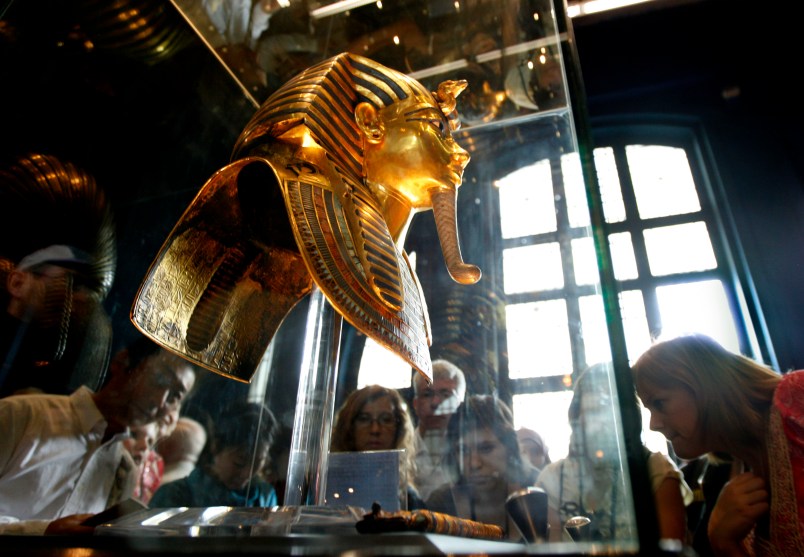
CAIRO (AP) — A German expert summoned to Cairo to examine the damaged burial mask of King Tutankhamun says that epoxy used to glue the mask’s beard back on can be removed and the mask properly restored.
Speaking at a packed news conference Saturday at the Egyptian museum, restoration specialist Christian Eckmann said the beard, which had been detached before from the mask in the past, had been accidentally knocked off last August during work on the relic’s lighting.
He says that a committee of experts consisting of conservators, archeologists and natural scientists will develop a plan to restore the beard, glued back on with an unknown type of epoxy.
A scratch discovered on the mask is visible, he says, but it was unclear when the mark was made.
Copyright 2015 The Associated Press. All rights reserved. This material may not be published, broadcast, rewritten or redistributed.





What idiot was allowed access to the relic? This mask is priceless and an incredible work of art. That it was improperly handled is inexcusable.
I was lucky enough to attend the Tutankhamun: The Golden King and the Great Pharoahs exhibit in Seattle a couple of years back–a bucket list event for me. The relics exhibited relating to Tutankamun and Akhenaten were astounding to see up close and in-person. But not too close, and no photographs or video allowed. The security was very alert. One golden burial mask was enclosed in it’s own 10’x10’ free-standing glass case, but if you came closer than about 18" or so to the glass, the alarm sounded–and did, while I was standing a few feet away. It was the last showing in the U.S. for some time, and the items in the gift shop were actually rescued from the Cairo Museum gift shop before the Arab Spring shut down the tourist trade.
http://www.pacificsciencecenter.org/King-Tut/king-tut-the-exhibition
Removing epoxy is a bitch but it can be done with a very high heat source. The obstacle is that the surrounding gold will melt at such high temperatures. The inlaid glass and precious stones like the lapis lazuli, carnelian, and turquoise, etc., will also have to be well protected. Some of those are fairly soft gem stones. I could see them having to reapply gilding to it in some places as part of the restoration process after they’re done removing the epoxy. I’m just speculating.
There are a few industrial solvents that can melt epoxy, like those used in the electronics industry, and those might do the trick but they have other effects that would be highly corrosive perhaps on some of the surrounding material. I’m sure they’ll find the best way possible. Then they can show us how they managed to do it in some new documentary, entitled…“Restoring King Tut’s Mask”, or some such shit.
Its just so stunningly beautiful…Iconic in the truest sense of the word.
I saw the 1978 exhibit in Seattle. The mask is incredible - photos don’t begin to capture how beautiful it is. But I thought the most exquisite piece was a small golden statue of Isis.
There are several debonders for epoxy that are pretty effective and not corrosive to a metal like gold. I even used to use some to remove set epoxy from my fingernails and skin. Once you have broken the bond it should be fairly easy to remove the rest of the stuff with careful use of fine rotary burrs and small chisels.