

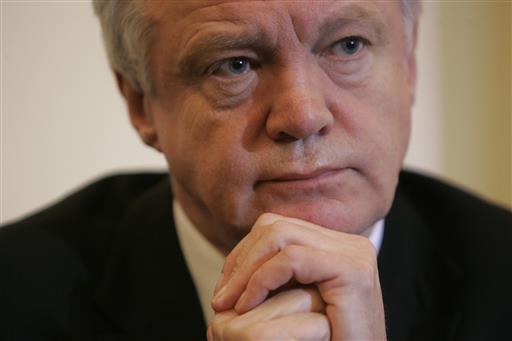
LONDON (AP) — Exposing the uncertainties unleashed by Britain’s decision to leave the European Union, the U.K. minister in charge of negotiating the divorce said Sunday that most EU citizens in Britain when it leaves the bloc will be able to stay — but some might have to leave.
Brexit Secretary David Davis dismissed suggestions that the estimated 3 million EU nationals now living in Britain might be forced to leave, telling Sky News that “I want to see a generous settlement for the people here already. They didn’t seek this circumstance — we did.”
But he said if a surge of new immigrants trying to “beat the deadline” floods into Britain before it leaves the EU, the Conservative government may have to set a cutoff date.
“We may have to say that the right to indefinite leave to remain protection only applies before a certain date,” Davis said in a separate interview with the Mail on Sunday newspaper. “You have to make those judgments on reality, not speculation.”
A desire to reduce immigration from other EU nations was a key reason many Britons voted last month to leave the EU. Under the bloc’s rules, EU nationals can move feely among member states, and Britain has seen its population swelled by hundreds of thousands of new arrivals in recent years.
Prime Minister Theresa May has been criticized for refusing to guarantee the right of EU citizens to remain in the U.K. after its EU exit — something that is more than two years away. She says she needs to ensure that hundreds of thousands of Britons living in other EU countries get the same protection.
Britain’s vote to leave the EU has unleashed political and economic turmoil, as people and markets absorb the uncertainties about the country’s economic future as it leaves the 28-nation single market of 500 million people.
Davis said he believes Britain will be able to retain access to the single market while opting out of the EU’s right to free movement. EU leaders say that’s impossible because free movement is a key EU principle, but Davis said “everybody is taking starting positions.”
“Of course they are talking tough,” he said. “If I was negotiating to buy your house or your car my first offer wouldn’t be my final one, would it?”
The referendum has also put the future of the U.K. itself in question, with the pro-independence Scottish administration suggesting it could seek a new independence referendum if Britain takes Scotland out of the EU against its will. Scottish voters strongly backed remaining in the EU in the June 23 referendum.
Scottish First Minister Nicola Sturgeon said Sunday she did not rule out Scotland staying both in the U.K. and in the EU even if the rest of the country leaves the bloc — though it’s not clear how that could happen.
“We’re in uncharted territory, and when you are in uncharted territory with effectively a blank sheet of paper in front of you, then you have the opportunity to try to think things that might have previously been unthinkable,” Sturgeon told the BBC.
Meanwhile, the government is seeking to reassure Britons that the U.K. can build strong and profitable trade ties outside the EU. May said she spoke with Australian Prime Minister Malcolm Turnbull, who expressed a desire for a free trade deal with Britain as soon as possible.
“It is very encouraging that one of our closest international partners is already seeking to establish just such a deal,” May said — although Britain can’t make any new trade arrangements until it actually leaves the EU.
Copyright 2016 The Associated Press. All rights reserved. This material may not be published, broadcast, rewritten or redistributed.




One of the odder and unfortunate aspects of the EU’s rapid eastern expansion has been the rise of “crime tourism”. People from e.g. Romania and Bulgaria take a van to the western or northern parts of the EU, spend a few weeks committing low level property crimes, loading up the loot and head home. Even when caught, the unavailability of translators at police stations, lack of coordination and data exchange and free movement within the EU, makes monitoring such people a nightmare. The EU saw this coming. It was no secret that the TI Corruption Perception Index ranks Bulgaria as even more corrupt than Turkey, while some of the least corrupt countries in the world are found in northern Europe. The large Russian-speaking populations in the Baltics (who have traditionally been treated as second-class citizens) also opened a window for Russian crime organizations to move largely unobstructed within the EU. Balkan-based gangs penetrate the EU quite easily. In the case of the UK, the press (and not just the pure-xenophobe Daily Express) is full of stories about dangerous East Europeans. When the discussion gets this confused, as Misha Glenny noted, traditional migrant groups like the Rom (gypsies who came to Europe around 1300) become scapegoats for crimes of other groups, adding to the confusion.
Wow. Britain seems to be threatening to isolate itself even more. Lovely they still have Australia, but that’s hardly enough to keep it going.
I’m still shocked they did this.
The Rom aren’t a British problem -they are a European problem. And you hear that same thing everywhere - they are criminals, they don’t send their kids to school, they refuse to assimilate.
. Britain’s “problem” with them is nothing compared to the problem elsewhere, like Italy. The Rom and Albanian immigrant population in Italy is enormous.
But this is a problem that has been around for at least a millennium
I had heard that roughly 1/4 of all the doctors in the NHS are immigrants and many are looking to leave England. Apparently, feelers are being put out to some of these heallth professionals from institutions in different countries who would welcome their expertise.
I’m very close friends with a Rom singer. She has a constant parade of relatives through her apartment, and even met personally with Indira Gandhi (the Rom originate from Northern India). Many of their traditional skill sets such as tinker, horse-trading, fortune-telling, auction-managing, rental musician, etc. have vanished making the mobile lifestyle increasingly difficult. Django Reinhardt, for example, was a classic working gypsy musician. They are close-knit, take care of each other, dreamers, free-spirited, and mostly pretty fun once you get to know them. Of course, they are expert in working the social benefits system and petty crime because traditional career paths are largely unavailable. The fear of education runs deep, but Finland (which calls them mustalaiset, the “black ones”) a couple years ago produced its first Rom to get a doctorate. If anything, the 800-or-so-year history with the Rom suggest how hard it is to integrate a migrant population intent on keeping its traditions. They still use the word Gadjo or Gadže to describe non-Rom people, who are unclean. It derives from a town named Gadze in northern India. Cultural memory runs deep with these folks.