


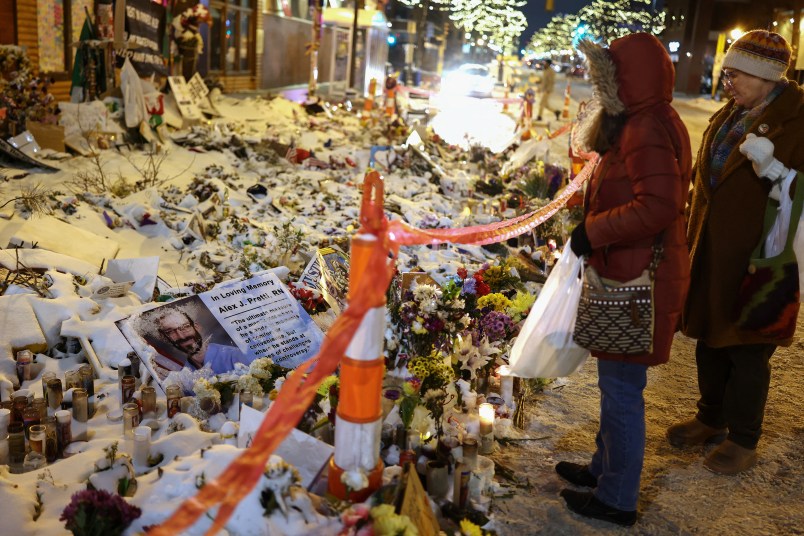
Judge Eric Tostrud, a Trump appointee, handed down an often contradictory ruling Monday night lifting his order requiring the preservation of evidence surrounding Customs and Border Protection agents’ killing of Alex Pretti last month.
On one hand, he acknowledged that statements from Trump officials absolving the agents of any culpability for the killing immediately after they shot Pretti are “troubling.”
“They reflect, not a genuine interest in learning the truth, but snap judgments informed by speculation and motivated by political partisanship,” he wrote.
But the connection between the administration’s stance on the fatal shooting, and its intentions in terms of properly preserving evidence of the possible crimes committed, is too “remote” for him to extend the temporary restraining order. He handed down that initial order last week after the Minnesota Bureau of Criminal Apprehension and Hennepin County Attorney’s Office had sued a series of administration officials and agencies, including DHS Secretary Kristi Noem, Attorney General Pam Bondi and FBI Director Kash Patel, seeking access to evidence.
Elsewhere, Tostrud acknowledges that, after barring state investigators from the crime scene even when they returned with a judge-signed warrant, federal agents allowed the scene to be overrun by bystanders. Indeed, that “federal officers had not prevented spoliation from occurring” and “their refusal to cooperate at all with state officers,” had provided the basis of Tostrud’s initial ruling mandating the preservation of evidence.
Still, he concludes bafflingly, “concerns over past conduct do not hold substantial predictive value regarding Defendants’ ongoing evidence-preservation practices.”
In other words, the administration’s clearly communicated disinterest in conducting a legitimate investigation, its letting the crime scene be violated in the hours after the killing and its refusal to cooperate with state investigators do not dent the judge’s confidence that it will do everything by the book from here on out. Next time, Charlie Brown will surely kick Lucy’s football.
Some of the ruling is indecipherable. Here’s Tostrud’s calculus about whether the potential of spoiled evidence causes irreparable harm to the state investigators: “If I’m correct that Defendants are not likely to spoliate or destroy evidence related to Mr. Pretti’s shooting, it follows that Plaintiffs are not likely to suffer irreparable harm caused by spoliation or destruction. If I’m wrong about that and spoliation is assumed, irreparable harm seems likely, but it is not certain.”
In another judge’s hands, such a risk would almost certainly justify handing down an injunction. If the government doesn’t destroy the evidence, there’s no harm to the plaintiffs, he wrote. Right — which is why plaintiffs provided the “troubling” evidence that the government can’t be trusted not to do so, and are asking for a court order to make sure they don’t.
Read the ruling here:





Bad faith and stupid are a heady mix. Sure, of the head in the mix is pure bone, but it’s always a sight.
tl;dr – “Feel free to start destroying evidence”?
FIFY!
The judge must be hyper-focused on evidence-tampering, and not on evidence withholding, which we are witnessing in the Epstein matter.
“Yeah, you’re right. But I’m going to do less than nothing about it.” Passive aggressive conspirator 101