


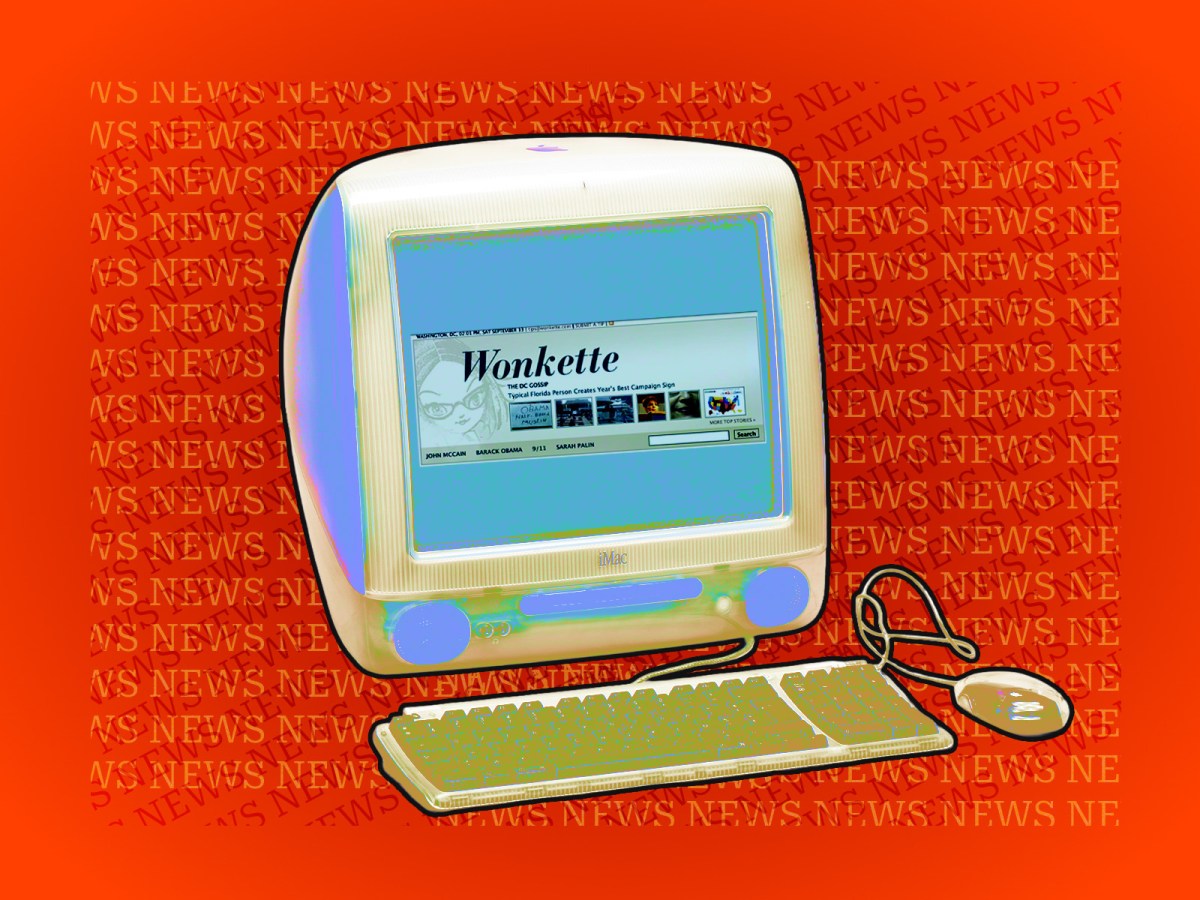








My favorite political blog post of all time was published by Jim Newell on the manic site Wonkette.com on September 12, 2008, at the height of the hope-and-change era preceding Obama’s first election. Its headline is, “Typical Florida Person Creates Year’s Best Campaign Sign.” The entire body of the post, cribbed from a long-disappeared local news story, consists of a closeup photo of a handmade plywood yard sign that reads “OBAMA HALF-BREED MUSLIN,” accompanied by two sentences of the news story: “Lacasse put the sign in his front yard four days ago. ‘If I see anybody touching that sign, I got a club sitting right over there,’ Lacasse said.”
The original story, to be sure, had the name and age of the man and relevant background facts and context. But the blog post had everything you really needed to know. He got a club sitting right over there.
When the blog era really got rolling in the late aughts, much of the traditional media dismissed bloggers as amateurish and borderline unethical pretenders to the title of “journalists.” Bloggers, the traditional wisdom went, were young, snide purveyors of dashed-off riffs on the weightier work of Real Reporters, a band of irresponsible little shits making fun of writers whose prestige they would never match.
Well. Not all of us were so young. The rest of the criticism was kind of true. Still, as the golden age of blogs recedes in the rearview mirror, one point about the editorial legacy of bloggers demands to be made. For all of the derision that traditional journalism heaped upon them, I’d argue that good bloggers have better editorial judgment than any other type of writer.
Pulitzers? No. A quarter century of teaching stuffy old news publications what it looks like to boil news down to its absolute essence and present it in an interesting way? Yes. They won’t tell you this in journalism school, but the best bloggers have a defter touch with tone, style, and length than your average Pulitzer-winning newspaper reporter.
Newspaper and magazine stories come with a built-in frame. They have word counts. Even books, the pinnacle of Serious Writing, have their limits: a hundred pages is too few, a thousand is too many. On the internet, there is no word count. Indeed, there are almost no limits of any kind. At some sites, for every news item or essay or feature story, a lone blogger was tasked with deciding how long it should be, how serious or funny it should be, and how it should be presented on the page. This caused much unpolished crap to be published online, sure. But those who mastered the craft of blogging did a job that requires three editors and a graphic designer at a major newspaper. And they could make it funny, something that no number of New York Times editors can achieve.
This type of journalism with no guardrails was difficult for many to navigate. Traditional reporters who came to work at blogs often ended up dumping newspaper stories onto the page, which stank of wooden formality. One of the great favors that blogs did for all of journalism was to expose the amount of unnecessary convention, of hemming and hawing and ass-covering, that goes into typical news stories. By dispensing with all of that and getting right to the fucking point, blogs set off a competitive feedback cycle that has made mainstream news writing today snappier and more engaging than it was when nobody was around to point out that you could toss 90% of the story in the trash, write a better headline, and get more people to read it.
The judgment skills necessary for great blogs were not only about brevity. “On Smarm,” Tom Scocca’s classic Gawker essay, clocked in at nine thousand words; Caity Weaver’s tale of a day spent eating unlimited mozzarella sticks at TGI Friday’s is more than six thousand words, with a dozen embedded photos. Each of those will, in its own way, have more cultural influence than many self-serious prestige magazine cover stories. Their word count is not a product of the need to create a sense of gravity to impress journalism award judges. What these intricate features have in common with the “OBAMA HALF-BREED MUSLIN” post is that they are each exactly as long as they need to be. Furthermore, they could be funny in a way that the layers of traditional media editing just didn’t allow. Readers like that. They always will.
Not all bloggers were great. The archives of Gawker Media and Buzzfeed and Vice and their peers are clogged with thousands of examples of the perils of the freedom that blogging offered. Many Adderrall-popping writers unrestrained by word counts allowed pieces that should have been paragraphs to spiral into essays. Many hungover writers sapped of energy churned out bad one-liners that failed to land. Yet those who studied the craft long enough became Jedi Masters of the news cycle, able to frame huge amounts of public discourse just by recognizing when something deserved respect, and when it deserved mockery.
In January of 2013, Deadspin broke a big story exposing college football star Manti Te’o’s girlfriend as a fictional creation. As the story spread throughout the national news, a businessman and reality television star took to Twitter to congratulate Deadspin for “exposing the Manti Te’o fiasco.” It was a characteristic act of Donald Trump inserting himself into an unrelated story — and, potentially, a bit of free publicity for a site that wasn’t frequently praised by celebrities.
Fourteen minutes later, Deadspin replied from its official account: “@realDonaldTrump Go fuck yourself.”
Two years later, Deadspin’s parent company would be bankrupted in a lawsuit funded by Republican billionaire Peter Thiel, a major donor to the presidential campaign of Donald Trump, who would win the 2016 presidential election. Over the next decade, the entire digital media industry would begin to crumble in earnest, its business model disrupted by the predations of big tech companies, the CEOs of which would all sit on stage behind Donald Trump when he was inaugurated for his second term in January of 2025.
Woe is us. The bloggers have been vanquished. We really got our asses kicked. But when the dark history of the Trump era is written one day in our smoldering, dystopian future, I think that the most prescient assessment of what was coming for us all will stand as: “Go fuck yourself.”
Anyhow. This should have been shorter.



I just went looking for the Sarah Pround and Tall post about Christmas dinner at Trump’s parents place, but I couldn’t find it. I think it was from 2011.
Was it this?
Oh. My gods. I think I have read the whole saga, and I must thank you for putting me on to it.
Stuck the landing.