









You can leave journalism altogether or you can take the longest way around the barn possible to try and keep doing it (and maybe, in the process, save local journalism).
That was the choice that I and four other journalists were facing in fall 2021, after witnessing countless talented colleagues get fired, pushed out, or just endure being grievously underpaid until they said fuck it and quit, that they’d had it with an industry marred by catastrophically inept management decisions. Staring down the middle parts of our careers, the landscape where we had begun our time in journalism was completely cratered out — the once voluminous flow of investment into digital media had dried up, while the local news outlets where we cut our teeth were blinking out, little fires smothered by hedge fund buyouts and consolidation. Everything was getting balkanized, with popular writers from the internet launching their own Substacks after their publications died. The funders for non-profit journalism were, as ever, wildly up their own asses and couldn’t figure out how to sustainably fund or scale a newsroom. Google and Facebook had devoured whatever was once financially enticing about publishing on the internet, with their wild overpromise of ad revenue from clicks.
In short, it was a pretty rough time to start a local news outlet. Even worse, a local news outlet that expected people to pay to read it, so journalists could have an actual income they could be proud of and live on (in New York City, no less!). AND EVEN CRAZIER THAN THAT — we’d own the whole thing and make it sustainable as a for-profit business. The shiftless, unemployed, know-nothing-about-running-a-business journalists would crack the code once and for all. But looking around at the time, in the pandemic ashes of 2021, other alternatives were limited. Surveying the carcasses of digital publications that had seemingly just hours ago been swimming in millions of dollars of funding, we were reminded of the wisdom of Anton Chigurh: If the rule you followed brought you to this, of what use was the rule?
And that rule, the most bone-headed of all the rules for journalism on the internet, was this: journalism should be free.
When did this become the golden rule for journalism? When did it become somehow dirty for a publication to demand remuneration for the investment it takes to report, edit, and publish stories that reveal important truths about your community, things that make you a better, more informed member of society? Why did it become a calling card for all the new local publications to tell readers up front that their work would be free, in perpetuity, because they’d never stoop so low as to swipe a few bucks from your pocket (but please please please hit the “donate” button below, please!)?
At Hell Gate, where I now work with six other full-time journalists who also own the company, the decision was easy. If people wanted to read our reporting, they’d have to pony up. (And no, we’re not wild-eyed capitalists — I mean, check out the worker’s paradise of our business model.)
So why did we do it? Why were we so cold-hearted as to demand the equivalent of a cup of coffee each month for full access to our website? The answer is because we’d been through the maelstrom of journalism’s collapse, punctuated by the peculiar hiccup of the digital media boom and bust, and this seemed like the way out of it all. My own decade in digital media was a bit of a speedrun in learning this.
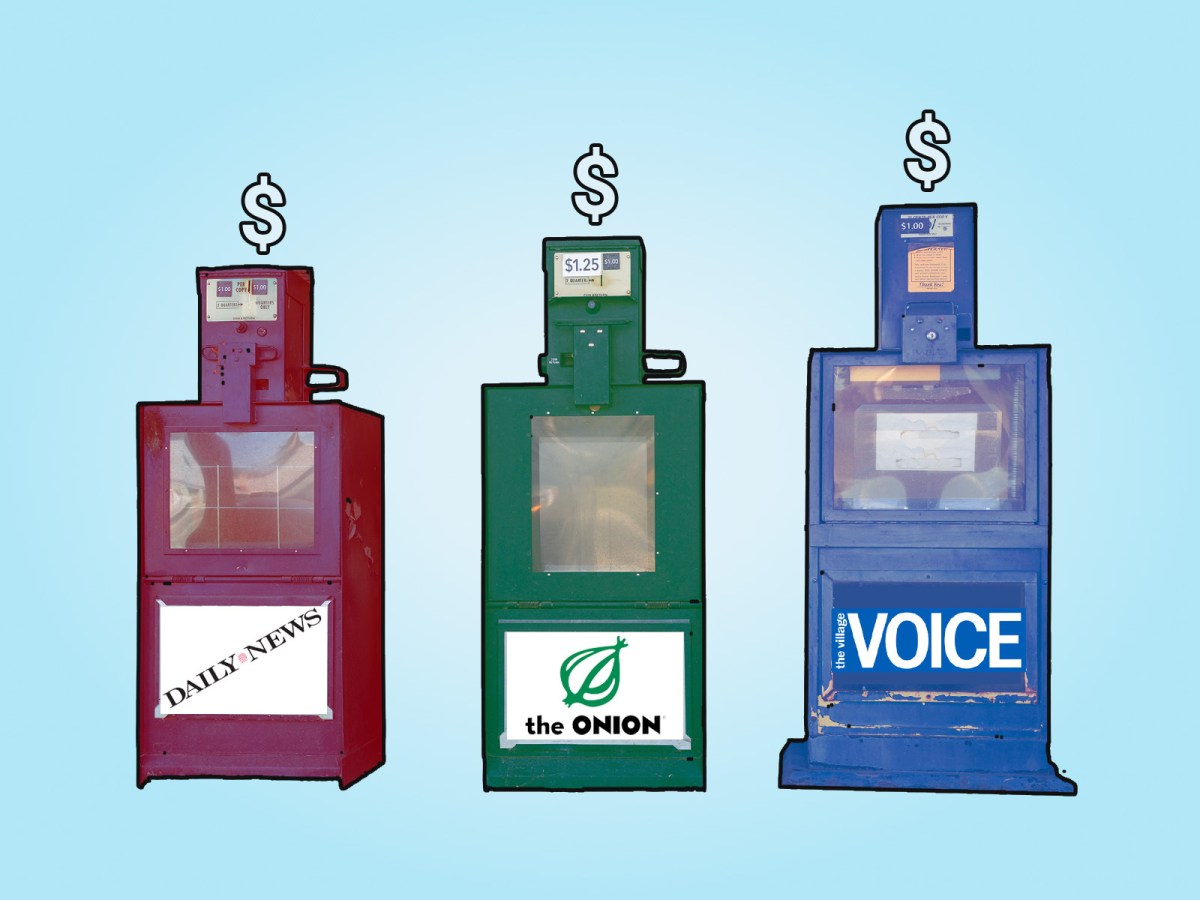
I cut my blogging teeth at Gawker, which, while profitable until the very end, was famously snuffed out by an evil billionaire and had a sale forced on it to pay off its legal bills. I learned local reporting at Gothamist, which was sold to a capricious billionaire who axed it when workers dared to unionize. I got to live the local journalism dream of working at the Village Voice, which was ultimately tossed aside by another billionaire scion owner when he got sick of losing money on it. I helped launch The Appeal, which collapsed under the weight of flagrant mismanagement by its non-profit parent organization. (It has since been reborn as a worker-led publication.) I even did a stint at the website for a feminism-forward rebrand of Maxim Magazine, but that too was not long for this world. By the time we started Hell Gate, I had just wrapped up a stint at the NPR affiliate in San Diego, where, after a decade of working in journalism and breaking big, national stories, I was making $55,000 a year, with pretty much no prospect of advancement.
Almost all of these publications were reliant on either a) big philanthropy or b) mercurial billionaires.
How could we break free from a cycle that had destroyed the careers of so many very, very good journalists? One way was to get back to basics and make people pay for journalism, something that had been the very model that helped make it possible for even the smallest of American localities to have a newspaper. (Of course, local advertising also played a huge role, but that’s mostly a dead letter thanks to the tech duopoly.)
Three years after launching, Hell Gate has almost 9,000 paying subscribers, and over $800,000 in annual revenue. We’re still in a growth spurt and hope to be for the foreseeable future, but at some point we’ll probably find a plateau of support, and be able to truly game out just how large our local, alternative news outlet is ultimately going to be, and how we should plan to operate for the long haul. Most important is that subscription money, barring some Washington Post-like self-immolation, is incredibly stable. Unlike funding from temperamental billionaires or fickle philanthropy, it won’t dry up overnight. If there is a serious downturn for some reason, we’ll be able to see it far in advance, and make changes to help the business stay afloat.
On top of that, when it comes to local news, having subscribers is just fun. We throw parties and events for them, hold live chats with them, and develop a rapport with individual subscribers in a way that puts everyone on pretty much equal footing, as opposed to just catering to large donors. Full disclosure: Hell Gate also accepts and very much appreciates large donations!
And remember advertising, which I said just two paragraphs ago was a dead letter? I was (kind of) wrong — we’re seeing a lot of interest right now from local businesses who want to reach customers from a trusted publication, as opposed to the airless vacuum of Facebook and Google.
Is this the way forward for local news? Is the cure to newspaper loneliness simply starting really small, building up subscribers day after day, month after month, and breaking big stories, until one day you look around and everyone has health care, decent salaries, and no threat of being laid off at the whim of investors, big philanthropy, or billionaires? Have we cracked the code?
Possibly! I’d really love to find out one day (maybe even at Hell Gate!) just how scalable this really can be. If you prioritize pay and benefits, work-life balance, and stability above all else on the business side of things, is there a natural equilibrium you’ll hit where your headcount will always level out far below the gap in local news coverage? If so, what does a looser, less consolidated network of local media look like? (Maybe like the very publication I’m writing for right now, which has survived along those lines for 25 years!)
Clearly at Hell Gate we’ve been very, very lucky to be able to cover Eric Adams and, soon enough, the first socialist mayor in the city’s history, but we’ve also been able to break stories and run incredible culture coverage, a testament to the fact that when journalists are allowed to pursue the story, unencumbered by economics, they’re usually right on the mark about what will have an impact, interest readers, and make a difference in their community. And wasn’t that the promise of non-profit, free journalism to begin with?



If Scientology can be tax-exempt, so can local newspapers. That would likely help more stay in business.
As both a virtual OG reader of TPM and a subscriber to Hellgate I’ve come to very much value learning and knowing the voices of the reporters. It helps make them feel like trusted sources, but sources with overt biases which we as readers are free to filter as well as to engage with. I gave up reading the NYT oped page years ago because it felt like the combination of self-satisfied elitist bubble in concert with largely boomer conventional wisdom was as predictable as the tide but without the ability to course correct required of a navigator. With so little public engagement, these writer’s thin skins were on public display while their frequently inaccurate takes are both embarrassing and unnecessary. Sites like TPM and Hellgate build reader trust through actual reader engagement, which is certainly a function of their relative small sizes but hopefully the success of both publications manages to maintain that connection -the essential source of this reader’s confidence.