


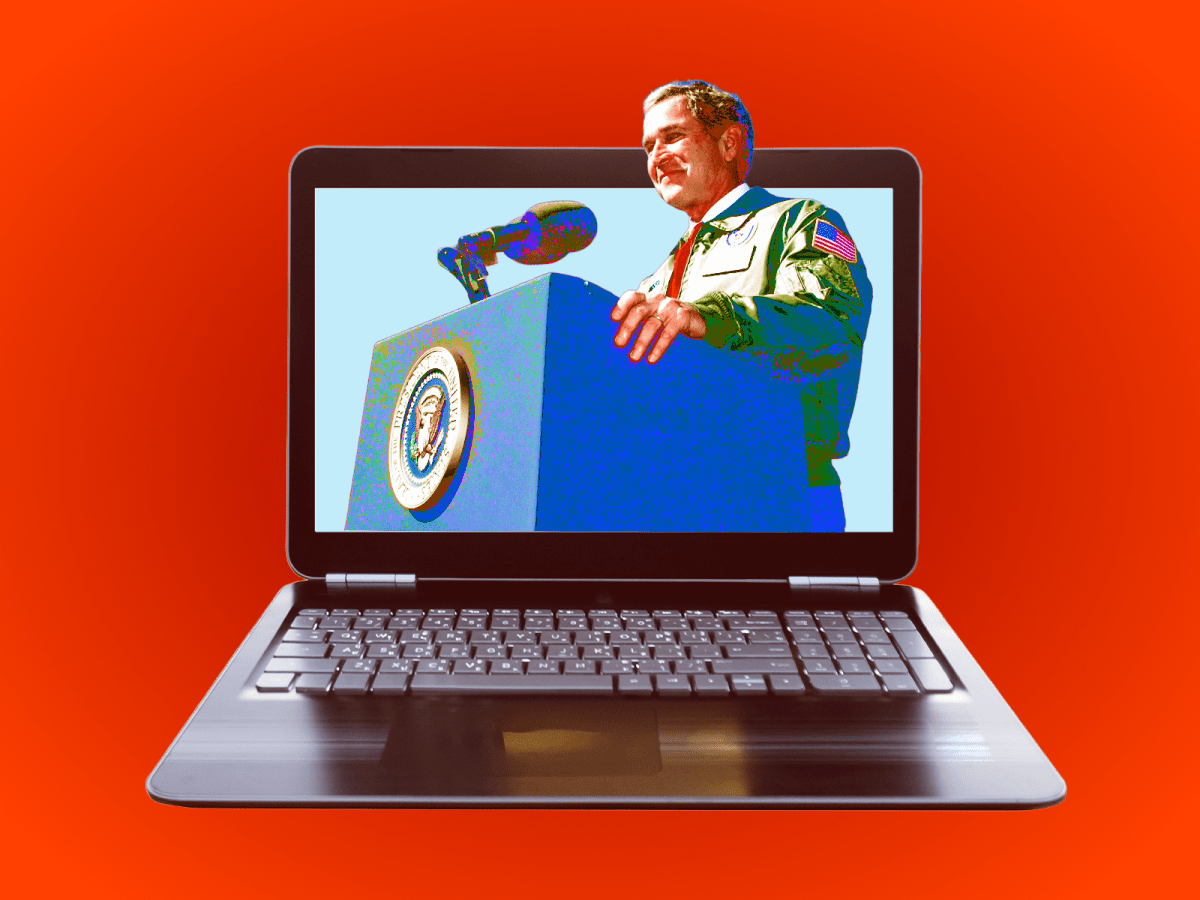








War is an accelerant of change, not least in the media. In the last century, every major war has helped a new medium prove itself as essential for communication. The popular experience of the Second World War was shaped by radio (famously Edward R. Murrow’s live dispatches from the Blitz in London), Vietnam by television (with Walter Cronkite’s dismay at the Tet offensive being a pivot point), and the first Iraq War by cable news (CNN becoming addictive for its 24-7 coverage).
For me — and not for me alone — the second Iraq War was the age of blogs. The first “web log” (an online diary accessible by search engines) was created in 1994 by a Swarthmore College student Justin Hall, who coded the HTML by hand. Even before 9/11, the new medium (now shortened to “blog”) was rising in popularity thanks to the development of easy-to-use hosting systems such as LiveJournal and Blogger. Most weren’t political, but rather digital daybooks revolving around personal concerns (parenting blogs) or obsessions (such as beloved celebrities). Talking Points Memo, created by Joshua Micah Marshall in 2000, was an early pioneer, notably for a bracing skepticism towards Republican Party propaganda.
Political blogs found their purpose once George W. Bush and his administration decided to use the justifiable outrage at the 9/11 attacks as a pretext for an ambitious remaking of the Middle East by military means. The run-up to the Iraq War and subsequent failure of Bush’s larger political project was enormously polarizing. Blogs became the perfect medium whereby this debate played out, especially important because much of the mainstream media had been cowed by nationalist fervor into going along with White House propaganda.
As the war progressed, it quickly became evident that Bush and his crew had been dishonest about many things, not least the fabled weapons of mass destruction, but also their success in stabilizing Iraq and in the conduct of the war. It’s a striking fact that many prominent bloggers who were initially supporters of the invasion of Iraq (albeit reluctant supporters who distrusted Bush’s competence) quickly became outspoken war critics: such disparate figures as Andrew Sullivan, Glenn Greenwald, Matthew Yglesias, and Ezra Klein all followed this trajectory. This is partially what made blogging at that time so exciting: both politics and the new medium were in flux. It was a period where you could see people changing their minds in real time as they were thinking out loud in their blogs. This gave an urgency to their writing and reflected the real time experience of making sense of the chaotic fog of war.
There were, of course, many stridently pro-war bloggers, notably Jonah Goldberg, Glenn Reynolds and Michelle Malkin. But even before the 2003 invasion, there was a vast audience for the millions of readers who were both skeptical of Bush administration claims and angry at the mainstream media for uncritically parroting those claims.
In her deft and informed 2020 book Political Junkies, the historian Claire Bond Potter notes
Major newspapers had failed to detect the Bush administration’s invented pretext for invading Iraq, so antiwar partisans turned to blogs like history professor Juan Cole’s Informed Comment, founded in 2002, for critical news and analysis, rather than to the New York Times, which had published the administration’s evidence against Iraq — information that later turned out to be false. Cole was receiving a million page views a month in 2004; his blog posts were being reblogged and included in antiwar newsletters, and he became a frequent guest on CNN.
Bush’s lies helped launch the new age of anti-system politics, which found its perfect media correlative in blogs. Potter argues that “blog culture” was “inherently subversive and antiestablishment.” It’s possible to overstate the democratic nature of blogging: many of the most prominent political bloggers had some professional affiliation (commonly in academia, think tanks or law firms). But these were also often the disaffected and critical wing of the establishment.
As the Iraq War turned sour, they were the voices that rose to prominence. As the Journal of Computer-Mediated Communication, an academic publication, noted in 2006, “For the blogosphere, growth is a certainty. A search in late 2005 of the Blogosphere Ecosystem at Truthlaidbear.com generated a list of 865 blogs that had recently mentioned the war in Iraq. Of those, more than 600 were born in 2004 and 2005.” By January 2002, Potter notes in her book, Blogger had 150,000 sites and was adding 40,000 new ones a month.
The best of these bloggers brought to the war a forensic analysis of government documents that the legendary I.F. Stone practiced during the Cold War.
A prime example was Marcy Wheeler, whose background was in literary studies, which made her an acute reader of texts that journalists scanned too quickly. The New York Times is not normally a publication that is generous in crediting other journalists, let alone outsiders such as Wheeler (another contributor to TPM’s 25th anniversary series). Yet a 2009 story contained this remarkable passage:
A footnote to another 2005 Justice Department memo released Thursday said waterboarding was used both more frequently and with a greater volume of water than the C.I.A. rules permitted.
The new information on the number of waterboarding episodes came out over the weekend when a number of bloggers, including Marcy Wheeler of the blog emptywheel, discovered it in the May 30, 2005, memo.
The sentences in the memo containing that information appear to have been redacted from some copies but are visible in others. Initial news reports about the memos in The New York Times and other publications did not include the numbers.
In other words, by simply paying attention, Wheeler and her fellow bloggers had helped break a hugely important story that the official media missed. This was the power of blogging, which showed itself repeatedly in the debunking of official narratives about weapons of mass destruction, the supposed ties between Saddam Hussein and al-Qaida, the smearing of former C.I.A. agent Valerie Plame, and the global torture regime set up by the U.S. government. The value of bloggers was they kept these stories alive.
In the clubby world of mainstream journalism, big stories often get pushed under the rug. A non-war example is instructive. On December 5, 2002, Mississippi Senator Trent Lott, then Senate minority leader, toasted fellow Senator Strom Thurmond in these terms, “And if the rest of the country had followed our lead we wouldn’t have had all these problems over the years either.” This was clearly a paean to segregation. Neither The Washington Post nor the New York Times thought these remarks were newsworthy. As Potter notes, the mainstream media “didn’t report the story until political bloggers did, eventually forcing Lott to resign his position as minority leader. On December 6, historian Josh Marshall, the founder of Talking Points Memo, covered Lott’s praise for Thurmond, as well as the senator’s own prior membership” in athe racist group, the Council of Concerned Citizens. Like Wheeler, Marshall helped break news by paying attention to a story the mainstream media was being inattentive to. As Potter notes, “a blogger could stay doggedly on one story, activating readers to dig up more information and calling attention to a news item until mainstream reporters were forced to report it.”
In 2004, rising anger at the Iraq War found expression in a political campaign that was notably attentive to bloggers: Howard Dean’s bid for the Democratic Party nomination. Although centrist on some issues, Dean was also strongly anti-war, which excited the burgeoning blogosphere. Thanks to tech-savvy political consultant Joe Trippi, Dean did far better than expected. As Dean recalled in 2007, “We would read the blog, we would respond to the blogs, we had a bunch of people whose job it was to read the blogs and respond. And people felt like we cared about what they had to say.” Even though Dean lost the nomination, his success at small donor-fundraising and online organizing profoundly remade the Democratic Party, paving the way for Barack Obama’s successful 2008 run.
Of course, blogs themselves would soon be absorbed and partly displaced by social media, a realm where Silicon Valley money would exercise a dire effect (as witnessed by Elon Musk’s takeover of Twitter, now called X). This is a story well-told in Eoin Higgins’s recent book Owned: How Tech Billionaires on the Right Bought the Loudest Voices on the Left.
But these dismal developments shouldn’t blind us to an earlier history when blogs were in fact a promising media which allowed talented upstarts to challenge a disastrous president. The real lesson of the blogging era is that journalism can always benefit from critical outside voices, who in a time of emergency are willing to tell the truths the powerful don’t want to hear.



I am not a blogger by my perception of Bush’s Iraq War is very clear. Saddam Hussein attacked his daddy, so we all had to suffer, plus the Bush family was in bed with the Saudis.
Too put it more simply, it was as if we went to war with China after Japan attacked Pearl Harbor.
And yes, television played a big part in ending the Vietnam war, bringing the war home to the dinner table every evening at six, over pork chops and mashed. Walter Cronkite was years late to the truth. All he did was admit it on TV. Not an act of courage as it is often told.
To this day, the media still refuses to discuss the truth about the Iraq War because of their own culpability in it.
Also, I believe the real reason for the war was to allow Saudi Arabia and big oil companies to gain control over the supply and price of oil. Prior to 9-11-2001, Dick Cheney held meetings with oil executives that are still secret. While I do not gamble, I do not even play the lottery, I will bet because I don’t believe it is gambling that if Cheney’s meeting ever become public, we will learn he discussed Bush’s plan to invade Iraq and take out Saddam and how it would make them richer by causing oil prices to rise.
Everything that happened in Iraq from its falling into chaos to the eventual takeover by Iran was not only predictable but predicted by many of us who opposed the war from the beginning, in fact it was the reason we opposed the war from the beginning.
Pat Buchanan called those of us opposed to the war from the beginning as “the coalition of the intelligent”. Not having as high opinion of myself as Mr. Buchanan, I called those of us opposed to the war from the beginning as “the coalition of the not really dumb”.
But before I get to much into the Iraq War, there is something not being discussed about that war that is very important in discussing politics today. “George W Bush lied America into a disastrous war in Iraq”, Donald Trump. The reason this is important today is it proves how little lying America into the Iraq War affects or affected our politics. That is it is impossible to have supported George W Bush, like every Republican from Lindsey Graham to Mike Johnson to everyone including the lowest of the base and now supporting Donald Trump without admitting that security and foreign are of no concern to you.
That is you cannot have supported both W Bush and D Trump if you care about foreign policy because according to Trump, W Bush and his supporters including Graham are war criminals responsible for the murder of over 1,000,000 people.
But back to the war itself, “It is inconceivable America invaded Iraq over suspected WMDs and then failed to secure any suspected WMD site upon taking control of Iraq”, former chief weapons inspector for Bush, David Kay.
That is we know from Bush’s actions, failure to secure suspected WMD cites, failure to secure Iraq’s borders to keep out undesirables to include terrorists and Iranian agents, and above all failure to provide everyday security to everyday Iraqis so they could build the institutions necessary for a unified democracy that Bush did not invade Iraq over WMDs, links to terrorism or to free Iraq’s people. Rather, Bush showed the world why he invaded Iraq when he ONLY secured, again the key word is ONLY, when Bush ONLY secured Iraq’s oil ministry and the oil fields.
That is what is obvious from Bush’s actions is that Bush himself knew he was lying about the reasons for the war and it was all about the oil. Furthermore, it was not about controlling the oil for lower but to get higher prices for America. That is Iraq under Saddam had been undercutting the any attempt to set a global benchmark for the price and quantity of oil causing gas prices in America to be under one dollar a gallon.
Regardless if W Bush invaded Iraq because Saddam tried to kill daddy Bush, the real result of how the war was conducted by Bush and Cheney led to Saudi Arabia and the cartel to include large oil companies to be able to control the price and production of oil with the accomplished goal of Americans paying more.
Won’t dispute the truth that the Iraq War buildup supercharged political blogging but would add that the 2000 election and subsequent court battles and MSM coverage primed the pump; it certainly was what got me looking for other voices.
That said, the post-9/11 drum-beating for war with Iraq–the era of ‘Freedom Fries’ and accusations of treason for every doubter of the war buildup–was a chilling time, and I clung to outlets like TPM, Kos, and Atrios as to a life-preserver in stormy seas. That gratitude helps to keep me a paying subscriber here.