









Before the internet, what would today be called a “paywall” was just a place where people could buy a newspaper or magazine. Your subscription or newsstand purchase didn’t pay for every far-flung reporter; media outlets subsidized access to readers with advertising and other revenue streams. But though the barrier to entry was relatively low, it was still a barrier. You had to acquire the physical object hosting the material, and unless you went to the library every day or got your hands on a discarded copy in a coffee shop, you would have to pay for it.
Once all articles got posted on websites, tension grew between the idea that information wants to be free and the need for reporters and editors and production teams to afford food and shelter. At first, legacy subscriptions and digital advertising covered the nut; I remember the New York Times and Washington Post segmenting stories into sections so readers had to click repeatedly to finish them, ringing up more ad impressions. But Google and Facebook robbed publishers of the ad revenue that made this (sort of) work, and ever since, media companies big and small have been grasping for an alternative.
They have mostly failed. Between 2004 and 2022, over 2,100 newspapers have gone out of business, according to data from the University of North Carolina. New media pivots from words to video and back again have proven disastrous. Layoffs have touched everyone in this industry; friends and colleagues habitually call me asking for advice or referrals for hiring.
Those of us remaining to report the news have settled on a noble idea: A community of readers can pay to get the information they need. Sometimes the “reader” is one rich person keeping things alive, but that usually ends in tears. A broader base of support is far more sustainable, and there are several outlets, from my site The American Prospect to the one you’re reading right now, that are making this work.
In some ways, it’s a throwback to the pre-internet era, or even the premodern era of patronage. But the pay-to-play trend in journalism is happening at a time of runaway income and wealth inequality, when the top 10% of income earners account for nearly half of all the spending. This has created a strange paradox: The average news consumer today has more available to read than at any time in human history, yet less ability to understand what’s really going on.
Access to news and information has become a luxury good, no different than the comfortable seat you must pay to access on an airplane. Insider tip sheets and exclusive journalism services trade information, written largely for investors and political professionals with personal interests — largely financial interests — in understanding the world. We’ve created a media ecosystem that operates more like a medieval royal court, where proximity to the king determines true knowledge of events. In America, that proximity is available for purchase. That changes how the news is reported, what subjects are given priority, and how access drives the narrative.
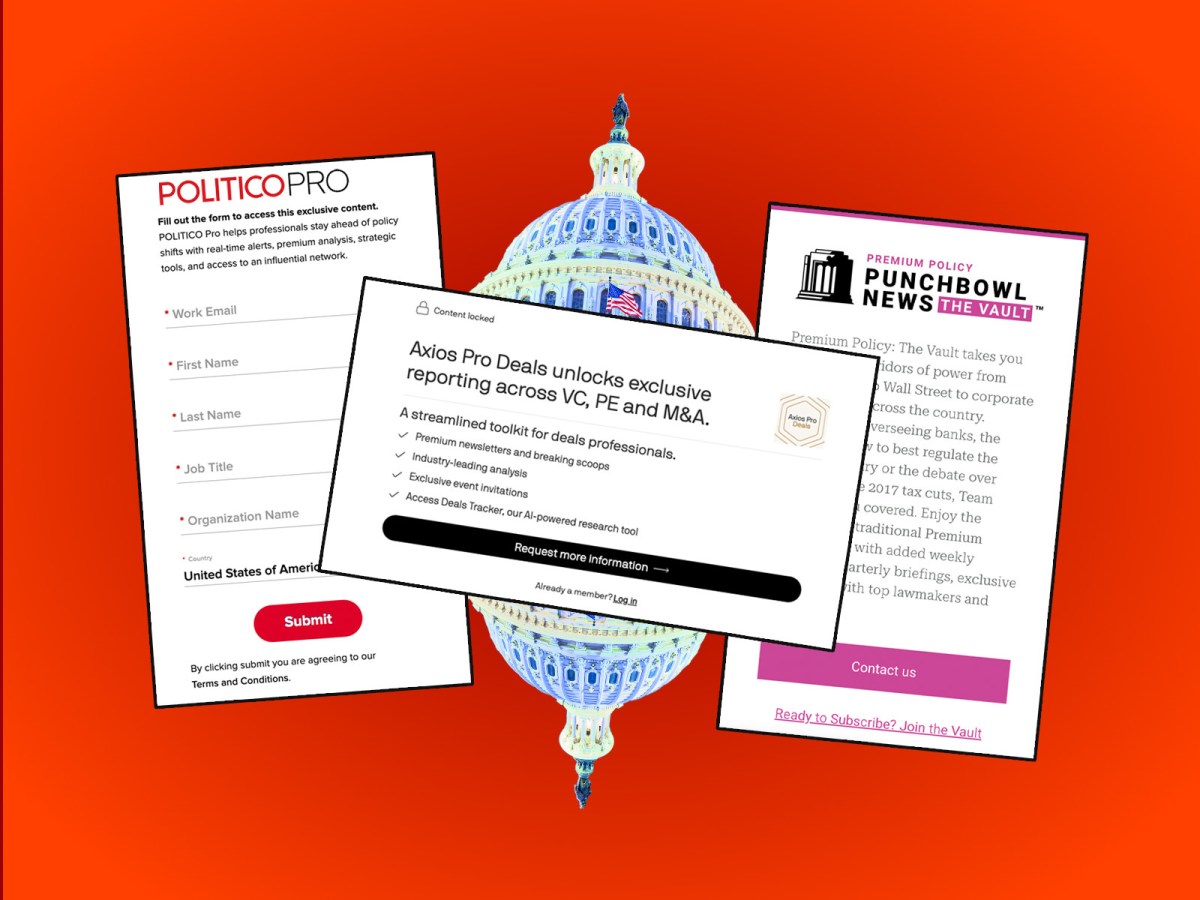
Paywall journalism dominates coverage of Congress and the White House. Punchbowl News, Axios, Politico Pro, and several others specialize in it. Niche publications like Law360, American Banker, and Inside U.S. Trade practice this style for particular subject areas. As the seminal story on paywall journalism, a 2015 piece in Washington Monthly, indicates, just as many journalists have congressional credentials today as they did decades ago; more and more of them are simply behind the paywall.
These sites often go beyond stories about the inner workings of government, but offer exclusive directories, briefings, events, and more. They really operate as political intelligence services, ferreting out information and access and delivering it to those who can afford it.
The base of subscribers can be small but the cost can be high. Punchbowl News’s premium policy services cost as much as $1,200 a year or more; Politico Pro started at around $3,300 per year a decade ago, and now can be more than $12,000.
We know the targets for this journalism, as the companies put them right on their websites. Axios Pro Deals, which delivers “actionable intelligence” on venture capital, private equity, and mergers and acquisitions, lists some of the leading organizations who subscribe: private equity firms KKR, Warburg Pincus, and Silversmith Capital Partners, investment banks Evercore and Raymond James, and pharmaceutical giant Johnson & Johnson. It’s not hyperbole to say that these reports are produced for Wall Street, so they can get an incremental advantage on whoever doesn’t have a premium subscription.
When members of Congress use inside information to trade stocks, it’s considered a scandal; when access journalists dig that information out and hand-deliver it to investors seeking political intelligence for a fee, it’s considered a solid business model.
Obviously the tenor of coverage changes when the core audience is investors, lobbyists, and political professionals. It becomes a version of the political horse race: will the bill pass, what executive order is getting written, who is influencing what. This information is vitally important, and I use it and report on it independently in my own work. But often the missing ingredient on the paywalled tip sheet is the stakes outside of Washington. What the decisions of powerful people mean for everyday people, not investor balance sheets, is what we actually need to know.
Beyond how things are covered, the high price of privatized political intelligence has created a class system for information. If you can afford it, you can obtain all the knowledge you need to understand and make informed choices about our government. If you can’t, you are left with the scraps: YouTube and social media rants, cable news shoutfests, unreliable information on websites where you are the product.
It made perfect sense for news outlets to preserve some of the specialness of what they write by putting the most important stuff out of the reach of the ordinary reader. But withholding access, bit by bit, has turned the fourth estate into a gated community. Majorities of Americans don’t trust the news because they don’t trust what they get in the news’s place. Reliable information is being reported and written every day, but the less it’s available to everyone, the more of the garbage people are fed in their media diet poisons the entire project.
My outlet, The American Prospect, makes our articles free to everyone, but asks readers to cover the cost of making that viable. If you want our best stuff written down with pictures and art and sent to your door, we’ll do that for a fee. Our core principle is that private journalism for the benefit of the few is bad for democracy. But we barely have the means to live those values.
The cycle of news privatization can be broken, but in this moment, it feels fanciful to even suggest. We could support media with tax dollars, but public funding of PBS and NPR was just eliminated. Nonprofits like my organization can supplement reader support with charitable foundations, but that just substitutes reliance on rich guy ownership with reliance on rich guy philanthropy. We could break up Google and Facebook, and federal courts are hearing cases about both of those firms right now; Google’s online advertising platform has been found to be an illegal monopoly by a federal judge. But a lot would have to go right for publishers to truly benefit.
All of this is a bit more bleak than necessary. Communities of readers can support good journalism and uplift the vital free press. Millions of subscribers on Substack are recognizing that journalism is worth paying for, and innovative models like worker-owned collectives (such as Defector) are being formed. But even many of these outlets rely on the paywall, reasonably believing that the way to get people to pay is to not give everything away for free.
Among other things, this exposes journalists to the boom-and-bust cycles of the macro-economy, where a recession (or even just a shift in search engines to AI summaries) can wipe out their livelihood. Even if it were a viable ethical strategy to gatekeep news, it may not be a viable economic strategy. Perhaps worst of all, in an age of inequality, the paywall shapes journalism only for the readers who can get over it. That’s bad news for all of us.



Excellent overview of the shifting economics in journalism.
I’m small fry compared to publications like TPM or The American Prospect. But many years ago I decided never to paywall any of my reporting about Iowa politics. When publications put their best original reporting behind a paywall, that’s great for the people in power. It guarantees limited reach for any accountability journalism.
And as publications raise their prices (e.g. the New York Times) and more authors move to Substack, it gets ever more expensive to access the news.