

Former President Trump sought to cordon off conversations and records sought by the Jan. 6 Committee on Monday, suing both the panel and the National Archives in a bid to block the investigation from accessing documents from his time in the White House.
Continue reading “Trump Sues Jan. 6 Committee And National Archives In Bid To Block Probe”More on BIF Envy and Dem Culs-De-Sac
From TPM Reader PT …
Continue reading “More on BIF Envy and Dem Culs-De-Sac”I don’t think it’s fair to say that the Democrats “drove themselves into a cul-de-sac” on the reconciliation bill because that assumes, or implies, that the Democrats had other options. It also makes the Democrats, writ large, responsible for the fact that two (!) of their Senators haven’t managed to learn the lessons of the last 30 years.
Perhaps it’s worth replaying the tape to see how we got here.
Report: Manchin Wants Work Requirements, Income Cap For Child Tax Credit
Sen. Joe Manchin (D-WV) has reportedly outlined his position on the child tax credit to the White House amid Democrats’ ongoing negotiations for the Build Back Better reconciliation package, according to Axios.
Continue reading “Report: Manchin Wants Work Requirements, Income Cap For Child Tax Credit”Dozens Of State Lawmakers Sign Letter Calling For MAGA Audit Of All 50 States
Dozens of state lawmakers from around the country have signed onto a letter falsely referring to the 2020 elections as “corrupted” and insisting on “forensic audits” in all 50 states.
Continue reading “Dozens Of State Lawmakers Sign Letter Calling For MAGA Audit Of All 50 States”Colin Powell Dead Of COVID-19 At 84
Former Secretary of State and Chairman of the Joint Chiefs of Staff Colin Powell died on Monday morning due to complications from COVID-19, his family announced.
Fox News Anchor Thoroughly Dragged For Boosting Anti-Vax Talk After Powell’s Death
No vaccine can cure getting ratio’d on Twitter.
On the morning of former Secretary of State and Chairman of the Joint Chiefs of Staff Colin Powell’s death from complications of COVID-19, Fox News anchor John Roberts boosted vaccine skepticism in a now-deleted tweet. Roberts failed to acknowledge Powell’s battle with multiple myeloma, a blood cancer that impairs the body’s ability to fight infections.
Continue reading “Fox News Anchor Thoroughly Dragged For Boosting Anti-Vax Talk After Powell’s Death”Trial Of Ahmaud Arbery’s Accused Killers Will Scrutinize The Use—And Abuse—Of Outdated Citizen’s Arrest Laws
This article is part of TPM Cafe, TPM’s home for opinion and news analysis. It first appeared at The Conversation.
The murder trial of three men accused in the death of unarmed Black jogger Ahmaud Arbery gets underway on Oct. 18, 2021, with the issue of what makes for a lawful citizen’s arrest set to be central to court arguments.
Arbery was shot dead on Feb, 23, 2020, after being pursued through a residential area of Brunswick, Georgia.
The three men accused in his killing – Greg McMichael, Travis McMichael and William Bryan – contend that they had reason to believe Arbery was responsible for home break-ins in the area. Arbery, they claim, was shot as he tried to resist a legal citizen’s arrest by wrestling a shotgun from Travis McMichael.
Whether the defendants acted lawfully will depend, in large part, on the strength of their citizen’s arrest claim. At a pretrial hearing in July, prosecutors noted that Arbery was not carrying anything at the time of his death. They are expected to argue in the trial that there was no grounds for an attempted citizen’s arrest.
The controversy surrounding Arbery’s killing led to the repeal of Georgia’s almost-150-year-old citizen’s arrest law. But as a law professor and former police officer, I’m aware that most states retain similar, outdated laws that set the stage for vigilantism.
From ‘vigilant Snorers’ to police officers
So-called “citizen’s arrest” laws, which allow private individuals to apprehend an alleged wrongdoer, have been around for centuries. Such laws protect people from civil or criminal liability in the event they “arrest” someone.
In theory, that makes sense. Public safety is everyone’s responsibility, after all. In practice, however, citizen’s arrest doctrines have set the stage for tragic, unnecessary and avoidable confrontations and deaths.
Modern citizen’s arrest rules can be traced back to 1285, when England’s Statute of Winchester directed that citizens “not spare any nor conceal any felonies” and commanded that citizens bring “fresh suit” – prosecute – whenever they see “robberies and felonies committed.”
Back then, there was no “law enforcement” as we understand it today – no cops, no prosecutors. It was largely left to private citizens to apprehend and prosecute felons.
Prior to the development of professionalized police agencies in the mid- to late-1800s, there was no particular legal distinction between arrests made by private citizens and those made by public officials.
In English cities and larger towns, able-bodied men were expected to take generally unpaid shifts patrolling as night watchmen. Watchmen were often conscripted, and citizens of means could hire someone to serve on their behalf, resulting in a dubious dedication to duty.
This practice extended beyond England to its colonies. An account published in the New York Gazette in the mid-18th century described night watchmen as “a parcel of idle, drinking, vigilant Snorers, who never quelled any nocturnal Tumult in their Lives.”
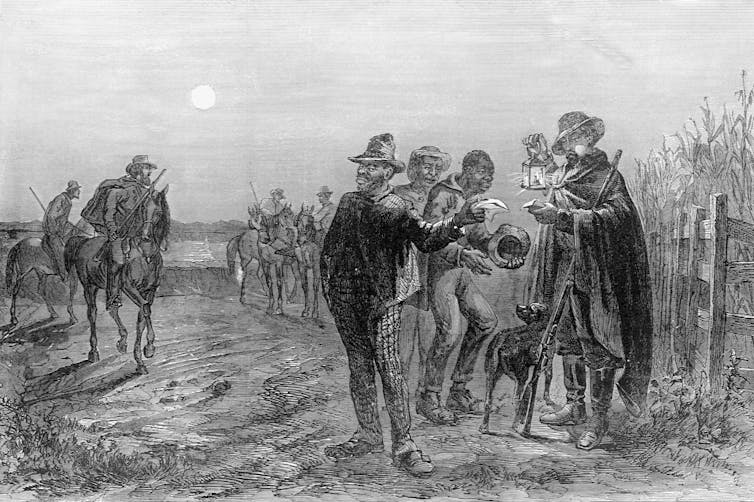
When watchmen did take action, they often did so in problematic ways. In New England, that often involved enforcing the ethnic segregation between different neighborhoods. In the mid-1600s, the slave codes of the colonial American South declared that controlling the enslaved population was a matter of public responsibility – the “public” here being exclusively white men. Paid and volunteer militiamen were tasked with, as the author Kristian Williams has noted, “making regular patrols to catch runaways, prevent slave gatherings, search slave quarters … and generally intimidate the black population.”
Shopkeeper’s privilege and security guards
Today more than 18,000 local, state and federal agencies provide police services in the U.S. But citizen’s arrest lives on in the form of a national patchwork of statutes and common law doctrines.
Most states have “shopkeeper’s privilege” laws that provide a defense for business owners and employees who arrest someone for theft so long as they have probable cause. Resisting such an arrest is a crime in some states. Private security guards, similarly, may be authorized to make arrests, at least on the property they are hired to protect. And when bounty hunters capture someone who has jumped bail, the Supreme Court has said the arrest “is likened to the rearrest by the sheriff of an escaping prisoner.”
Those who are not a shopkeeper, security guard or bounty hunter may still be able to effect an arrest under more generic citizen’s arrest rules.
Citizen’s arrest rules are not the same as the legal rules that govern arrests by police officers. In some ways, private individuals have more limited authority to make arrests than officers.
In many states, for example, an officer can make arrests for offenses classified as misdemeanors – minor crimes typically punishable by up to a year in jail – but a private citizen cannot.
In other states, a private citizen may make an arrest only if they witness or have firsthand knowledge of an offense. This was the case in Georgia, at least with regard to misdemeanor crimes, until public pressure after Arbery’s death led to the 2021 repeal of the state’s citizen’s arrest statute. Under the laws in effect at the time, Arbery’s pursuers would only have been able to make a citizen’s arrest if they had probable cause to believe that he had committed a felony.
In a similar vein, some states only permit individuals to invoke “citizen’s arrest” as a defense to civil or criminal liability if the person they arrested actually committed an offense, while officers are protected if they had probable cause to believe that the person committed an offense (even if that belief was incorrect).
But in other ways, private actors have more authority than officers do. Perhaps most obviously, the constitutional rules that limit police authority to conduct searches, seizures, and interrogations do not apply when “a private party … commits the offending act.”
Citizens may have more authority to use force than law officers, too, depending on state law.
In South Carolina, a citizen can use deadly force to effect the nighttime arrest of someone who has any stolen property in their possession or, more problematically, someone who “flees when he is hailed” if the circumstances “raise just suspicion of his design to steal.”
If an officer in South Carolina did the same, he would likely run afoul of state law or the Fourth Amendment, which the Supreme Court has held requires probable cause “that the suspect poses a significant threat of death or serious physical injury.”
Race and status
No one knows how many citizen’s arrests occur in the U.S. every year because the police are usually called and an officer processes the arrest, leaving little evidence of private involvement.
We do know, however, that private arrest authority is too often badly misused by those who believe their higher social status gives them authority over someone they perceive as having lower status.
Frequently, this falls along racial lines, as seen in the detention of immigrants by militias at the U.S. border, the attitude of nightwatchmen in gated communities, and in situations like the Arbery case.
The three defendants say they chased Arbery because they believed he was behind neighborhood burglaries and allege they saw him trespass prior to the incident. Arbery, of course, had committed no crime; under Georgia’s “criminal trespass” law, entry onto “land or premises,” including a construction site, is only a crime when committed “with an unlawful purpose” or when there are posted “No Trespassing” signs. There is no evidence of either in this case.
And even if Arbery had committed a burglary, his death would have still been the result of an unjustified act of vigilantism. As the Supreme Court has said in the context of police uses of force, “It is not better that all felony suspects die than that they escape.” Remembering that as the U.S. considers reforming citizen’s arrest statutes may go a long way in preventing any further unnecessary deaths.
This is an updated version of an article originally published on May 29, 2020.
Seth W. Stoughton is an associate professor of law at the University of South Carolina.
This article is republished from The Conversation under a Creative Commons license. Read the original article.

The Road to 2024
Kari Lake, the frontrunner for the GOP gubernatorial nomination in Arizona after an endorsement by former President Trump, has called for the imprisonment of the state’s Secretary of State, Katie Hobbs, along with other election officials and various journalists over the 2020 election. Hobbs is also a leading Democratic candidate for governor. Arizona holds its next gubernatorial election in 2022 and the state will certainly be hotly contested in the 2024 presidential election.
Continue reading “The Road to 2024”RIP Colin Powell
We’re unspooling the news of Colin Powell’s death from COVID-19 complications here.
Jan. 6 Defendants Keep Trying To Be Their Own Lawyers
A lot of things happened. Here are some of the things.
Fool For A Client
At least five people who’ve been charged with storming the Capitol on Jan. 6 have insisted on representing themselves in their court cases, a strategy that doesn’t seem to working out super well for them so far.
- Alan Hostetter, the retired police chief-turned-yoga instructor who has been charged with conspiracy in the attack, told the judge that he wanted to represent himself due to what he called the “corruption of this investigation.”
- Pauline Bauer, a restaurant owner in Pennsylvania, has gotten sassy with the judge, at one point telling him that she doesn’t want “any lawyering from the bench,” according to the Associated Press.
- Brandon Fellows, a Pennsylvania man who happens to have the same judge as Bauer, U.S. District Judge Trevor McFadden, accidentally blabbed about new alleged felonies while he was speaking during his hearing last week.
Dems Troll Trump Over GOP Nominee Running Away From Him
The Democratic National Committee is pouncing on how Virginia gubernatorial candidate Glenn Youngkin, a Republican who’s been endorsed by Trump, has persistently kept Trump at an arm’s length as he tries to win over a state that roundly rejected the former president in both 2016 and 2020.
- The Democrats flew banners and parked billboards and signs near Trump’s Mar-A-Lago resort in West Palm Beach, Florida asking why Youngkin “won’t let” Trump campaign for him in Virginia:
BTW, you might remember that one way Youngkin tried to get the Trump stench off him in the gubernatorial race was by passing it on to Terry McAuliffe, his Democratic rival, with a “no, u” ad pointing out the Democrat’s ties to the ex-president.
Biden’s Climate Centerpiece Imperiled Thanks To Manchin
It looks like Sen. Joe Manchin (D-WV), an actual coal baron in his home state, might have won in his fierce opposition to President Joe Biden’s effort to replace coal and gas-powered plants with clean energy in the sweeping reconciliation plan.
- The program is likely to be cut from the bill, congressional source told the New York Times.
- West Virginia is exposed to more flood damage than any other state thanks to climate change, by the way.
Congress Back To Business This Week
The Senate’s back in session today, and the House is reconvening tomorrow.
Pro-Impeachment GOP Senator Has Low ’24 Expectations For Trump
Sen. Bill Cassidy (R-LA), one of the seven Republican senators who voted to convict Trump in the post-Jan. 6 impeachment trial, said during a pre-taped Axios interview that it’s not a given that the former president will have a red carpet rolled out in front of him in the 2024 primaries.
- “I don’t know that,” Cassidy interrupted when the Axios reporter, true to form, tried to whip out some conventional wisdom assuming that Trump would definitely win the presidential nomination.
- Cassidy noted that the GOP lost the Senate, House, and the presidency in four years under Trump’s watch. “Elections are about winning,” the Louisiana Republican said.
- Cassidy also claimed he won’t vote for Trump in the next election. “I’m not,” he told Axios.
Must-Read
“Strikes are sweeping the labor market as workers wield new leverage” – The Washington Post
? Morning Memo Radio ?
GOP Guv. Says Trump Needs To Give The Big Lie A Rest
Arkansas Gov. Asa Hutchinson (R) is pushing back against the ex-president’s demand that the GOP somehow “solve” the 2020 election that he definitely lost.
- “Relitigating 2020 is a recipe for disaster in 2022,” Hutchinson told “Meet the Press” on Sunday. “Let’s talk about the future. The election is past. It’s been certified.”
- Trump’s “comments” about election fraud “are not constructive,” the Republican governor also said.
Bill Clinton Released From Hospital
The former president was discharged from UC Irvine Medical Center in Orange, California on Sunday, according to Dr. Alpesh Amin, the chairman of the Department of Medicine at the University of California, Irvine.
- Clinton’s fever and white blood cell count “are normalized,” Amin announced, and “he will return to New York to finish his course of antibiotics.”
- Clinton was admitted to the hospital to be treated for a “non-Covid-related infection” on Tuesday, according to his spokesperson, Angel Ureña.
Jan. 6 Insurrectionist Who Attacked Cop Calls Himself ‘Piece Of Shit’
Daniel “D.J.” Rodriguez, the insurrectionist who allegedly shocked Metropolitan Police officer Michael Fanone with a cattle prod during the Capitol attack, self-flagellated several times during his interview with the FBI.
- The interview transcript obtained by the HuffPost also showed one of the FBI officials giving a weirdly Fox News-esque view of the insurrectionist’s predicament. “Danny gets to choose if he writes a story today with us. But right now, the story that’s being told is by D.C. ― is by antifa, BLM, and the Huffington Post,” the official said.
Do you like Morning Memo? Let us know!