One week ago, people across Ukraine were living their normal lives. Going to work, cooking meals at home, seeing friends, planning for the future.
Now, people are trying to survive — either by fighting the war, sending relatives or themselves to the nearest border, or sticking it out in long-unused bomb shelters or metro stations.
But so far, the country’s army and its volunteer territorial defense battalions have stuck it out, apparently repelling the first wave of Russia’s attack. The country’s capital Kyiv remains under government control, as does Kharkiv — Ukraine’s second city and a former capital.
The U.S., EU and other nations have ratcheted up sanctions on the Russian economy, cutting multiple Russia banks off from SWIFT access and pressuring Switzerland into clamping down on oligarch wealth.
European nations — some non-NATO — have also committed to steady weapons supplies to Ukraine. Former Warsaw Bloc nations reportedly are sending operable Soviet-era fighter jets to Ukraine.
It’s a devastating war with civilians and soldiers dying every day. Russian troops occupied Berdyansk over the weekend, a city of 100,000.
I wanted to address a few points that have come up in discussions about the Ukraine Crisis in recent days and which John mentions below. I’ll start with the question of U.S. intelligence estimates about an imminent Russian invasion which appear to have been very accurate both in the overall prediction and the specifics of how one would take place.
I’ve seen a number of people say this was a surprise or at least not a given because of the intelligence failure that preceded the invasion of Iraq in 2003.
The Supreme Court is hearing arguments Monday morning in West Virginia v. EPA, where red states and coal companies are asking the Court to dramatically limit the agency’s ability to regulate greenhouse gas emissions.
Legal experts were stunned that the Court took up this case in the first place, since both agency rules in question, one from the Obama administration and its replacement from the Trump EPA, are no longer operational. The Biden administration asked the Court not to take up the case over the defunct rules, saying that it’s working on a replacement that will likely inspire more litigation then anyway.
The Court didn’t listen. That struck court watchers as ominous, perhaps signaling that the conservative justices are too eager to curtail the EPA’s power to wait.
I made several mistakes in judging the conflict with Russia over Ukraine. In so far as others may have made similar errors, it may be worth saying what these are, and what I think is still valid in my earlier criticisms of the U.S. policy. These observations bear on what is valid and not in the foreign policy outlook called realism.
Amid conservatives’ ham-fisted attempts to blame Russian leader Vladimir Putin’s invasion of Ukraine on American “wokeness,” Rep. Clay Higgins (R-LA) apparently tried to make the same point in the form of an inscrutable rant via Twitter on Sunday.
A number of you have asked me, where’s President Biden? Why aren’t we seeing him on TV? Note that he has a State of the Union address coming up which will provide an extremely high profile setting. But the real reason is almost certainly that the U.S. administration wants to have Europeans taking the most visible role announcing new sets of sanctions. I suspect they also want to avoid taking the bait of President Putin’s nuclear saber-rattling. Reports suggest that — wisely and unsurprisingly — President Biden has chosen not to match Russia’s nuclear forces alert status. First, there’s no need to. Our strategic nuclear forces are already on plenty of alert to manage the unthinkable. There’s no need for that kind of tit for tat escalation. We also don’t need competing press availabilities.
With all this said, though, there’s clearly something more happening here than just allowing Europe to take the lead in announcing measures the U.S. was trying to persuade them to take. There’s also clearly a sea change, both in the willingness to contemplate crippling economic sanctions as well as to openly arm the Ukrainian army.
This article is part of TPM Cafe, TPM’s home for opinion and news analysis. It was first published by The Conversation.
Russian President Vladimir Putin justifies his war on Ukraine as a peacekeeping mission, a “denazification” of the country.
In his address to the Russian people on Feb. 24, 2022, Putin said the purpose was to “protect people” who had been “subjected to bullying and genocide … for the last eight years. And for this we will strive for the demilitarization and denazification of Ukraine.”
The victims of the genocide claimed by Putin are Russian speakers; the Nazis he referenced are the elected representatives of the Ukrainian people. While Ukraine’s new language laws have upset some minorities, independent news media have uncovered no evidence of genocide against Russian speakers. In fact, as the historian Timothy Snyder has pointed out, Russian speakers have more freedom in Ukraine than they have in Russia, where Putin’s authoritarian government routinely suppresses political dissent. And while far right groups have been growing in Ukraine, their electoral power is limited.
As the author of a recently published book on anti-Jewish violence in Ukraine and a historian of the Holocaust, I know why the accusations of Nazism and genocide have resonance in Ukraine. But I also understand that despite episodic violence, Ukrainian history offers a model of tolerance and democratic government.
Ukraine’s Jewish leadership
First, it is worth pointing out that Ukraine today is a vibrant, pluralistic democracy. Ukrainian President Volodymyr Zelensky won a five-year term in the 2019 presidential election with a landslide majority, defeating 39 candidates. His Servant of the People party then swept the parliamentary elections in July 2019, winning 254 seats in the 450-seat chamber, becoming the first majority government in the history of the modern Ukrainian state. Zelensky was well-known as a comedian and star of the popular sitcom “Servant of the People,” from which his party’s name was derived.
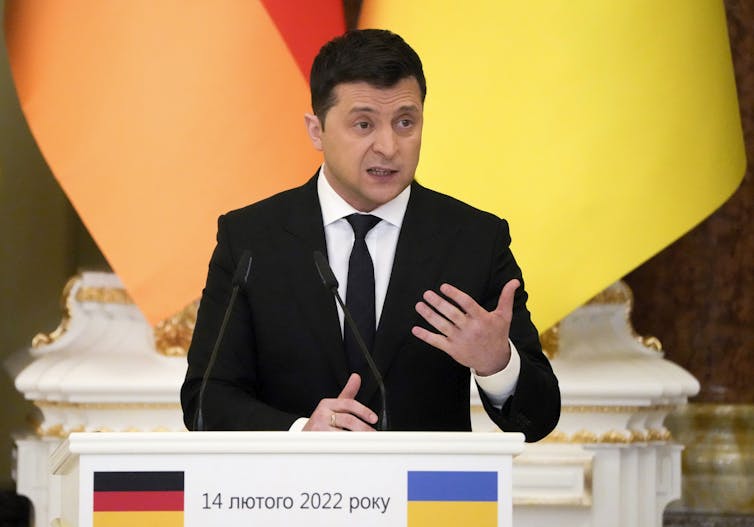
Ukrainian President Volodymyr Zelensky speaking at a news conference. AP Photo/Efrem Lukatsky
The fact that Zelensky is the grandson of a Holocaust survivor and was raised in what he told The Times of Israel was “an ordinary Soviet Jewish family” was barely noted during the election. “Nobody cares. Nobody asks about it,” he remarked in the same interview. Nor did Ukrainians seem to mind that the prime minister at the time of Zelensky’s election, Volodymyr Groysman, also had a Jewish background.
For a brief period of time, Ukraine was the only state outside of Israel to have both a Jewish head of state and a Jewish head of government. “How could I be a Nazi?” Zelensky asked in a public address after the Russian invasion began. “Explain it to my grandfather.”
The pogroms against Jews
Sporadic episodes of violence against Jews, or pogroms, began well before the Holocaust. In 1881, for instance, after the assassination of Tsar Alexander II, ordinary churchgoers, laborers, railway workers and soldiers attacked Jewish-owned shops, mills and canteens, resulting in the deaths of dozens of Jews in what was then considered the south of Russia, but is now Ukraine. During another wave of violence following the Revolution of 1905, workers, peasants and soldiers, egged on by Russian right-wing paramilitary groups, murdered 5,000 Jews in the region.
During the unrest that followed the Bolshevik Revolution of 1917, about 100,000 Jews died as a result of attacks perpetrated against them by soldiers fighting to restore a united Russia, as well as by the armies of the newly established Ukrainian and Polish states.
Finally, during the Second World War, German soldiers murdered 1.5 million Jews in the areas that are now Ukraine, often with the collaboration of Ukrainian militias established in the diaspora and with the help of local auxiliary police. The role of ethnic Ukrainians in the Holocaust remains contentious in Ukraine today, where nationalist heroes who collaborated with the Nazis continue to be honored.
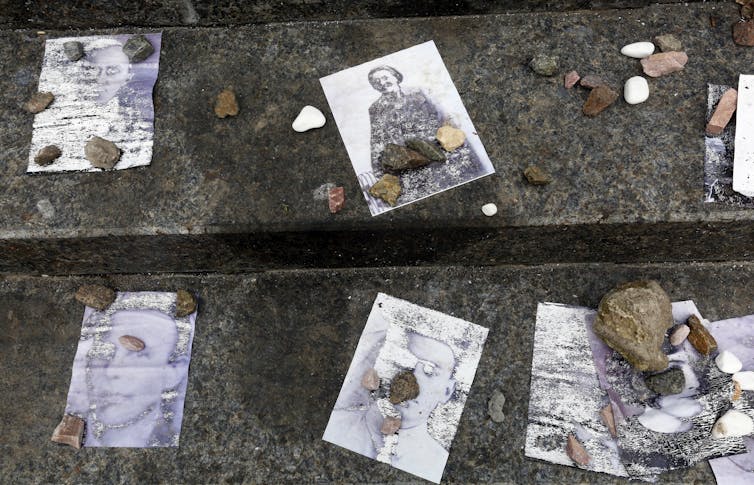
Small stones placed on the photos of victims of the 1941 massacre where the Nazi killed tens of thousands of Jews during WWII, in Kyiv, Ukraine. AP Photo/Efrem Lukatsky
Yet at the same time, millions of non-Jewish Ukrainians lost their lives under the Nazis or were exploited as slave laborers. The occupiers treated Ukrainian lands as little more than Lebensraum, living space for ethnic Germans.
A pluralistic state
Forgotten in this history is the period between 1917 and 1919 when an independent Ukrainian state offered a different model of multiculturalism and pluralism. The Ukrainian state that declared its independence from Russia in the aftermath of the 1917 Revolutions, envisioned a Ukraine for all ethnicities and religious groups living within its territory.
One of its first acts was passing the Law on National Autonomy in January 1918, which allowed each of the major ethnic minority groups – Russians, Jews, and Poles – broad autonomous rights, including the right to use their own language.
The cabinet included a Secretariat of National Affairs, with vice-secretariats for Russians, Jews and Poles, and, briefly in 1919, even a Ministry of Jewish Affairs. The legislative body, as well, included proportional representation from each of the national minorities. The state issued declarations and currency printed in four languages: Ukrainian, Russian, Polish and Yiddish.
However, this state, hailed by Jews around the world as a model for the new nation states then emerging in eastern and central Europe, never managed to hold the capital for more than a few months at a time. By April of 1919, the government was being run from a moving train and could barely claim more land than the tracks beneath it.
From its inauguration in January 1918, Ukraine found itself enmeshed in a bloody war on multiple fronts. The Soviet Red Army attacked it from the east, while Moscow sought to ignite Bolshevik revolutions throughout Ukraine. A Russian White Army led by officers from the old tsarist army attacked from the south, hoping to reestablish a version of the Russian Empire. From the west, the army of the newly established Polish Republic attacked with the goal of restoring historic Poland’s borders.
At the same time, a range of insurgent fighters and anarchists formed militias to seize land for themselves. In the midst of this chaos, the dream of a pluralistic state devolved into inter-ethnic violence.
In March 1921, the war ended with the Treaty of Riga, incorporating much of the territory claimed by the independent Ukrainian state into the Soviet Union.
Putin’s selective telling of the past exaggerates the legacy of Nazism in Ukraine while ignoring the state’s historic struggle for pluralism and democracy. There is a good reason for this: he fears democracy more than he fears Nazism.