

A leader of the neo-Nazi group Atomwaffen was sentenced to 84 months in prison on Tuesday over the group’s threat and intimidation campaign against reporters and Anti-Defamation League staff, according to the Justice Department.
Continue reading “Neo-Nazi Leader Slapped With 7-Year Sentence For Threatening Journos And Anti-Semitism Group”Ahmaud Arbery’s Murder Showed ‘Southern Hospitality’ Doesn’t Always Apply To Black People
This article is part of TPM Cafe, TPM’s home for opinion and news analysis. It first appeared at The Conversation.
The idea of community and who belongs and who does not was a common theme in the Jan. 7, 2022, sentencing hearing of three white men convicted of killing Ahmaud Arbery.
“They chose to target my son because they didn’t want him in their community,” said Arbery’s mother, Wanda Cooper-Jones, during the hearing. “When they couldn’t sufficiently scare him or intimidate him, they killed him.”
Arbery was the 25-year-old unarmed Black man who was shot to death on Feb. 23, 2020, while jogging through a predominantly white, middle-class neighborhood in Brunswick, Georgia. Race went largely unspoken throughout the trial, but the idea of belonging was clearly drawn in black and white.
Continue reading “Ahmaud Arbery’s Murder Showed ‘Southern Hospitality’ Doesn’t Always Apply To Black People”Trump Takes A Not-So-Subtle Shot At ‘Gutless’ GOPers Who Won’t Say Whether They Got Boosters
Former President Donald Trump swiped at certain unnamed politicians on Tuesday for not revealing their COVID-19 vaccine booster status.
Continue reading “Trump Takes A Not-So-Subtle Shot At ‘Gutless’ GOPers Who Won’t Say Whether They Got Boosters”A 21st-Century Reinvention Of The Electric Grid Is Crucial For Solving The Climate Change Crisis
This article is part of TPM Cafe, TPM’s home for opinion and news analysis. It first appeared at The Conversation.
In the summer of 1988, scientist James Hansen testified to Congress that carbon dioxide from burning fossil fuels was dangerously warming the planet. Scientific meetings were held, voluminous reports were written, and national pledges were made, but because fossil fuels were comparatively cheap, little concrete action was taken to reduce carbon emissions.
Then, beginning around 2009, first wind turbines and then solar photovoltaic panels decreased enough in cost to become competitive in electricity markets. More installations resulted in more “learning curve” cost reductions – the decrease in cost with every doubling of deployment. Since 2009, the prices of wind and solar power have decreased by an astonishing 72% and 90%, respectively, and they are now the cheapest electricity sources – although some challenges still exist.
With the planet facing increasingly intense heat waves, drought, wildfires and storms, a path to tackle the climate crisis became clear: Transition the electric grid to carbon-free wind and solar and convert most other fossil fuel users in transportation, buildings and industry to electricity.
The U.S. is headed in that direction. Early projections suggest the world just wrapped up a record year of renewable electricity growth in 2021, following a record 33,500 megawatts of solar and wind electricity installed in the U.S. in 2020, according to BloombergNEF data. Even faster growth is expected ahead, especially given the Biden administration’s plans to tap high-value offshore wind resources. But will it be fast enough?
The Biden administration’s goal is to have a carbon emissions-free grid by 2035. One recent study found that the U.S. will need to nearly triple its 2020 growth rate for the grid to be 80% powered by clean energy by 2030. (As difficult as that may sound, China reportedly installed 120,000 megawatts of wind and solar in 2020.)
The foundation of this transition is a dramatic change in the electric grid itself.

3 ways to bring wind and solar into the grid
Hailed as the greatest invention of the 20th century, our now-aging grid was based on fundamental concepts that made sense at the time it was developed. The original foundation was a combination of “base load” coal plants that operated 24 hours a day and large-scale hydropower.
Beginning in 1958, these were augmented by nuclear power plants, which have operated nearly continuously to pay off their large capital investments. Unlike coal and nuclear, solar and wind are variable; they provide power only when the sun and wind are available.
Converting to a 21st-century grid that is increasingly based on variable resources requires a completely new way of thinking. New sources of flexibility – the ability to keep supply and demand in balance over all time scales – are essential to enable this transition.
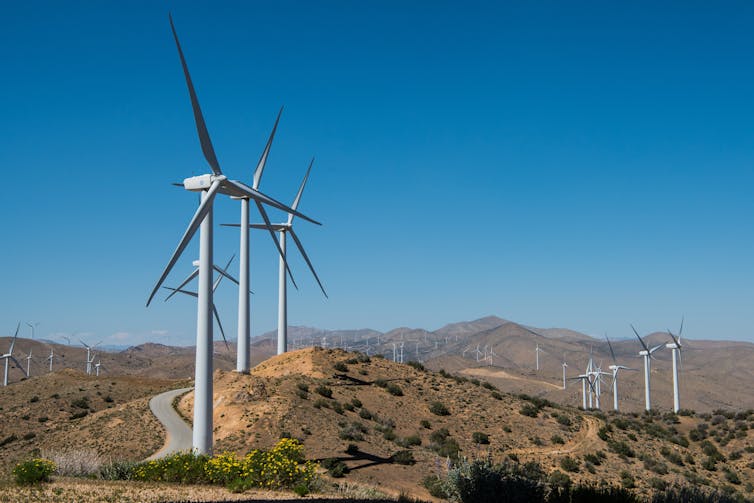
There are basically three ways to accommodate the variability of wind and solar energy: use storage, deploy generation in a coordinated fashion across a wide area of the country along with more transmission, and manage electricity demand to better match the supply. These are all sources of flexibility.
Storage is now largely being provided by lithium-ion batteries. Their costs have plummeted, and new storage technologies are being developed.
Expanded transmission is especially valuable. When the Northeast is experiencing peak electric demand in the early evening, there is still sun in the West. And, with more transmission, the large wind resources in the center of the country can send electricity toward both coasts. Transmission studies have shown that stronger interconnections among the country’s three power grids are highly beneficial.
Making buildings more efficient and controlling their demand can also play a big role in cleaning up the grid. Buildings use 74% of U.S. electricity. Interconnected devices and equipment with smart meters can reduce and reshape a building’s power use.
Innovations that make 100% clean power possible
Many analysts believe the U.S. can cost-effectively and reliably operate a power grid with 80% to 90% clean electricity, but decarbonizing the last 10% to 20% will be notably more challenging. While short-duration storage, lasting four hours or less, is becoming ubiquitous, we will likely need to provide power during some periods when wind and solar resources are at low levels (what the Germans call dunkelflaute, or “dark doldrums”). An expanded national transmission network will help, but some amount of long-duration storage will likely be needed.
Numerous options are being explored, including alternative battery technologies and green hydrogen.
Flow batteries are among the promising approaches that we are working on at the Renewable and Sustainable Energy Institute at the University of Colorado. In a typical design, liquid electrolyte flows between two storage tanks separated by a membrane. The tanks can be scaled up in size corresponding to the desired storage duration.
Green hydrogen is a potential storage option for very long durations. It is produced by splitting water molecules with an electrolyzer powered by renewable electricity. The hydrogen can be stored underground (or in above-ground tanks) and either burned in combustion turbines or converted back to electricity in fuel cells. Green hydrogen is currently very expensive but is expected to become more affordable as the cost of electrolyzers decreases.
In addition, new business, market design and grid operator models are emerging. Community solar gardens, for example, allow homeowners to purchase locally produced solar electricity even if their own roofs are not suitable for solar panels. Microgrids are another business model becoming common on campuses and complexes that produce electricity locally and can continue to operate if the grid goes down. Clean microgrids are powered by renewable energy and batteries.
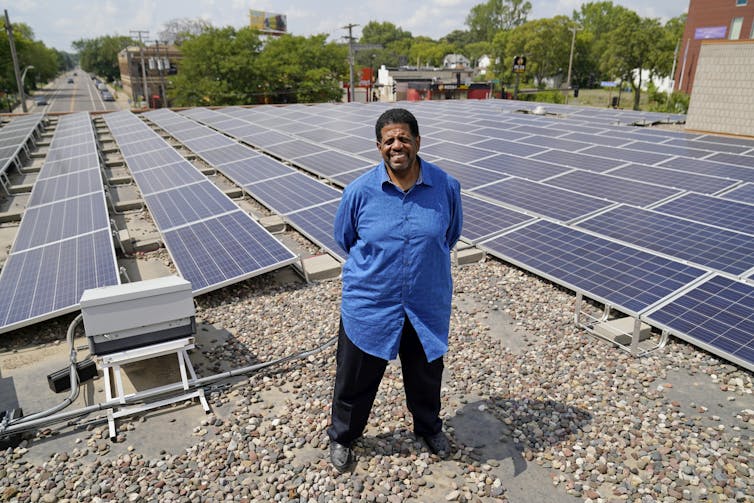
Innovative market designs include time-of-use rates that encourage electricity use, such as for charging electric vehicles, when renewable electricity is plentiful. Expanded balancing area coordination draws on variable solar and wind resources from a wide region to provide a smoother overall supply. Improved grid operations include advanced forecasting of wind and solar to minimize wasted power and reduce the need for costly standby reserves. Dynamic line rating allows grid operators to transmit more electricity through existing lines when favorable weather conditions permit.
Across the economy, greater attention to energy efficiency can enable power sector transformation, minimizing costs and improving reliability.
Nuclear power is also essentially carbon-free, and keeping existing nuclear plants running can make the transition to renewables easier. However, new nuclear plants in the U.S. are very expensive to build, have long construction times and may prove too costly to operate in a manner that would help firm variable solar and wind.
In our view, the urgency of climate change demands an all-out effort to address it. Having a 2035 emissions goal is important, but the emissions reduction path the U.S. takes to reach that goal is critical. The No. 1 need is to minimize adding carbon dioxide and other greenhouse gases to the atmosphere. The world already has the tools to get the grid 80% to 90% carbon-free, and technical experts are exploring a wide range of promising options for achieving that last 10% to 20%.
Charles F. Kutscher is a fellow and senior research associate at the Renewable & Sustainable Energy Institute of the University of Colorado Boulder.
Jeffrey Logan is the associate director of energy policy and analysis at the Renewable & Sustainable Energy Institute of the University of Colorado Boulder.
This article is republished from The Conversation under a Creative Commons license. Read the original article.

A GOP Sen Hopeful Hyped Some Kind Of Fake Anti-COVID Spray
A lot of things happened. Here are some of the things.
Moonlighting Snake Oil Salesman
Republican Georgia Senate candidate Herschel Walker peddled a “dry mist” and “spray” that he claimed would “kill any COVID on your body” during a Glenn Beck interview last year, per the Daily Beast.
- Whatever this is, it doesn’t exist, and it’s definitely not “EPA-, FDA-approved,” as he claimed.
- You just haven’t heard of it because conspiracy or something. “They don’t want to talk about that. They don’t want to hear about that,” the candidate insisted.
- Walker has refused to say if he’s gotten the COVID-19 vaccine.
A Reckoning On Voting Rights In Senate — Potentially As Soon As Today?
Senate Majority Leader Chuck Schumer (D-NY) announced on Tuesday that voting rights legislation will be brought to a vote on the Senate floor “as soon as today,” a day after Biden’s remarks on changing the filibuster for the legislation.
- But it’s unclear what the exact plan is, given that — at least as far as we know! — he still doesn’t have the votes needed from Sens. Joe Manchin (D-WV) and Kyrsten Sinema (D-AZ) to make any changes to the filibuster.
Congressional Staff Asked DOJ For Security Plans Ahead Of Jan. 6
Before the Jan. 6 Capitol insurrection, staffers from at least two House and Senate committees went to the FBI and the Justice Department previewing threats and pleading for heightened safety that day, according to emails obtained by Buzzfeed News.
Texas Sheriff Allegedly Shook Down Migrants
Check out the crime in the migrant community: A rural Texas sheriff is under criminal investigation for allegedly ordering his deputies to take money from undocumented immigrants during traffic stops on the regular, even if they hadn’t committed any state crimes, per the Texas Tribune. He would then allegedly have them handed over to U.S. Border Patrol.
- The sheriff has admitted to this scheme, according to investigators.
- He declared via Facebook that he was against “illegal alien traffic in our community” in December (after his offices were raided).
Biden Admin Greenlights More Gitmo Releases
Five more detainees at Guantánamo Bay were approved for release, the Pentagon disclosed yesterday on the 20th anniversary of the notorious prison’s opening.
In Case You Missed Biden’s Push For Filibuster Reform
We did a liveblog on Biden’s speech and reactions to his remarks in Atlanta, Georgia on voting rights and the filibuster. Check it out.
Basically Everyone’s Going To Get COVID, Fauci And FDA Head Warn
Strap in, folks: Infectious diseases expert Dr. Anthony Fauci said yesterday that “just about everybody” is going to catch the coronavirus thanks to the Omicron variant.
- Acting commissioner of the Food and Drug Administration Janet Woodcock echoed Fauci’s warning, saying that “most people are going to get COVID.”
- But infected people who’ve been vaccinated will “very likely, with some exceptions, do reasonably well,” Fauci said.
Fauci Calls GOPer A Moron LOL
Fauci has just about had it with Republican senators who use his committee hearings to showboat, peddle COVID-19 conspiracy theories or otherwise try to out-grift each other by repeatedly attacking him and using the gambit as a fundraising tactic:
Trump Abandons NPR Interview In A Huff
NPR host Steve Inskeep announced an interview with Trump yesterday that Inskeep said he’s been seeking for six years, and teased that “we’ll hear what he said, up to the moment that he hung up on me.”
- NPR released that interview this morning, and it’s not really mind-blowing stuff. Trump lies about the 2020 election, Inskeep tries to stop him from lying, Trump steamrolls him as he keeps lying until the ex-president abruptly deserts the whole thing.
- “He’s gone. OK,” Inskeep remarks after Trump hangs up.
Labor Board Schedules Amazon Warehouse Union Election Do-Over
The National Labor Relations Board has set a timetable for a second union vote at the Amazon facility in Bessemer, Alabama after the board found that Amazon had meddled in the first election last year.
- Ballots will be mailed out on Feb. 14, the board announced.
- The vote count will begin on March 28.
Cher Speaks
Graphic Design Is My Passion
GOP Ohio Senate candidate and MAGA convert J.D. Vance would like to invite you to his statewide Nobs Tour next week:
Do you like Morning Memo? Let us know!
McConnell Gets Behind Rounds After Trump Attacks Him Over ‘Fair’ Election Remark
Senate Minority Leader Mitch McConnell (R-KY) on Tuesday joined other GOP senators who have rallied behind Sen. Mike Rounds (R-KS) after former President Trump attacked him for daring to factually state that the 2020 presidential election was “fair.”
Continue reading “McConnell Gets Behind Rounds After Trump Attacks Him Over ‘Fair’ Election Remark”Where Things Stand: ‘Grim Reaper’ Won’t Retire, Yet
Or so he says.
Senate Minority Leader Mitch McConnell (R-KY) told reporters today that he plans to run for majority leader again after the midterms, on the assumption that Republicans will be able to take back the upper chamber in November.
“I’m going to be running again for leader later this year,” he said, putting to rest rumors of his possible retirement, at least for the time being.
Continue reading “Where Things Stand: ‘Grim Reaper’ Won’t Retire, Yet”Biden Makes Voting Rights Pitch In Georgia To Keep Democrats’ Push Alive
President Joe Biden, flanked by Vice President Kamala Harris and a whole host of Georgia politicians, will deliver a speech Tuesday from the Peach State on the sacred importance of voting rights and the imperative to protect them with legislation.
“The next few days, when these bills come to a vote, will mark a turning point in this nation,” he will say, according to remarks provided to TPM. “Will we choose democracy over autocracy, light over shadow, justice over injustice? I know where I stand. I will not yield. I will not flinch. I will defend your right to vote and our democracy against all enemies foreign and domestic.”
“And so the question is,” he’ll ask, “where will the institution of United States Senate stand?”
Man At Center Of ‘Fedsurrection’ Conspiracy Theory Says He’s Never Been An Informant
The man at the center of feverish right-wing speculation that Jan. 6 was secretly engineered by federal agents denied that he has ever been a federal informant.
Continue reading “Man At Center Of ‘Fedsurrection’ Conspiracy Theory Says He’s Never Been An Informant”Jan. 6 Panel Subpoenas More Trump-World Operatives, Revealing Deepening Investigation
The Jan. 6 Committee issued subpoenas on Tuesday to three people purportedly involved in discussions with Trump administration officials and rally planners on Jan. 6.
Continue reading “Jan. 6 Panel Subpoenas More Trump-World Operatives, Revealing Deepening Investigation”