A lot of things happened. Here are some of the things. This is TPM’s Morning Memo.
Hawlin’ Ass
Look, the events of Jan. 6 were horrific and absolutely must be taken seriously for the sake of preserving American democracy, but during its hearing last night, the House Jan. 6 Committee unveiled security footage of fist-pumper Sen. Josh Hawley (R-MO) scampering away from the insurrectionists as they ransacked the Capitol, and it was a truly incredible sight to behold:
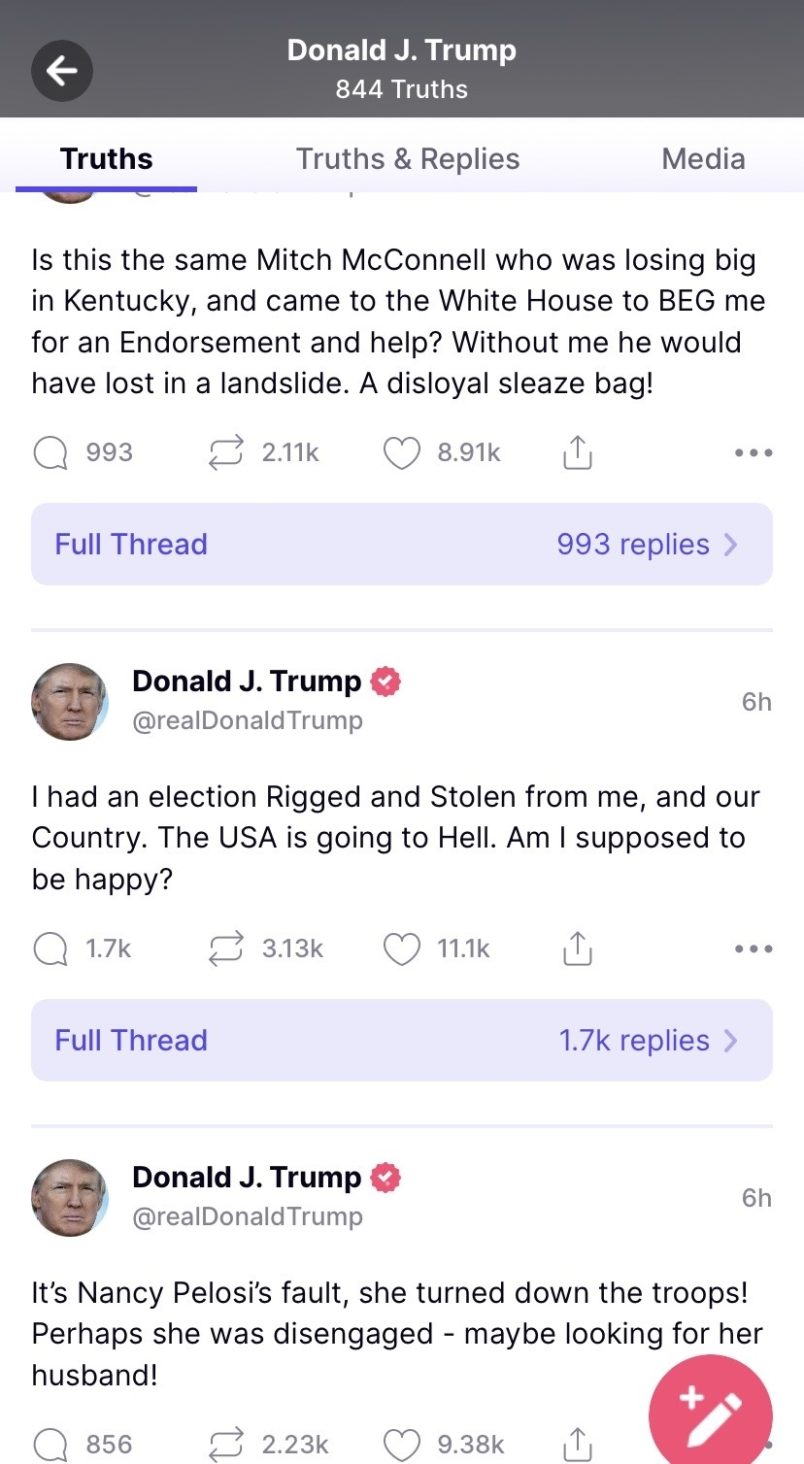
Naturally there’ve been more rants since the ones Aaron Rupar showed in his video:
(Screenshot: TRUTH Social)
Catching Up On Our Hearing Coverage
The House Jan. 6 Committee’s hearing last night aired during primetime, so we stayed up until midnight so you didn’t have to to get y’all caught up on how the session unfolded:
One particularly disturbing moment during the hearing came when the committee presented a White House security official’s testimony and audio recordings of the Secret Service’s fearful radio exchanges during the Capitol attack as then-Vice President Mike Pence was being whisked away to safety from the mob.
Trump’s Pouring Big $$$ Into Legal Fees For Jan. 6 Witnesses
Trump is getting close to spending $2 million from his political committees on legal expenses for witnesses who’ve been testifying in front of the House Jan. 6 Committee, according to new FEC filings reported by the Daily Beast.
Trump’s Already Crafting Plot To Fully Control Federal Government
Axios has a shocking report laying out a detailed plan Trump and his cronies are currently hammering out in which the ex-president, if reelected to the White House, would expel what could be thousands of career employees in the federal government to replace them with MAGA loyalists.
GOP NY Guv Nominee Zeldin Attacked During Campaign Event
Rep. Lee Zeldin (R-NY), who’s running to replace incumbent New York Gov. Kathy Hochul (D), was attacked in the middle of a stump speech on Thursday by a man Zeldin said was wielding a knife. Reports vary on whether the man was carrying a knife or some kind of pointed object. The county sheriff’s office reported that the attacker was taken into custody, and Zeldin’s campaign announced later that the Republican was not injured.
The House on Thursday approved the Right To Contraception Act, legislation that would enshrine the right to obtain contraception into federal law, by a 228-195 vote, with all Democrats and eight Republicans voting “yes.”
The GOP votes came from:
Liz Cheney (R-WY)
Adam Kinzinger (R-IL)
Brian Fitzpatrick (R-PA)
Anthony Gonzalez (R-OH)
John Katko (R-NY)
Nancy Mace (R-SC)
Maria Salazar (R-FL)
Fred Upton (R-MI)
Two Republicans voted “present”:
Bob Gibbs (R-OH)
Mike Kelly (R-PA)
Sens. Ed Markey (D-MA), Mazie Hirono (D-HI) and Tammy Duckworth (D-IL) have already introduced the Senate version of the bill. We don’t know yet if it has enough support to make it past the filibuster, though.
5 GOP Sens Support Marriage Equality Bill
Sen. Ron Johnson (R-WI) said on Thursday that though he felt the bill aimed at codifying marriage equality into law, aka the Respect for Marriage Act, was “unnecessary,” he would “see no reason to oppose it” if it was put to a vote in the Senate.
Johnson’s announcement means Democrats are halfway toward overcoming the filibuster to pass the bill. Sens. Rob Portman (R-OH), Susan Collins (R-ME), Lisa Murkowski (R-AK) and Thom Tillis (R-NC) have already said they support or are likely to support it.
Biden Tests Positive For COVID
White House press secretary Karine Jean-Pierre announced on Thursday that the President had tested positive for COVID-19 earlier that day and had only mild symptoms. The press secretary also promised to give daily updates on Biden’s health status “out of an abundance of transparency,” and one can’t help but wonder if that promise was prompted by Trump’s notorious attempt to cover up his COVID diagnosis.
Biden put out a video a short while later saying he was “doing well”:
Outgoing GOP Maryland Guv Won’t Back GOP Nominee As His Replacement
In case you missed it: Term-limited Maryland Gov. Larry Hogan (R) won’t support Dan Cox, a hardcore MAGA election denier who won the GOP’s gubernatorial primary in Maryland on Tuesday, according to Hogan’s spokesperson. (And more than just being an election denier, Cox also chartered buses to go to the D.C. Trump rally on Jan. 6)
Italy’s PM Resigns
Italian Prime Minister Mario Draghi resigned on Thursday, triggering a snap election that will be held on Sept. 25.
Trump Lawyer Allegedly Had Racist Meltdown About NY AG
According to a new lawsuit filed against her, Trump defense lawyer Alina Habba allegedly screamed “I hate that Black bitch!” in her office after New York Attorney General Letitia James (D), who is Black, successfully convinced a judge to hold Trump in contempt in April. The allegation is included in a lawsuit against Habba filed by a Black former assistant who accused the Trump lawyer of a bunch of racist behavior in the workplace.
The Jan. 6 Committee on Thursday used radio traffic and the account of a White House security official to illustrate just how close of a call things were for Mike Pence — and for his Secret Service agents — during the heart of the attack.
Thursday’s hearing, initially billed as the prime-time season finale to the summer slate of Jan. 6 committee hearings, will focus on what then-President Donald Trump did and didn’t do as the insurrection unfurled.
A new episode of The Josh Marshall Podcast is live! This week, Josh and Kate discuss a bill to codify the right to same-sex marriage, Joe Manchin’s latest antics and the possible last Jan. 6 hearing.
You can listen to the new episode of The Josh Marshall Podcast here.
Eighteen months after the Jan. 6 attack on Congress, a bipartisan group of senators released a proposal Wednesday to help prevent future election theft attempts, and pro-democracy groups and experts are rallying around the legislation.
The Secret Service text destruction story has been a sort of slow burn. As Kate Riga and I discussed in the new podcast episode, I think this is due to the fact that a lot of people in government and media are having a hard time making sense of the story. They keep wanting to hear more because the current facts don’t make any sense. More to the point, both the guilty and the innocent versions of events seem equally absurd. Is it really possible that the Secret Service would purge its records of Jan. 5th and 6th and somehow not think anyone would notice or care? It seems too over-the-top and brazen even for some of the most cynical of observers. At the same time, the Secret Service’s explanation seems even more absurd. Let’s take a moment to walk through what that story is.
During its hearing on Thursday night, the House Jan. 6 Committee will present clips of then-President Donald Trump having a hard time sticking to the script while taping his address on Jan. 7 decrying the Capitol insurrection.
This article first appeared at ProPublica. ProPublica is a Pulitzer Prize-winning investigative newsroom. Sign up for The Big Story newsletter to receive stories like this one in your inbox.
His last night as a prisoner in North Florida, Kelvin Bolton couldn’t sleep. Fifty-five years old, with a wispy goatee the same color as the gray flecks in his hair, he was about to get out after serving a 2 1/2-year sentence for theft and battery. The last time he’d seen his brothers and sisters at a big family gathering, he’d marched onto the dance floor ostentatiously, turned away and wrapped his arms around himself to caress his own back. As he swayed goofily to the music, everybody laughed.
Now Bolton was so close to being free and seeing his family again. The next morning, a bright Wednesday in April, he was already dressed in his street clothes and cleared to go when the woman processing his paperwork stopped him.
“The lady said, ‘Hold on, you can’t go anywhere,’” Bolton remembered in a recent phone call.
Confused, he asked her what was going on, he recalled. There was a warrant out for his arrest for incidents in 2020, she explained gruffly. But that was impossible. He’d been in jail at the time, awaiting his prison stint.
Guards loaded Bolton into a van, then drove an hour and a half south to deposit him in Alachua County Jail.
There, he found out what he’d done wrong.
He’d voted.
In 2018, Florida voters overwhelmingly passed Amendment 4, in a historic ballot initiative that restored the right to vote to most state residents with felony convictions. Until then, Florida had been one of only four states — the others were Iowa, Kentucky and Virginia — where people who had committed felonies needed to petition the governor to have their voting rights restored. It was a grim legacy of 19th-century laws passed after the 15th Amendment granted African American men the right to vote.
Supporters applauded the law as restoring voting rights to what experts estimate is over 1 million people in Florida, about 5% of the population of the state.
But the state’s dominant Republican lawmakers quickly installed a financial hurdle to those new rights. The following year, they passed a law to clarify that people convicted of felonies could only vote if they first paid off any money they owed for committing their crimes. The penalty for registering or voting without doing so: a felony charge for voter fraud.
On the surface, the mandate seemed reasonable: Even advocates for Amendment 4 agreed that requiring paying off fines and restitution to victims was just. In Florida, however, that task proved a sometimes insurmountable challenge — one that disproportionately hit Black people. Florida has no centralized database to allow people to figure out what legal financial obligations they owe to the state. Instead, its 67 counties and various state agencies each maintain their own databases. The state also does not track information for federal or out-of-state convictions, which people are also required to pay off before voting.
On top of the fines and restitution, Florida layers on court fees that can run into the hundreds of dollars. Together, a voter’s debt can run into the thousands, a financial hole that some may never climb out of.
“That’s kind of the bottom line of the absurdity of this — it’s Kafkaesque,” said Dan Smith, chair of the political science department at the University of Florida. “It’s very troubling that we would have state attorneys prosecuting individuals who did not know their status, and there was no way for them to determine their status.”
Florida’s voting hurdles are part of a national pattern. For years across the country, Republican state lawmakers have been implementing new restrictive voting laws, including reducing access to vote-by-mail ballots, stricter voter identification rules and limits on early voting. These efforts have accelerated since Donald Trump promoted the false claims that Joe Biden stole the 2020 presidential election. Democrats, meanwhile, have pushed to expand voting access.
Republican Gov. Ron DeSantis boasted that in 2020, Florida, a swing state with a history of contentious elections, “held the smoothest, most successful election of any state in the country,” while he also signed a flurry of voting law changes that he said would further strengthen the integrity of future votes. And DeSantis has tacitly endorsed prosecuting people convicted of felonies for voter fraud. In April, he signed a bill establishing the Office of Election Crimes and Security, which will investigate alleged election violations.
Despite the increased scrutiny, voting fraud remains so rare in Florida that it hasn’t come close to altering election outcomes. The Florida Department of State in 2020 received 262 election fraud complaints, just 75 of which were referred to law enforcement or prosecuting authorities, according to the agency.
“Florida is an outlier, because the intentional targeting of citizens with felony convictions as a way to undermine democracy has been a throughline in that state,” said Nicole Porter, senior director of advocacy for the Sentencing Project. “And the attempt to address that, by popular vote, has been undermined by the legislature.”
In 2020, a representative of the Alachua County Supervisor of Elections conducted a series of outreach efforts at the local county jail to let inmates know of their new rights and offer to help them add their names to the voter rolls.
During three visits to the jail, the official helped sign up at least 10 inmates, including John Boyd Rivers, Dedrick Baldwin and Bolton.
Rivers, 44, felt a visceral thrill at the prospect. Sitting in his cell in February 2020 facing a battery charge for hitting his wife, he was told by the county representative that he could register to vote. The official, he said, told him that he could disregard the check box on the form that asks whether the applicant has a felony conviction because he didn’t have a disqualifying felony. That seemed odd to Rivers, since he had a previous felony conviction. (He subsequently was sentenced for the battery charge.) No one told him anything about needing to pay off his financial obligations before registering to vote, Rivers said, and the jail didn’t give him an accounting of those debts when he was later released.
Back at home, Rivers was excited when his voter registration card arrived in the mail. He’d lost his right to vote at 18, he said, after voting just once. Now he could vote in a presidential election. He and his wife went to their polling place, and he cast his vote for Donald Trump.
Bolton, too, was excited to sign up. He also said no one told him he’d need to pay off his debts before casting his ballot. Although he registered as a Republican, he said he decided to vote for Biden.
In all, 10 of the men who the official helped register to vote have been charged with voter fraud on the grounds they were ineligible.
Their alleged illegal voting was first spotted by a citizen who analyzed Florida’s voting rolls and then shared the information with the state. The Florida Department of Law Enforcement subsequently launched an eight-month investigation, after which it identified the 10 inmates.
State investigators found that some jail employees remembered the elections official giving clear directions to inmates about having to pay off financial obligations, while others did not. The investigation concluded that the jail visits were “lacking in both quality and longevity” and “showed a haphazard registration of inmates.” But the state prosecutor nevertheless proceeded with charges, although not against county officials.
Officials at the Alachua Supervisor of Elections office declined to comment to ProPublica. But Supervisor of Elections Kim Barton denied any wrongdoing in a statement released in June.
Brian Kramer, the state attorney for the Eighth Judicial Circuit of Florida, defended his office’s prosecutions to ProPublica, saying he believed the 10 men knew they were committing fraud. “I’m not going to say I will prosecute or not prosecute because it’s politically popular or unpopular,” he said.
Four of the 10 have pleaded guilty and have been sentenced to between 364 days and three years in prison. Bolton and three others have vowed to go to trial, while the remaining two await arraignment. They face charges that carry a penalty of up to five years in prison, five years of probation or $5,000 in fines. Eight of the men are Black, and two are white.
Critics say the charges are unjust and, at a bare minimum, excessive. In nearby Lake County, the state prosecutor declined to bring charges against sex offenders who had registered to vote despite the law prohibiting voting rights restoration for those charged with sex offenses or murder. In April, two white men living in The Villages in Sumter County, an overwhelmingly white county in central Florida, pleaded guilty to each casting two ballots for Donald Trump during the 2020 election. Rather than face prosecution, they entered a pretrial intervention program, under which they must serve 50 hours of community service and attend an adult civics class, among other requirements. Because the men in Alachua County have prior felony convictions, they are ineligible for pretrial intervention and face harsher sentences.
“I’m thinking I’m doing something good for the community, so that’s why I chose to try to do it,” Bolton said. “It was not malicious — I was not trying to commit a felony of voting fraud. I never would have voted.”
Baldwin, 47, who is in prison on a manslaughter conviction, was sentenced to an additional 364 days. He felt “set up,” he said, since nobody told him he wasn’t eligible.
“There’s no way Biden was that important to me to vote for him,” he said in an email to ProPublica from prison. “We were flat out tricked into voting.”
The elections official who visited the jail denied telling the men that they could disregard the check box and said he warned them that they’d need to pay off their financial obligations, according to a person familiar with the matter who declined to be named because he feared reprisals. The elections official declined to comment to ProPublica on the record.
The voter fraud charges were especially bitter for Rivers. By the time they were filed, Rivers said, he had already used part of his federal stimulus check to pay off more than $3,000 in costs related to his criminal record so he could reinstate his driver’s license and return to work.
“I should have known there would be some kind of catch,” Rivers said.
Florida’s history of felon disenfranchisement dates back to 1838, when the state’s first constitution prohibited people convicted of bribery or assorted “high crimes and misdemeanors” from voting. After the Civil War, faced with the prospect of formerly enslaved Black men voting, the state expanded the law so that anyone convicted of a felony lost the franchise. But in 2018, 64% of Florida voters approved Amendment 4, allowing people convicted of felonies, except for murder or sexual offense convictions, to vote.
This embrace of new voters became more complicated the following year when the state legislature passed its law. It required that people convicted of felonies must determine their own eligibility before registering to vote. The Florida Department of Corrections and county detention facilities are required to provide notice to inmates at the time of their release of their outstanding financial obligations.
But it is unclear if all of the facilities do so.
Florida charges those convicted of crimes with an array of fines and fees, some of which statutorily cannot be eliminated or reduced. Defendants facing felony charges are assessed $100 to use a public defender, as well as a $100 prosecution fee. At least one person already sentenced in the Alachua County cases has been charged an additional $671 for his voting fraud charges on top of the financial obligations he already owed.
Finding out what someone owes is time-consuming and expensive. An analysis led by Traci Burch, a political science professor at Northwestern University, tried to determine the legal financial obligations owed by a random sample of 153 Florida residents convicted of felonies and found consistent information for only three of them. Counties often keep poor records, have cumbersome websites and employ unhelpful clerks.
What’s more, it can cost money merely to find out how much money you owe. Four in 10 Florida counties charged either a payment or processing fee to look at their databases, and 15% charged a fee to access certain records, according to Burch’s research.
In 2020, Smith, the Florida political scientist, estimated that just over 1 million people would be eligible to vote under Amendment 4. Of that number, about 77% had outstanding legal financial obligations, rendering them ineligible to vote under Florida’s new law until they paid their debts. Four out of five Floridians with felony convictions owed at least $500 in fines and fees, Smith’s analysis found. More than 59% owed more than $1,000.
The state legislature immediately disqualified about 750,000 people from being able to vote when it passed its law requiring people convicted of felonies to pay their debts first, Smith estimated. And the new law’s impact was felt much more harshly by Black people, who faced greater fines and fees: 26% of white Floridians with a felony conviction would be eligible to get their voting rights restored under the new requirement, but only 18% of Black people, according to Smith.
In May 2020, a district court judge ruled that parts of the law were unconstitutional and that the law had established a pay-to-vote system. The 11th Circuit Court of Appeals overturned the ruling the following September, saying it was in the state’s power to require the payoffs and the law didn’t violate people’s rights. The state Supreme Court has also issued an advisory opinion that deemed the law legitimate.
Unsurprisingly, the number of people with felony convictions who have registered to vote has fallen far short of what supporters hoped. More than 85,000 such people registered in Florida ahead of the 2020 election.
Supporters of the law say that it’s only fair to have people fulfill their full sentences, including paying any crime-related debts. Some state attorneys, including Kramer, the attorney prosecuting the Alachua cases, have also developed processes within their jurisdictions by which people with felony convictions can verify their voting eligibility or request to reduce their fines and fees.
Felons who have not yet registered to vote can also appeal to the state to have certain fees reduced or eliminated, said Republican State Sen. Jeff Brandes, the sponsor of the law demanding the payoffs before voting rights restoration.
“We truly believe there are people who are indigent that will just simply never be able to pay,” he said. “The court only collects a fraction of what is given out anyways. And so there should be a way for the state to grant some grace or for the court to grant some grace and provide people flexibility.”
Kelvin Bolton has been sitting in the Alachua Council Jail since April, waiting for his case to proceed.
He’s been in and out of the system since he was 16, piling up a long record of mostly nonviolent crimes, most recently for stealing a car, groping a woman in a store and taking cigarettes from a Dollar General.
He aims this time to keep a vow he made to his family and himself to stay straight. He said he is frustrated that the prosecutor subsequently created a program for people convicted of felonies to check their voting eligibility while he and the others are still facing charges.
“Why would they want to keep charging us for something that they’re in the wrong for?” he said. “The state is in the wrong for what they did to us.”