A lot of things happened. Here are some of the things. This is TPM’s Morning Memo.
‘It’s Not How White Men Fight’
What to make of the latest Tucker Carlson revelation, a Jan. 7, 2021 text showing him in full racist froth over the beating of a Antifa protestor in DC?
We are to believe, based on the NYT reporting, that this Carlson text “set off a panic at the highest levels of Fox.” Coming as it did on the eve of the scheduled trial of the Dominion defamation case against Fox, we can perhaps attribute some of the so-called panic to the timing. Perhaps.
But after years of Carlson going on the air every weeknight to espouse white nationalism, foment racial hatred, and demean people of color with racist tropes and stereotypes, we’re supposed to accept that the Fox board somehow came to its senses when confronted with a single 18-month-old text?
The key part of the text (emphasis mine):
A group of Trump guys surrounded an Antifa kid and started pounding the living shit out of him. It was three against one, at least. Jumping a guy like that is dishonorable obviously. It’s not how white men fight.
To be fair, the NYT story couches the text not as a smoking gun per se, but reports that it “contributed to a chain of events that ultimately led to Mr. Carlson’s firing.” That leaves a fair bit for interpretation of how much the text contributed and what other things also contributed to the firing.
There’s also this bit of new reporting from the WaPo which seems relevant:
After seeing the message, the board alerted Fox executives that it planned to retain a law firm to investigate Carlson’s behavior, according to a person familiar with the matter who spoke on the condition of anonymity to describe sensitive discussions.
We’re not in a position to know, with so many of the Carlson internal communications either still private or redacted in court documents, what combination of revelations or notifications to the board prompted it to act finally. But it’s simply way too credulous to pretend this text somehow represents a greater display of racism from Carlson than he displayed on air in front of million of viewers night after night for years, in plain view of the Fox board.
Scavino Sighting At DC Federal Courthouse
NOW: Trump aide Dan Scavino and his legal team have left the federal courthouse in DC where a grand jury is hearing evidence in special counsel Jack Smith's investigations. Scavino arrived shortly before 9am and had been inside all day.
Donald Trump will not testify in his own defense in the E. Jean Carroll trial. Trump’s team may still decide to do a videotaped deposition of Trump in the case at trial.
In the Proud Boys seditious conspiracy trial, a couple of new jury notes Tuesday suggested that it is being diligent and may be deadlocked on at least one of the charges.
Ex-FBI Supervisor Arrested On Jan. 6 Charges
A former FBI supervisory special agent was arrested in Oregon this week in connection with the Jan. 6 attack and accused of encouraging rioters to kill police officers protecting the Capitol:
“I’m former—I’m former law enforcement. You’re disgusting. You are the Nazi. You are the Gestapo. You can’t see it. … Shame on you! Shame on you! Shame on you!” federal authorities say he told officers before he entered the Capitol. “Yeah, f— them! Yeah, kill ’em! Kill ’em! Kill ’em! Kill ’em!”
Notable
A Big Lie-touting elections official in Michigan has been voted out in a recall election in conservative Hillsdale County.
Zooey Zephyr Loses In Court
A state court declined to intervene on behalf of transgender state Rep. Zooey Zephyr after the GOP-controlled House banned her from the floor of the chamber for the rest of the current session:
Judge Mike Menahan, who served in the House as a Democrat before being elected to the state’s First District Court a decade ago, said in a five-page order issued late Tuesday that he did not have the authority to intervene in the legislative dispute.
The current session ends Friday.
Where Things Stand On The Debt Ceiling
House Minority Leader Hakeem Jeffries (D-NY) started the long-shot process of using a “discharge petition” to force a vote on a clean debt ceiling increase.
One way out of this seeming logjam – with the Speaker of the House taking the world economy hostage and the President refusing to deal with terrorists – has been obvious all along: Each of them asserts that a final package consisting of some spending cuts and a debt ceiling hike to be true to their own values, declares victory and walks away. We’ll see.
Noted
Rep. Matt Gaetz (R-FL) is pressing charges against a woman who allegedly threw a glass of wine at him over the weekend back home in Florida.
Ethics Rules For SCOTUS? Gasp!
Senate Judiciary Democrats tried to make a go of elevating the Clarence Thomas scandal and other recent SCOTUS revelations. TPM’s Kate Riga was there.
One highlight of the hearing was former Attorney General Michael Mukasey being 100% on brand:
Mukasey: If I were a district judge and somebody wanted to fly me on his private plane on a vacation with his family, I were friendly with that person, would I have refused and endangered the friendship? I’m not sure that I would’ve pic.twitter.com/nKNg1wfnuA
Sen. Dianne Feinstein (D-CA) could return to DC as soon as next week, according to … notes Sen. Chuck Schumer (D-NY) was holding that reporters spied.
(My own read, since these were notes Schumer prepared for a press conference, is that “We are both hopeful she can return next week” is buying time.)
Nice Little Public Radio Network You Got There …
After NPR stopped using Twitter, Elon Musk emailed an NPR reporter the following threat: “So is NPR going to start posting on Twitter again, or should we reassign @NPR to another company?”
Abortion Rights Alert
North Carolina: After months of closed-door deliberations, statehouse Republicans unveiled a new proposal for a 12-week abortion ban. In a sign of the evolving politics of abortion rights post-Dobbs, the ban is being pitched by Republican women lawmakers as a less-harsh compromise than stricter bans in other Southern states.
…Just take a look at this promo video for the town hall. Looks more like a time capsule from 2015 than, for example, anything presenting even remote awareness of every scandal and crime Trump is implicated in.https://t.co/lplkj7ICP6
Democrats are more likely than ever to harshly criticize judge shopping, the practice where almost exclusively right-wing litigants seek out court divisions with one or two Donald Trump appointees who they can count on for a favorable decision.
President Joe Biden stepped up to the House GOP on Tuesday, posting a chart on Twitter sarcastically emphasizing that the debt ceiling bill Republicans narrowly passed last week will hurt veterans’ benefits.
As we hurtle toward the entirely House-GOP-created debt ceiling crisis, I wanted to address some issues which are technical but also really important to understanding how this story can play out and what’s involved.
What exactly happens when the debt limit is hit?
Good question. Indeed, that’s the question. The U.S. government brings in a ton of money every month. Just not enough to pay all the obligations that it is bound to pay by statute law. So really there’s no reason that the U.S. government can’t continue to cover the principal and interest on its debt obligations from now until the end of time without ever having to borrow more money. There’s plenty of money. But other things will have to go unpaid.
The Senate Judiciary Committee is holding a hearing today on ethics reform for the Supreme Court after a string of news reports documenting various cozy financial entanglements between right-wing justices and powerful figures in the conservative world.
Senate Judiciary Chair Dick Durbin (D-IL) has been somewhat less than lightning fast in trying to address the issue substantively or to capitalize on it politically. But today is a small step in that direction.
Durbin had invited Chief Justice John Roberts — or a justice of his choice — to testify. Roberts declined.
The fact that one or more of the Supreme Court Justices appear to be venally corrupt in a rather fulsome fashion is a new addition to the story of the early 21st century. But the heart of it remains this: The current corrupt majority wants to wholly remake American law with little attention to precedent or any coherent jurisprudence or theory of interpreting the constitution. They’ve got the power and they’re going to use it. If you don’t like it, too bad. Yet they also want the deference and respect accorded to thoroughly apolitical players guided by restraint and an approach to the work that is more than dressing up their own policy aims with whatever theory serves the needs of the moment.
Texas Gov. Greg Abbott (R) vowed Monday he would continue busing migrants to Democratic cities — an ongoing stunt he and Florida Gov. Ron DeSantis have been using to score political points for months, all at the expense of vulnerable migrants.
This story first appeared at ProPublica. ProPublica is a Pulitzer Prize-winning investigative newsroom. Sign up for The Big Story newsletter to receive stories like this one in your inbox.
In a mountainous forest in southwest Puerto Rico, workers cleared a patch to make room for a 120-foot cellphone tower intended for use by AT&T and T-Mobile. The site, as the tower company later acknowledged, destroyed some of the nesting habitat of the Puerto Rican nightjar, a tiny endangered songbird. Fewer than 2,000 are believed to be alive today.
In the northwestern New Mexico desert, a company called Sacred Wind Communications, promising to bring broadband to remote Navajo communities, planted a cell tower near the legally protected Pictured Cliffs archaeological site, which contains thousands of centuries-old tribal rock carvings.
And in Silicon Valley, a space startup pursued plans to equip thousands of satellites to use mercury fuel in orbit, even as an Air Force official at one of the possible launch sites voiced “extreme concern” that the toxic element could rain back down to earth.
You may be surprised to learn that these potential harms fall under the jurisdiction of the Federal Communications Commission. Few people think of the FCC as an environmental cop. It’s known for regulating television and radio and overseeing the deployment of communications technology. But the agency also has a broad mandate to ensure that technology doesn’t damage the environment. The task includes everything from protecting wildlife and human health to preserving historic sites and even preventing aesthetic blight.
This role is particularly critical now, as the FCC presides over a nationwide buildout for 5G service, which will require 800,000 new “small cell” transmitters, those perched on street poles and rooftops, often near schools, apartments and homes. But even with this massive effort underway, as ProPublica previously reported, the FCC has refused to revise its radiation-exposure limits, which date back to the era of flip phones. In addition, the agency has cut back on the environmental reviews that it requires while also restricting local governments’ control over wireless sites.
And as the satellite-fuel example reflects, the FCC’s ambit extends even into space. The agency is licensing thousands of commercial satellites at a moment when the profusion of objects circling the planet is raising concerns about collisions in space, impediments to astronomy, pollution, and debris falling back to earth.
To call the FCC’s environmental approach hands-off would be an understatement. The agency operates on the honor system, delegating much of its responsibility to the industries that it regulates. It allows companies to decide for themselves whether their projects require environmental study. And if the companies break the rules, they’re expected to report their own transgression. Few do. In the rare instances in which the FCC investigates, even brazen illegality is often met with a minor fine, a scolding “admonishment” or no action at all. (The FCC declined to make officials available for interviews for this article or to respond to questions sent in writing.)
The FCC’s inaction can have dire consequences. For years, the agency refused to take action even as millions of birds died by flying into communications towers. Only after a federal appeals court castigated the agency for its “apparent misunderstanding” of its environmental obligations did the FCC take steps that addressed some, but not all, of the problem.
In most instances, the scale of damages is relatively small: a half-acre of demolished habitat, a mound of damaged Native American artifacts, an ugly tower looming over a national scenic trail. But the FCC authorizes thousands of projects each year, and the effects add up.
These days, the FCC’s laissez-faire approach is sparking resistance. Hundreds of conflicts have erupted across the country, triggered by citizens fearing risks to their health from wireless radiation, harm to their property values, damage to the environment and the destruction of treasured views. Fights are raging from rural Puerto Rico, where protesters have been arrested for blocking roads used by cell-tower-construction crews, to New York City, where a dozen community boards protested the appearance of visually jarring three-story 5G poles on neighborhood sidewalks. In New York, state officials got involved, then a local congressman. Finally, in late April, the furor grew intense enough that the FCC was forced to act; it belatedly ordered a company to halt construction — after more than a hundred poles had been built — and begin the type of reviews that are supposed to be completed before breaking ground.
Environmentalists are routinely infuriated by the FCC’s stance. The telecommunications industry, which is eager to avoid the costs and delays of reviews, is considerably happier. In 2014, the FCC hired its first full-time environmental lawyer, Erica Rosenberg. Her mission was an afterthought at the agency, she told ProPublica: “Everybody was set on deployment. These environmental laws just got in the way.” Rosenberg finally quit in frustration in 2021. “It was just the culture of the place,” she said. “Nobody cared.”
The FCC’s ecological role originated in the National Environmental Policy Act, passed in 1969 at a moment of fervor for protecting the earth. The law requires federal agencies to assess whether projects they’ve authorized will cause harm. The goal is to “assure for all Americans safe, healthful, productive and aesthetically and culturally pleasing surroundings.”
The law mandates an exhaustive environmental impact statement for big federal projects, such as a new dam or highway. Smaller agency actions that are judged to pose a risk of significant harm, either individually or cumulatively, require a less detailed environmental assessment. Any finding of significant impact is supposed to trigger an effort to avoid or minimize the damage.
Since the anti-regulatory era under President Ronald Reagan, the FCC has largely abandoned direct environmental oversight. Using a provision of the law that allows agencies to grant themselves “categorical exclusions” — exemptions from any review — for actions they deem risk-free, the FCC removed review requirements for the vast majority of its actions. The only FCC actions still requiring review are those that fall into one of eight categories, including construction in protected habitat or wilderness areas, building in or near historic or Native American sites, projects that would significantly alter a site’s “surface features” and towers taller than 450 feet. Aesthetic harms were dropped from routine consideration, even though NEPA required federal agencies to consider them.
Stricter rules were a “waste of time,” according to comments cited by the FCC. In the decades since, the agency has never required a single environmental impact statement.
The FCC’s blanket exemption for its actions went unchallenged by a White House office, called the Council on Environmental Quality, that was set up to review agency NEPA rules. Dinah Bear, who joined the council under Reagan and served as general counsel there for 23 years, told ProPublica that “never should have happened. … It’s completely abysmal.”
By the time Republican Michael Powell took office as FCC chairman in 2001, the agency had yet to fine a single company for violating environmental rules. (At the FCC, he told ProPublica, environmental regulation is “chronically unattended to.”) Powell vowed to get “serious” about enforcement, telling a congressional committee, “When you cheat, I’m going to hurt you and hurt you hard.”
Powell took aim at a major obstacle to punishing violators, urging Congress to extend the FCC’s unusually short one-year statute of limitations for prosecuting misconduct, which starts running from the date of an alleged offense, not when the violation is discovered. Congress refused; the rule remains in place today. Powell, who now heads NCTA, a Washington trade association representing the cable industry, calls the rule “ridiculous. You don’t have a real statute if the offense can hide in the woods and by the time you know about it, it’s too late.”
Under Powell, the FCC proposed its first environmental fine against a company, citing a 180-foot cell tower built without approval near five historic sites in North Dakota, including a cabin where Teddy Roosevelt lived while hunting bison. The agency promptly dropped the matter after the company fought back.
Of the technologies the FCC oversees, broadcast and cell towers have long generated the most environmental controversy. They’re mammoth eyesores. They emit wireless radiation. Their construction requires clearing the ground of trees and vegetation, pouring concrete and building fences, access roads and support structures.
Yet for decades, the FCC refused to address their most gruesome impact: dead birds. Drawn by red nighttime lights intended to warn aircraft, migrating birds were slamming into communications towers, crashing into their support wires or tumbling to the ground in exhaustion after circling the lights for hours. As far back as 1974, the agency had identified this as “a matter of concern.”
Experts would later estimate the annual toll from North American towers at around seven million birds. In one much-cited tale of carnage, a researcher reported in 1996 that a 1,000-foot TV tower in Eau Claire, Wisconsin, had claimed more than 12,000 birds on a single stormy night.
“We don’t have the resources to investigate or monitor sites,” FCC attorney Ava Berland said at a 1999 workshop convened to discuss the bird issue. “What the FCC does is delegate our environmental responsibilities to our licensees and our applicants.” Consideration of bird mortality, she noted, wasn’t required.
The FCC resisted pleas to require environmental assessments of new towers as industry groups insisted that the bird-mortality estimates were grossly overstated. (“Not one member has witnessed more than a few dead birds at one time,” wrote the National Association of Tower Erectors.) In 2008, following a lawsuit by the American Bird Conservancy, a U.S. Court of Appeals panel scolded the agency’s “refusal to take action,” noting that the environmental law required agencies to assess the risks of their actions up front, “rather than wait until it is too late.” It ordered the FCC to examine the problem.
As the agency slowly moved to do so, Joelle Gehring, then a biologist at Michigan State University, published a study suggesting that switching from steadily burning to flashing lights could cut bird mortality by as much as 70%. In January 2013, she joined the FCC as its first staff biologist, focused on reducing the toll.
In December 2015, the agency, with the FAA’s concurrence, finally approved a requirement for all new towers over 150 feet to use flashing lights. But the FCC rejected pleas to mandate that the tens of thousands of existing towers be retrofitted. Gehring quietly launched a personal persuasion campaign, emailing tower operators individually with a plea to voluntarily make the shift. Just a third of the tallest towers, the ones most lethal to birds, have been switched over to date.
Erica Rosenberg was shocked by the FCC’s approach to environmental oversight when she arrived at the agency in 2014. Then 53, Rosenberg had spent most of her career doing environmental work, with stints at the EPA, on the staff of congressional committees, as a consultant for nonprofits and as director of a public policy program at Arizona State University.
Part of her new job involved reviewing submissions involving broadcast and cell towers. Most could be built without any notice to the FCC. Environmental assessments were required only when companies volunteered that their project would be built on a sensitive site, one that fell into any of the eight categories on the FCC checklist. Projects near historic or Native American sites also required prior reviews by state and tribal officials to avoid or minimize any “adverse impacts.”
But as Rosenberg and Gehring, the FCC’s biologist, reviewed the reports, which were supposed to be submitted for FCC approval before construction started, they sometimes discovered photos revealing that the tower had already been built or trees and vegetation removed in preparation for building. It happened frequently enough that they even coined a term for it: “premature construction.”
Such rule-breaking was rarely penalized. Companies were simply instructed to perform their own after-the-fact reviews; unless the companies confessed that they expected to cause harm, they were granted permission to build their tower.
In one rare instance in which a tower was blocked, it happened only because of the FCC’s inaction — and only after the tower’s developer had already damaged a sensitive site. In that episode in Puerto Rico, a developer had cleared scarce habitat of the endangered nightjar in 2014 before completing any environmental review. An uproar ensued, including a hearing in Puerto Rico’s Senate. In 2017, FCC officials finally drafted an order denying the developer the usual no-impact finding, citing the habitat destruction. But the denial was never issued, leaving the project on terminal hold. Even in this case, Rosenberg said, the FCC simply didn’t want to set a precedent of formally rejecting a tower approval.
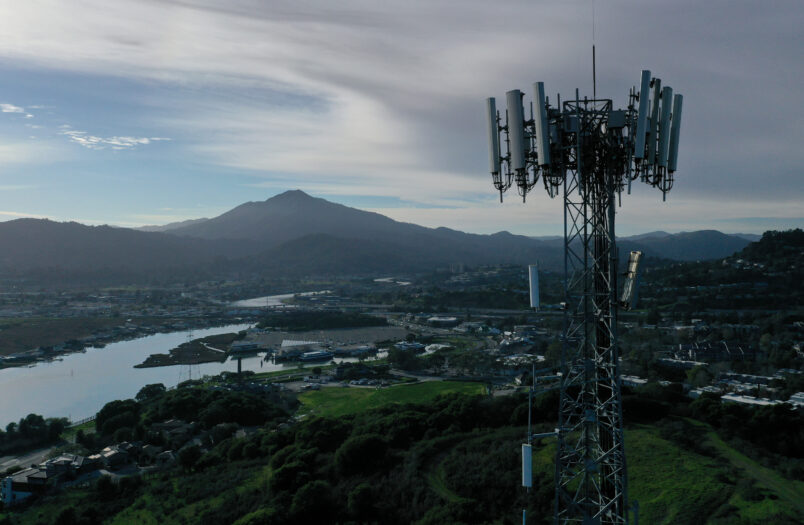
In an aerial view, a cellular tower stands on the top of a hill on January 18, 2022 in Larkspur, California. (Photo by Justin Sullivan/Getty Images)
Much has escaped the FCC’s notice. In 2020, Alabama’s historic preservation office alerted the FCC about a 160-foot TV tower in downtown Montgomery, which had already been built and was operating within blocks of the state Capitol and the Selma to Montgomery civil rights trail, in violation of requirements to assess harm (including aesthetic impact) to any national historic site within a half-mile. Because the structure had been built more than a year earlier, the company was immune from any enforcement action.
Self-reporting is rare, according to FCC officials speaking on condition of anonymity. As one put it, “It’s a game that gets played. A very small percentage of actual violations come to our attention.” Industry executives seemed to confirm that indirectly in a 2017 Government Accountability Office report on FCC enforcement (which addressed all forms of agency enforcement, not just environmental). Nine stakeholders offered the seemingly improbable explanation that they had “lost the incentive to self-report potential violations” because they felt they’d be treated too harshly.
There was little evidence of harsh consequences in that same GAO report: Just 10% of FCC enforcement cases between 2014 and 2016 resulted in a monetary penalty, while 40% ended with a warning and the rest resulted in no action. In a 2018 email, the agency’s federal preservation officer commented, “Industry treats our environmental rules like a joke.”
A year into her time at the FCC, Rosenberg started keeping a color-coded enforcement cheat sheet listing the status of apparent violations crossing her desk, which was then happening at a pace of about one a week. Among them was the case of Sacred Wind Communications, the New Mexico company that had built a 199-foot cellphone tower without undergoing any cultural review near a site containing Native American rock carvings. (In an interview with ProPublica, Sacred Wind co-founder John Badal blamed the violations on an outside consultant and the company’s failure to properly oversee him.)
Frustrated to see that the FCC’s enforcement team wasn’t pursuing many of these cases, Rosenberg began promoting the idea of sending violators public “admonishment letters” to deter future violations. After months of internal debate, a half-dozen letters finally went out in June 2016. But the agency declined to issue a press release publicly shaming the offenders, and it abandoned the effort months later.
The arrival of the 5G era stirred the FCC to make things even easier for the telecom industry. In September 2016, five senior agency officials met with 20 representatives from wireless and cell tower companies, including AT&T, Verizon and T-Mobile, who were eager to press their agenda. Jon Wilkins, chief of the FCC’s wireless telecommunications bureau, began by stating that “there is bipartisan support among the Commissioners for doing all that they can to help the industry with infrastructure deployment,” according to a summary of the session obtained through a public records request.
The industry delegation laid out a wish list of changes aimed at making the 5G rollout cheaper and faster. After Trump appointees assumed majority control of the agency in 2017, the FCC would seek to give the industry virtually everything it wanted. The agency passed new rules limiting what local governments could charge for access to utility poles and restricting the aesthetic requirements they could put in place. In 2018, with one commissioner blaming “outdated NEPA procedures” for slowing 5G deployment, the FCC exempted most small cell sites from environmental, historic-preservation and tribal reviews. In 2019, the commission shut down reconsideration of whether its wireless-radiation limits adequately protect people and the environment.
Federal appeals court challenges overturned most of these actions. Citing the vast scale of the 5G deployment, one court rejected the FCC’s claim that deregulating small cell sites would have “little to no environmental footprint.” It wrote that the FCC had “dismissed the benefits of historic-preservation and environmental review in a two-sentence paragraph.” A second appeals court later ordered the FCC to revisit the adequacy of its wireless-radiation safeguards, excoriating the agency for its “cursory analysis” of human health and environmental risks.
The FCC doesn’t release the totals, but, according to current and former agency employees, companies overseen by the FCC now submit just a few dozen environmental assessments a year, down from several hundred in 2016.
The FCC’s biggest environmental penalty ever — $10 million imposed on Sprint Corp. — stemmed from an investigation prompted not by the FCC, but by a wireless industry website called Event Driven. In May 2017, it published an internal Sprint memo detailing a “trial” aimed at speeding small cell deployment. The memo authorized Mobilitie, a Sprint infrastructure contractor, to start construction on scores of sites “without fully completing regulatory compliance.” The FCC’s consent decree in the Sprint case, made public in April 2018, noted that ignoring review requirements displayed “contempt” for regulatory authority. A spokesperson for T-Mobile, which purchased Sprint in 2020, said the violations occurred “long before” T-Mobile acquired it and “Sprint took steps to address their procedures at the time.” Mobilitie, which paid $1.6 million in a separate consent decree, said the episode involved “less than 1%” of the small cell sites it has constructed and that the company has subsequently developed “a robust compliance program.”
The latest environmental threat that falls under the FCC’s jurisdiction is in the heavens. Because the agency has broad authority over communications, it also licenses commercial satellites. And under the FCC’s watch, space is rapidly becoming a far more crowded place. Five years ago, there were fewer than two thousand satellites in orbit. Last December, the FCC approved the deployment of 7,500 satellites by a single company, Elon Musk’s SpaceX, that is building an extraterrestrial broadband network called Starlink. By 2030, experts project that as many as 60,000 satellites will be orbiting the Earth. In January the FCC approved the creation of a new Space Bureau to “better support the needs of the growing satellite industry.”
The FCC has approved Musk’s space armada, and many other satellite constellations, without requiring an environmental assessment, on the premise that, even cumulatively, they present no serious risk. (Musk has also argued that NEPA rules don’t apply to space.)
The agency has rejected fears from multiple quarters that tens of thousands of satellites pose worrisome threats. These include toxic emissions from rocket fuels that could pollute the earth, deplete the ozone layer and worsen global warming; increased radio congestion and space traffic that could destroy other satellites and impede critical astronomy used for weather tracking, national security and science; and a growing threat of human casualties and property damage from falling bits of satellite debris. The GAO inventoried the concerns in a September 2022 report.
For more than a year, the FCC did nothing to stop a more imminent environmental threat that emerged in 2018. It involved a Silicon Valley startup called Apollo Fusion, which was developing a low-cost satellite thruster system that uses a secret, proprietary fuel: liquid mercury. Mercury has big advantages as a fuel, but it’s also a toxic heavy metal that causes an array of harms to humans and the environment. NASA discarded it as a fuel option decades earlier. Ten years ago, the U.S. was among more than 140 countries that signed a United Nations treaty aimed at cutting global mercury emissions. But the restrictions didn’t apply to space.
Apollo was engaging in discussions with multiple big companies interested in purchasing its mercury-fueled thruster for their satellites. Its website claimed the company had a signed contract with at least one customer, with plans for a trial launch by the end of 2018.
That November, Public Employees for Environmental Responsibility, a nonprofit that had been tipped off by a whistleblower, revealed Apollo’s plans, warning that they could create an “eco-catastrophe.” The group accused the FCC of abdicating its responsibility to protect the public and petitioned the agency to halt the use of mercury. Two experts voiced concern in a Bloomberg Businessweek article that much of the toxic mercury emitted in space would descend back to earth.
At least two companies in 2019 sought FCC approval to launch satellites using Apollo’s mercury-fueled thrusters, FCC documents show. One later withdrew its request. The second, Astro Digital, applied in April for an experimental satellite license.
At what was then known as Vandenberg Air Force Base, a California site for the planned launches, an environmental reviewer in 2019 voiced “extreme concern” about flight “anomalies” that could allow mercury “to enter the terrestrial or ocean environment,” according to documents obtained from a public records request.
In August, Astro Digital and Apollo executives insisted to FCC officials that the mercury they’d release in space would remain there and cause no harm. They pressed to move forward with the planned launch.
In mid-September, the FCC finally ordered Astro Digital to submit an environmental assessment covering Apollo’s thruster system. Astro Digital agreed to comply, but asked the FCC to reconsider whether it had the authority to order such an assessment, noting that it was “not aware that the FCC has ever requested such information from other satellite operators.”
The FCC never responded, either to grant Astro Digital’s request or to deny it, according to Apollo co-founder Mike Cassidy. “We spent a year and a half waiting,” he said. (Cassidy defended his company’s fuel while acknowledging that “you obviously have to be really careful with mercury from an environmental perspective.”) Astro Digital eventually withdrew its application and Apollo switched to another propellant.
In March 2022, a United Nations conference in Indonesia did what the FCC wouldn’t: It banned the use of mercury to propel spacecraft.