Researchers Think Climate Change Is Leading To More Home Runs

This article is part of TPM Cafe, TPM’s home for opinion and news analysis. It was originally published at The Conversation.

Home runs are exhilarating — those lofting moments when everyone looks skyward, baseball players and fans alike, anxiously awaiting the outcome: run or out, win or loss, elation or despair.

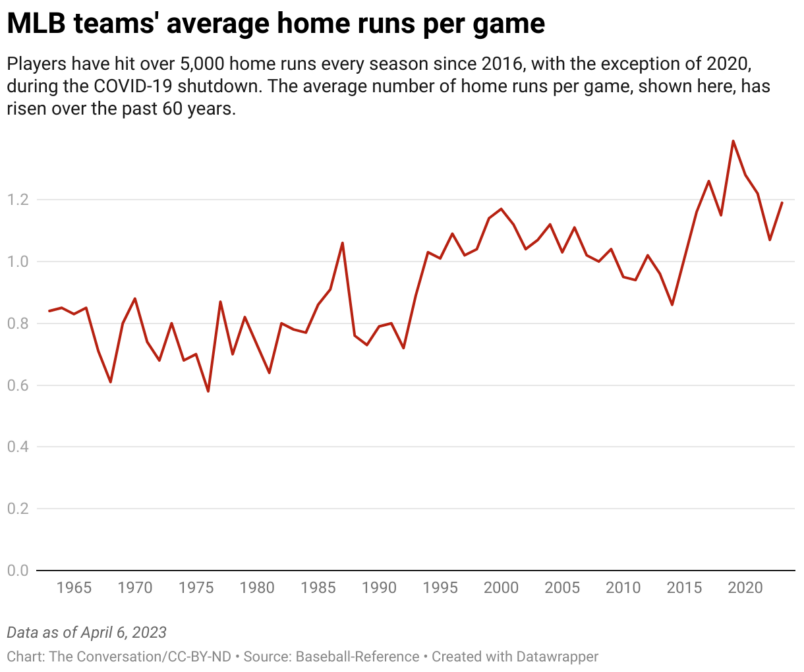
Over the past several Major League Baseball seasons, home run numbers have climbed dramatically, including Aaron Judge’s record-breaking 62 homers for the New York Yankees in 2022.

Baseball analysts have pointed to many different factors for this surge, from changes in baseball construction to advances in game analytics.

Our new study, published April 7, 2023, offers solid evidence for another cause — rising global temperatures.

What we learned from 100,000 baseball games

The physics tell a simple and compelling story: Warm air is less dense than cool air. As air heats up and molecules move faster, the air expands, leaving more space between molecules. As a result, a batted ball should fly farther on a warmer day than it would on a cooler day owing to less air resistance.

This simple physical link has prompted speculation from the media about the connection between climate change and home runs.

But while scientists like Alan Nathan have shown that balls go farther in higher temperatures, no formal scientific investigation had been performed to prove that global warming is helping fuel baseball’s home run spree — until now.
In our study, published in the Bulletin of the American Meteorological Society in collaboration with anthropologists (and baseball fans) Nathaniel J. Dominy and Jeremy M. DeSilva, we used data from over 100,000 Major League Baseball games and 200,000 individual batted balls, alongside observed game day temperatures, to show that warming temperatures have, in fact, increased the number of home runs.

Based on data between 1962 — when Mickey Mantle was American League MVP and Willie Mays topped the home run chart — and 2019, we found that a game that is 10 degrees Celsius (18 degree Fahrenheit) warmer than the average game would have nearly 20% more home runs than average.

So, what about everything else that drives home runs?

We can’t run a controlled experiment where we replay each pitch cast since the 1960s and vary only the temperature to assess its effect on home runs. But we can use the trove of data on home runs and temperature to statistically estimate its effect. Whether a game is hotter or cooler than average is not likely to be related to other factors driving home runs, like ball construction, steroid abuse, game analytics or elevation differences among ballparks. This fact allows us to statistically isolate the role of temperature.

To verify our game-level model, we use data from high-speed cameras that ballparks have had since 2015. The cameras provide the launch angle and launch velocity of each hit — 200,000 of them were included in our study. This means we can compare a ball coming off a bat at the same angle and velocity on a warm day and a cool day — near-perfect experimental conditions.

The high-speed camera model nearly exactly replicated the effect of temperature on home runs that we estimated with the game-level data. With this observed relationship between game day temperatures and home runs in hand, we were able to use experiments from climate models to estimate how many home runs have occurred because of climate change so far.

We found that more than 500 home runs since 2010 could be directly linked to reduced air densities driven by human-caused global warming.

More homers in a warming future

We can use the same approach to make estimates about home runs in the future.

For example, if the world continues to pump out greenhouse gas emissions at a high rate, the temperature will continue to climb, and that could soon yield several hundred additional home runs per year. It could add up to several thousand home runs cumulatively over the 21st century.
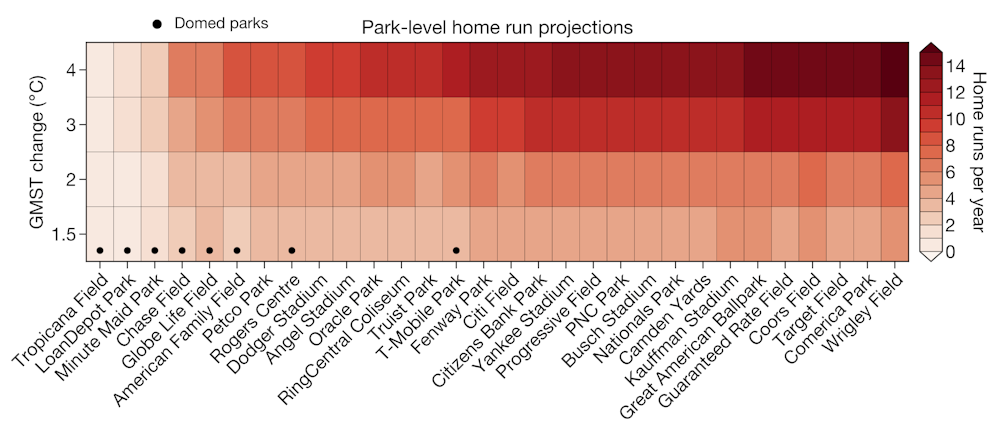
Increase in average number of home runs per year for each U.S. major league ballpark with every 1-degree Celsius (1.8 F) increase in global average temperature. Domed parks control the temperature on the field, so warming is less of a factor. Christopher W. Callahan, CC BY

Teams have ways to counter the heat. They can shift day games to be played at night, for example, or build domes over ballparks. In Denver, where the air is less dense because of its higher elevation, the Rockies started storing game balls in a humidor in 2002 to make them “mushier,” increasing their weight and giving pitchers more of a sporting chance.

It’s not all high-fives

More home runs might sound exciting, but that boost in homers is also a visible sign of the much larger problems facing sports and people worldwide as the planet warms.
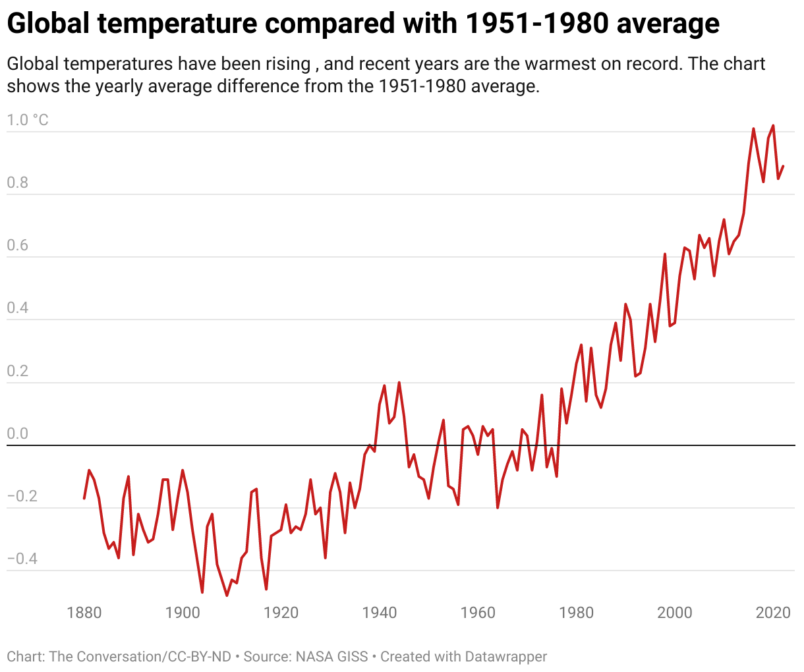
Rising temperatures will threaten the health and safety of baseball players, fans in ballparks and people around the world. Without serious efforts to reduce greenhouse gas emissions, rising temperatures will transform nearly all aspects of society, from cultural touchstones like baseball to basic human well-being.

This article is republished from The Conversation under a Creative Commons license. Read the original article.

Clarence Thomas Defends Undisclosed ‘Family Trips’ With GOP Megadonor. Here Are The Facts.

This story first appeared at ProPublica. ProPublica is a Pulitzer Prize-winning investigative newsroom. Sign up for The Big Story newsletter to receive stories like this one in your inbox.

In a rare public statement, Supreme Court Justice Clarence Thomas responded Friday to a ProPublica report that revealed that Thomas has, for decades, accepted luxury travel from billionaire Republican megadonor Harlan Crow and failed to disclose it.

Thomas’ brief statement acknowledges joining Crow and his wife, who he described as among his “dearest friends,” on “a number of family trips” over the years. He also defended his failure to disclose them.

“Early in my tenure at the Court, I sought guidance from my colleagues and others in the judiciary, and was advised that this sort of personal hospitality from close personal friends, who did not have business before the Court, was not reportable,” Thomas said in the statement. “I have endeavored to follow that counsel throughout my tenure, and have always sought to comply with the disclosure guidelines.”

But seven legal ethics experts consulted by ProPublica, including former ethics lawyers for Congress and the White House, said the law clearly requires that gifts of transportation, including private jet flights, be disclosed. If Thomas is arguing otherwise, the experts said, he is incorrect.

A Supreme Court spokesperson did not immediately respond to questions for Thomas about the specifics of the advice he was given or who he consulted.

ProPublica’s story Thursday revealed that Thomas had taken international cruises on Crow’s superyacht, flown on Crow’s private jet and regularly vacationed at Crow’s private resort in the Adirondacks. In one instance, Thomas flew on Crow’s jet from Washington Dulles airport to New Haven, Connecticut, then flew back three hours later.

Thomas did not respond to detailed questions for that story. His statement Friday did not dispute ProPublica’s reporting about his trips. It also did not address broader criticisms from ethics experts and other judges that by repeatedly accepting such trips, he broke long-standing ethical norms for judges’ conduct.

In a previous statement to ProPublica, Crow said that Thomas “never asked for any of this hospitality” and that his treatment of the justice was “no different from the hospitality we have extended to our many other dear friends.”

A law passed in the wake of the Watergate scandal, the Ethics in Government Act, requires Supreme Court justices and many other federal officials to report most gifts to the public. Justices are generally required to report all gifts worth more than $415, defined as “anything of value” that they don’t repay the full cost of. Gifts are disclosed in an annual financial report that is made public.

There are exceptions, and experts parsing the legality of Thomas’ failure to disclose the travel have been focused on a carve-out known as the “personal hospitality” exemption.

The exemption states that gifts of “food, lodging, or entertainment received as personal hospitality” don’t have to be disclosed. The law defines “personal hospitality” in a way that further limits the exception. It only applies to gifts received from an individual at that person’s home or at properties that they or their family own.

ProPublica asked the seven legal ethics experts about the exception and Thomas’ statement. All said that the law’s language clearly requires that gifts of transportation, such as private jet travel or cruises on a yacht, be disclosed and said Thomas appears to have violated the law by failing to report them.

“I don’t think you can make an argument that private jet flights need not be included under the statute,” said Stephen Gillers, a professor emeritus and ethics expert at New York University law school.

”It is absolutely impossible that anyone could reasonably interpret that exception to apply to private jet flights,” said Walter Shaub, former director of the U.S. Office of Government Ethics. “Not in any universe.”

Richard Painter, who served as the chief ethics lawyer for the George W. Bush White House, said Thomas’ explanation of why he didn’t disclose the trips “makes absolutely no sense.” Painter emphasized that the exemption only covers three categories: food, lodging and entertainment. Private jet flights would fall into none of those, he said.

“Justice Thomas likes to focus on the language of authoritative texts, and that’s not what he’s doing in this statement,” said Kathleen Clark, a legal ethics expert at Washington University in St. Louis.

Thomas himself disclosed at least one private jet flight from Crow, in his financial disclosure for 1997. He has not disclosed a trip on Crow’s plane in more than 20 years.

Reviewing other federal judges’ financial disclosure filings, ProPublica found at least six examples of judges disclosing gifts of private jet travel in recent years.

In the Ethics in Government Act, Congress explicitly stated that the law covers Supreme Court justices. But Chief Justice John Roberts has raised questions about Congress’ power to impose rules on the Supreme Court.

“The Court has never addressed whether Congress may impose those requirements on the Supreme Court,” Roberts wrote roughly a decade ago in an annual report on the judiciary. “The Justices nevertheless comply with those provisions.”

Thomas’ statement Friday does not cite the law itself but rather “disclosure guidelines” for the judiciary. The guidelines elaborate on how the law applies to the courts and are issued by the policymaking arm of the judiciary.

Thomas’ statement refers to a March update of the judiciary’s guidelines for financial disclosure. “It is, of course, my intent to follow this guidance in the future,” he said. The new guidelines explicitly say that transportation is not food, lodging or entertainment and so must be disclosed.

Questions about Thomas’ compliance with the disclosure law have come up in the past. In 2011, he announced that he was amending years’ worth of his disclosure forms because he had failed to disclose the sources of his wife, Ginni’s, income.

At the time, he cited a “misunderstanding of the filing instructions.”

Dueling Opinions Cast Uncertainty Over Future Of Abortion Drug

U.S. District Judge Matthew Kacsmaryk in Texas stayed the Food and Drug Administration’s (FDA) approval of abortion drug mifepristone nationwide Friday, including in blue states with robust abortion protections. 

Continue reading “Dueling Opinions Cast Uncertainty Over Future Of Abortion Drug”

Some Backstory on the Tennessee House Confrontation

You have certainly seen lots of coverage of the expulsion of Tennessee lawmakers Justin Jones (D) and Justin Pearson (D) yesterday from the Tennessee state house. One particular encounter caught my attention from the debate prior to the votes. It’s the moment when Rep. Andrew Farmer (R), a sponsor of the expulsion resolution, lectured Pearson about his behavior, saying that Pearson just wants attention and doesn’t know how to behave. It’s worth watching it to get the flavor of the comments and Pearson’s response. Someone else said Farmer seemed to be like the caricature of the racist white lawyer from a 1990s-era movie. And that captures it. It’s demeaning. He’s talking to Pearson like a child who simply doesn’t belong in the state capitol and doesn’t understand the work being done there. You can see the interchange here.

Continue reading “Some Backstory on the Tennessee House Confrontation”

Some Thoughts on Ukraine and Bakhmut

Like John, I’ve also frequently found it hard to make sense of what is happening in Ukraine, especially in recent months when the conflict has shown relatively little movement in lines of control. From my understanding, the real question is what will happen in the offensive the Ukrainian army has long telegraphed starting sometime in the spring or early summer. The brutal fight over Bakhmut, from what I’ve been able to understand, has to be seen in that context.

Continue reading “Some Thoughts on Ukraine and Bakhmut”

Who To Believe On The War In Ukraine?

I have been reluctant to write anything about the war in Ukraine, even though it is the American government’s most important current initiative and even though I remain skeptical about the administration’s war aims and about the role that Washington’s leading think tanks and media have played in pressing the conflict. One reason I have been hesitant to venture an opinion is that I am not an expert on the area. But the other reason is that the information we are getting from the mainstream press and official sources is, at best, inconsistent.

Continue reading “Who To Believe On The War In Ukraine?”

Elon Musk Admits Labeling NPR ‘State-Affiliated Media’ Might Not Have Been Accurate

Twitter CEO Elon Musk reportedly said the social media platform’s recent decision to label NPR as a “state-affiliated media” account might not have been accurate during a series of emails he exchanged with an NPR reporter earlier this week.

Continue reading “Elon Musk Admits Labeling NPR ‘State-Affiliated Media’ Might Not Have Been Accurate”

Much Of The Media Is Both Sides-ing, Obscuring The Truth In The GOP Tennessee Expulsion 

As Tennessee Republicans expelled two state House Democrats for joining in a protest calling for gun reform from the House floor, the national media turned its attention to the chamber. 

Continue reading “Much Of The Media Is Both Sides-ing, Obscuring The Truth In The GOP Tennessee Expulsion “