If you think back over the last three years, we’ve had a series of epic socio-cultural smackdowns over COVID: Lockdowns, masks, vaccines, schools. Each of these have tended to array broadly similar groups against each other, though with some key variations. But whatever you made of those fights, the public debate had really immense and immediate real world consequences. That is what is so odd and mystifying about the intensity of Lab Leak Discourse. It doesn’t actually matter. Or rather there are basically no real-world implications to either side being “right” or “winning.” I was talking to someone today who said how incredibly important it was. But after thinking about it for a bit, I thought, why? Now it’s much better for people to think up is up rather than up is down. And there are probably important secondary effects of getting this wrong, whichever way is “wrong.” But in any direct sense it’s not clear it has any real impact on anything.
I just wanted to flag for you that we’ve got our annual sign up drive coming up in a couple weeks. It’s a very important one. So if you’ve been a member and lapsed or if you’re a TPM Reader who’s never taken the plunge please consider becoming a member during this drive. Before we kick it off I’ll be sharing a few more thoughts with you about our membership business model, why we do these drives and what we’re doing more broadly today as an organization.
House Republicans ignored repeated requests from the Capitol Police to review and approve any Jan. 6 security footage that would be made public, according to Capitol Police general counsel Thomas DiBiase.
Outgoing Chief U.S. District Judge Beryl Howell for the District of Columbia ordered a key Trump attorney to testify before the grand jury investigating the Mar-a-Lago document scandal, multiple news outlets reported on Friday.
At present, my main contribution to Lab Leak Discourse is making fun of it. I say this operating on the distinction provided to us by TPM Reader JS a couple weeks ago, noting that Lab Leak Discourse is now entirely autonomous from the actual ongoing research into the origins of COVID-19. Indeed, I noticed yesterday that it has now taken a new turn focusing on public opinion surveys showing that a majority of Americans believe COVID began with a laboratory accident at the virology lab in Wuhan, China. The “wisdom of crowds,” one Lab Leak advocate told me, should be given its own weight along with the judgments of those with domain expertise in virology, genomics and other fields.
Donald Trump’s former personal attorney Michael Cohen said, in his view, Manhattan prosecutors have enough evidence to indict and convict the former president as part of the office’s investigation into the hush money payment to adult film actress Stormy Daniels.
This article is part of TPM Cafe, TPM’s home for opinion and news analysis. It was originally published at The Conversation.
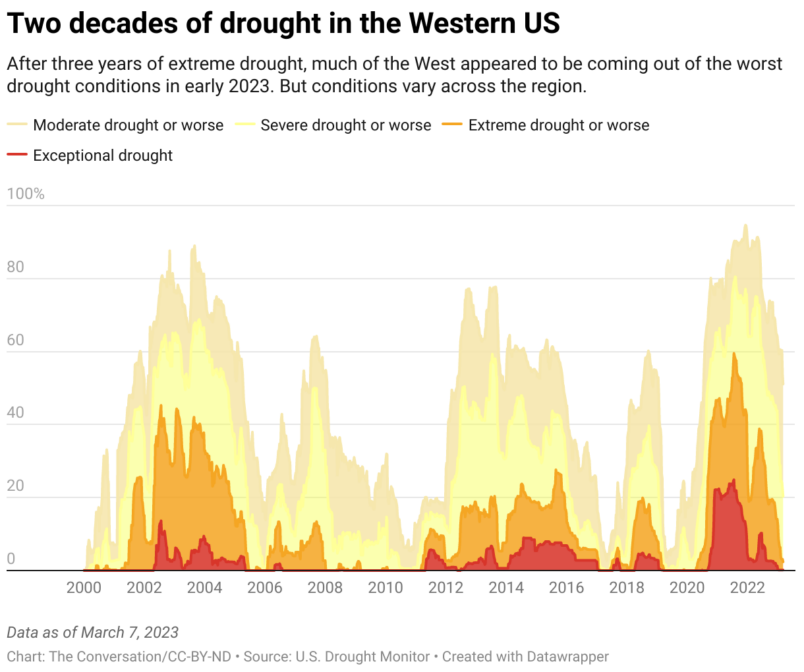
After three years of extreme drought, the Western U.S. is finally getting a break. Mountain ranges are covered in deep snow, and water reservoirs in many areas are filling up following a series of atmospheric rivers that brought record rain and snowfall to large parts of the region.
Many people are looking at the snow and water levels and asking: Is the drought finally over?
There is a lot of nuance to the answer. Where you are in the West and how you define “drought” make a difference. As a drought and water researcher at the Desert Research Institute’s Western Regional Climate Center, here’s what I’m seeing.
How fast each region recovers will vary
The winter of 2023 has made a big dent in improving the drought and potentially eliminating the water shortage problems of the last few summers.
I say “potentially” because in many areas, a lot of the impacts of drought tend to show up in summer, once the winter rain and snow stop and the West starts relying on reservoirs and streams for water. Spring heat waves like the ones we saw in 2021 or rain in the mountains could melt the snowpack faster than normal.
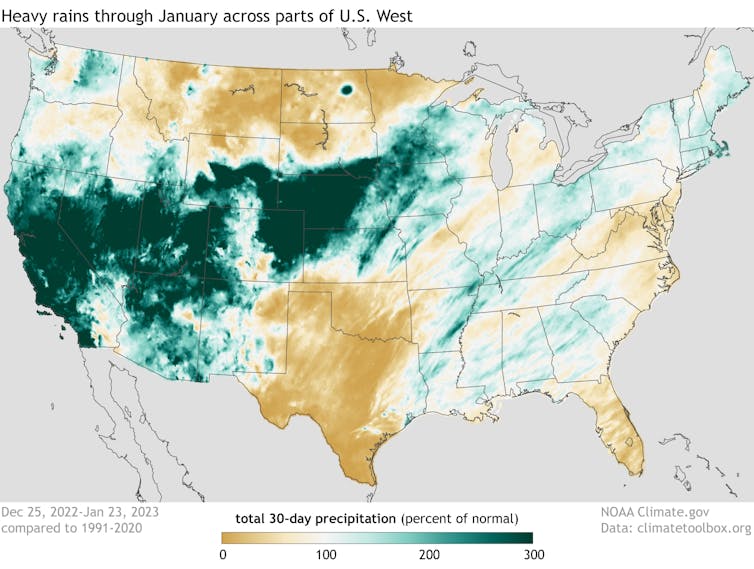
Atmospheric rivers in January brought heavy rain across large parts of the West. Another powerful storm system hit in March. Climate.gov
California and the Great Basin
In California, the state’s three-year precipitation deficit was just about erased by the atmospheric rivers that caused so much flooding in December and January. By early March, the snowpack across the Sierra Nevada was well above the historical averages — and more than 200% of average in some areas. The Metropolitan Water District of Southern California announced it was ending emergency water restrictions for nearly 7 million people on March 15.
It seems as though most of the surface water drought — drought involving streams and reservoirs — could be eliminated by summer in California and the Great Basin, across Nevada and western Utah.
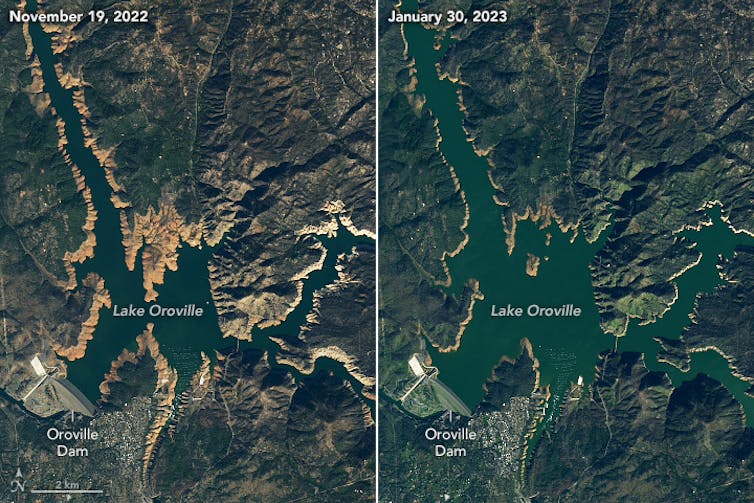
The early 2023 storms likely could have filled Lake Oroville, one of California’s largest reservoirs. But reservoirs are also essential for flood management, so managers balance how much water to retain and how much to release. NASA Earth Observatory images by Lauren Dauphin
But that’s only surface water. Drought also affects groundwater, and those effects will take longer to alleviate.
Studies in California have shown that, even after wet years like 2017 and 2019, the groundwater systems did not fully recover from the previous drought, in part because of years of overpumping groundwater for agriculture, and the aquifers were not fully recharging.
In that sense, the drought is not over. But at the broader scale for the region, a lot of the drought impacts that people experience will be lessened or almost gone by this summer.
The Colorado River Basin
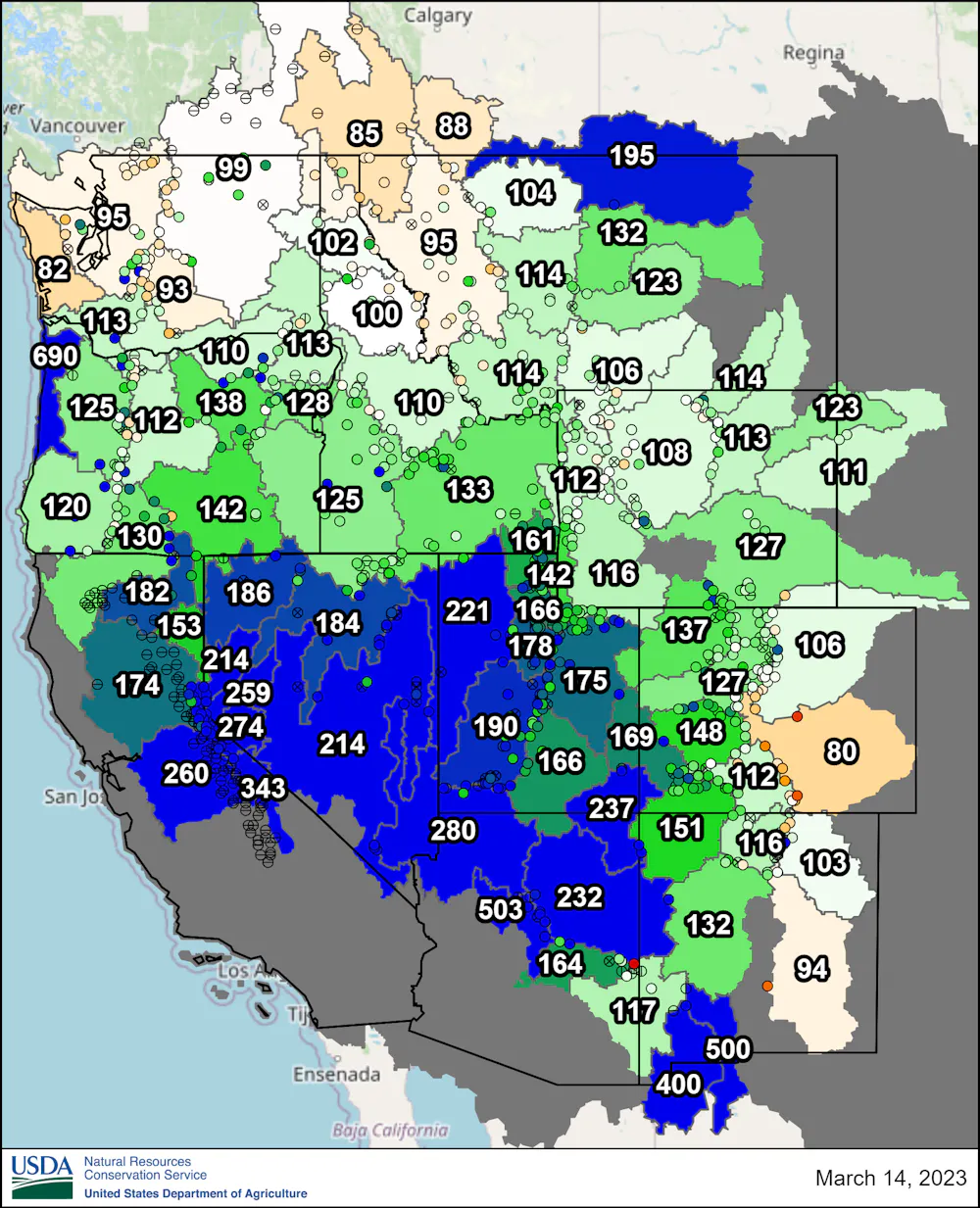
Similar to the Sierra Nevada, the Upper Colorado River Basin — Wyoming, Colorado, Utah and northwestern New Mexico — has a healthy snowpack this year, and it’s looking like a very good water year there.
The snow water equivalent, a measure of snowpack, was over 200% of average in several areas on March 14, 2023. Drought.gov
Two good water years won’t do it either. Over the next decade, most years will have to be above average to begin to fill those giant reservoirs. Rising temperatures and drying will make that even harder.
So, that system is still going to be dealing with a lot of the same long-term drought impacts that it has been seeing. The reservoirs will likely rise some, but nowhere close to capacity.
The Pacific Northwest
The Pacific Northwest isn’t having as much rain and snow, and it’s a little drier there. But it’s close to average, so there’s not a huge concern there, at least not right now.
Forests, range land and the fire risk
Drought can also have longer-term impacts on ecosystems, particularly forest health.
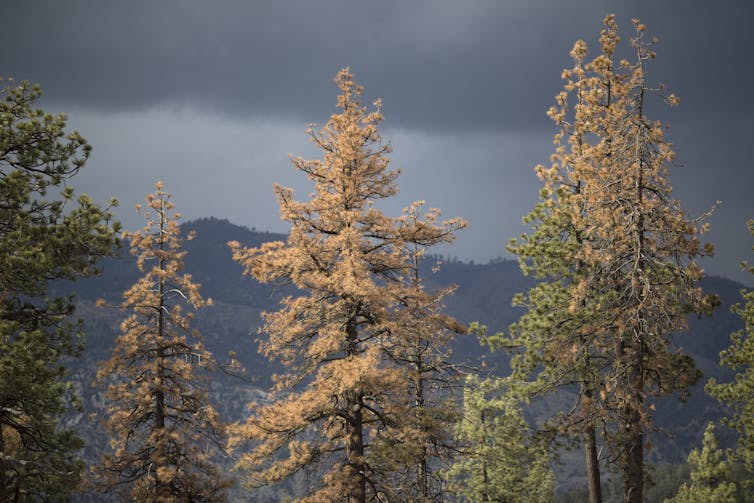
The Sierra Nevada range has seen large-scale tree die-offs with the drought in recent years, including in northern areas around Lake Tahoe and Reno that weren’t as affected by the previous drought. Whether the recent die-offs there are due to the severity of the current drought or lingering effects from the past droughts is an open question.
Even with a wet winter, it’s not clear how soon the forests will recover.
Drought and bark beetles have killed millions of trees across California in recent years, contributing to wildfire risk. David McNew/Getty Images
Rangelands, since they are mostly grasses, can recover in a few months. The soil moisture is really high in a lot of these areas, so range conditions should be good across the West — at least going into summer.
If the West has another really hot, dry summer, however, the drought could ramp up again, particularly in the Northwest and California. And then communities will have to think about fire risk.
In the higher-elevation mountains and forests, the above-average snowpack is likely to last longer than it has in recent years, so those regions will likely have a later start to the fire season. But lower elevations, like the Great Basin’s shrub- and grassland-dominated ecosystem, could see fire danger starting earlier in the year if the land dries out.
Long-term outlooks aren’t necessarily reliable
By a lot of atmospheric measures, California appears to be coming out of drought, and the drought feels like it’s ending elsewhere. But it’s hard to say when exactly the drought is over. Studies suggest the West’s hydroclimate is becoming more variable in its swings from drought to deluge.
Drought is also hard to forecast, particularly long term. Researchers can get a pretty good sense of conditions one month out, but the chaotic nature of the atmosphere and weather make longer-range outlooks less reliable.
We saw that this year. The initial forecast was for a dry winter 2023 in much of the West. But in California, Arizona and New Mexico, the opposite happened.
Seasonal forecasts tend to rely heavily on whether it’s an El Niño or La Niña year, involving sea surface temperatures in the tropical Pacific that can affect the jet stream and atmospheric conditions around the world. During La Niña — the pattern we saw from 2020 until March 2023 — the Southwest tends to be drier and the Pacific Northwest wetter.
But that pattern doesn’t always set up in exactly the same way and in the same place, as we saw this year.
A lot of things happened. Here are some of the things. This is TPM’s Morning Memo.
Hahahaha … Sob
I started this WaPo story – headlined “Much of the 2024 GOP field focuses on dark, apocalyptic themes” – with hope and optimism. Awesome, the bigs are treating this as not normal, which is good, just what democracy needs!
The trio of comments from 2024 Republican presidential hopefuls — either declared or expected — underscore the dark undertones and apocalyptic rhetoric that have pervaded much of the Republican Party in the era of Trump.
But in the very next ‘graph, immediately undercutting the story’s own premise, comes the first sign that the story is infected with the insidious journalistic trope of bothsidesism:
President Biden and Democrats often engage in their own existential messaging, warning that some Republicans — whom they deride as “extremists” — are out of step with most Americans, eager, for example, to cut programs like Medicare and Social Security.”
Wait, what? Equating the defense of Medicare and Social Security with “I am your retribution”? Putting extremists in quotes was a nice touch, too.
From there, the story’s structure deteriorates into a both-sides dipsy doo of apocalyptic things Republicans have said followed by “to be sure”-style tut-tutting over Democrats just to even things out, culminating in: “Of course, Democrats also deploy hyperbolic and dark language against their Republican foes.” Of course?!?
The peak of the bothsidesism comes when the story hands the baton to a dyed-in-the-wool Trumper who invokes … 85-year-old Jane Fonda … as representative of elected Democrats. What is this, 1972?
Cliff Sims, a former Trump White House official, pushed back on the notion that only Republicans are using overheated language. He pointed to the recent comments by actor and liberal activist Jane Fonda on ABC’s “The View,” in which she suggested the “murder” of antiabortion politicians — she later said she was using hyperbole and had made the suggestion in jest — and what he called “the never-ending drumbeat of Democrats who call Trump ‘Insert Authoritarian Phrase Here.’”
Remember this is a story ostensibly about how GOP contenders for president in 2024 are using dark and apocalyptic language, but okay sure Hanoi Jane half a century later as a counterpoint.
Democracy dies in darkness, though to be sure light has its own issues and has yet to account for its role in the arson problem.
At least two dozen people – from Mar-a-Lago resort staff to members of Donald Trump’s inner circle at the Florida estate – have been subpoenaed to testify to a federal grand jury that’s investigating the former president’s handling of classified documents, multiple sources familiar with the investigation told CNN.
Investigators have also sought to compel the testimony of another attorney for the former president, Jennifer Little, who has also sought to assert attorney-client privilege, as part of the investigation into the Mar-a-Lago documents, sources tell ABC News.
Do Tell!
The Georgia special grand jury heard the recording of another phone call from then-President Donald Trump pressuring a state official to overturn the 2020 election results.
Trump Lawyer Using Civil Suit To Fish For Info On Criminal Probes
As Donald Trump prepares for an indictment that could come any minute now, one of his top lawyers is apparently trying to use another case to siphon information about every possible pending investigation into the former president—including ones that Trump might not even know about yet.
That covert effort was revealed this week in a previously unreported letter that the office of New York Attorney General Letitia James (OAG) submitted in state court. James and Trump’s attorneys have battled over subpoenas for weeks as her $250 million fraud suit against the Trump Organization barrels ahead.
This Is Golden
UPDATE: Jan. 6 defendant Gabriel Garcia is defending his trip to CPAC last week w/o notifying the court (a potential violation of his pretrial release conditions) by telling Judge Jackson he was preparing his defense … by talking to Matt Gaetz and Ivan Raiklin. pic.twitter.com/PMSLmcxhjn
U.S. District Judge Amy Berman Jackson has ordered Garcia to appear Monday in person for a hearing on whether he violated the terms of his pre-trial release by going to CPAC. In doing so, she imposed strict limits on his trip to DC for the hearing: “Defendant is only permitted to leave the district where he lives to travel directly to DC, and he may go only to his hotel, his lawyers office, and the courthouse, where he must be accompanied by his lawyer at all times.”
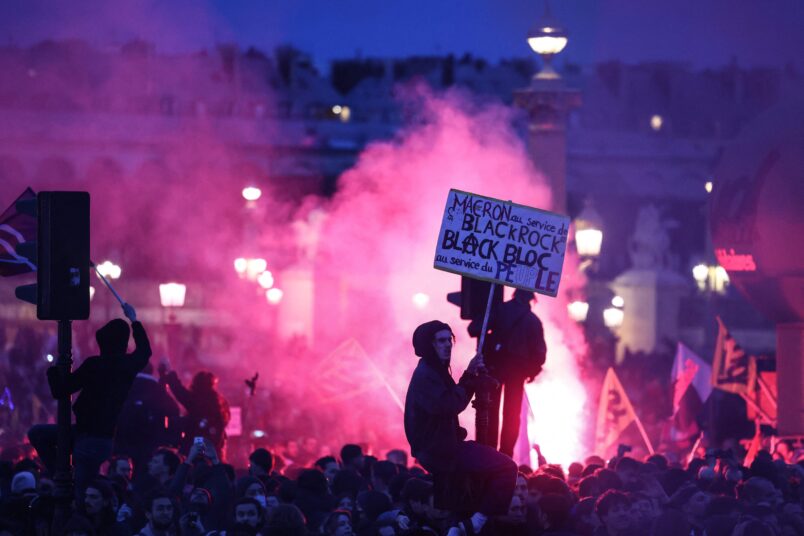
Amid large street demonstrations, French President Emmanuel Macron bypassed Parliament and invoked special constitutional powers on Thursday to raise the retirement age from 62 to 64.
TOPSHOT – A protester on a traffic light holds a placard reading “Macron at the service of Black Rock, Black bloc at the service of the people” during a demonstration on Place de la Concorde after the French government pushed a pensions reform through parliament without a vote, using the article 49,3 of the constitution, in Paris on March 16, 2023. – The French president on March 16 rammed a controversial pension reform through parliament without a vote, deploying a rarely used constitutional power that risks inflaming protests. The move was an admission that his government lacked a majority in the National Assembly to pass the legislation to raise the retirement age from 62 to 64. (Photo by Thomas SAMSON / AFP) (Photo by THOMAS SAMSON/AFP via Getty Images)
Put Me In, Coach!
I’m loving the sleuthing the WSJ is doing on the Nord Stream sabotage, especially since it involves reporting in German yachting circles and excursions to obscure (to me) Danish ports. Tough assignment, guys:
At least some of the six people on the suspected sabotage team boarded the Andromeda in Rostock’s Hohe Düne harbor, which caters to upscale tourists and hosts international yachting events. … From there, the Andromeda traveled to the Yachthafen Hafendorf in Wiek on the island of Rügen, a far more discreet harbor off the beaten track, with no camera surveillance at night, according to René Redmann, the harbor master.
German investigators believe that it was in quiet, out-of-the-way Wiek that the suspected saboteurs loaded explosives—ferried to the port in a white van—and additional operatives onto the Andromeda, according to a German official briefed on the investigation. …
After Wiek, the Andromeda sailed to the busier Danish port of Christiansø, farther north.
Dear Readers
I’ll be handing over the reins of Morning Memo for a few days to Nicole Lafond and the rest of the TPM team. Please treat them well! Be back soon.