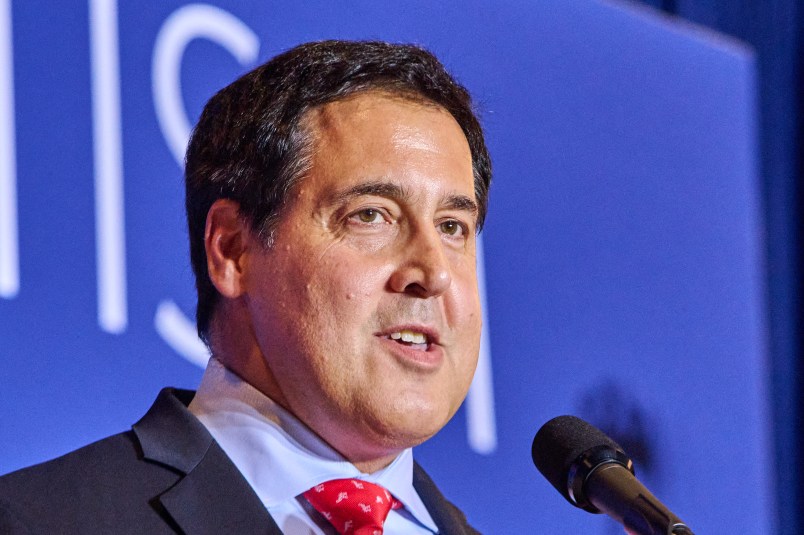
Apocalyptic Picture Trump Paints For Evangelicals Shows Where Campaign Is Headed

Donald Trump’s late February speech to the annual National Religious Broadcasters’ convention received a short-lived spurt of media attention, largely for its menacing pledges to protect Christians from supposed persecution by a “wicked system” and the “radical” left. But it would be a mistake to consign this speech to one-day-on-the-campaign trail status. Despite some assessments of the speech as “rambling,”wild,” and “incoherent,” it actually lays out a cogent, comprehensible narrative — for evangelicals. 

As the presidential campaign heats up, his seemingly bizarre oratory is a critical window into how the Trump campaign plans to maintain and mobilize his core base of white evangelicals, and potentially peel off more Black and Latino evangelicals along the way.

The NRB’s yearly convention is the premier gathering of Christian talk show hosts and influencers celebrating its mission of promoting “Christian broadcasters’ right to communicate the Gospel of Jesus Christ to a lost and dying world.” The 80-year-old organization, with over 1,100 members and a robust presence in Washington, represents the local and national Christian media landscape, from televangelists, radio sermonizers, podcasters, and social media influencers. NRB claims that 141 million Americans listen to or watch religious broadcasting at least once a month, on more than 4,000 Christian television and radio stations across the country. In his speech, Trump praised the talk show hosts as “brave independent Christian journalists,” and “pastors, podcasters, producers, and patriots” who are doing “an incredible thing for humanity.” The NRB speech gave Trump’s megaphone a ripple effect to others with smaller, but cumulatively powerful megaphones of their own.

While much of the coverage of the speech focused on his promises to end supposed anti-Christian persecution, Trump had been sounding those themes for months before the NRB speech, ratcheting up his attacks on Biden and the “radical left” as his own legal perils accumulated. The full speech, with characteristic digressions, incomprehensible improvisations, and outrageous lies on matters of both great and minimal importance, reveals how what outsiders see as Trump’s deficits are seen by evangelicals as heroism and even divine inspiration. 

(Photo by KEVIN WURM/AFP via Getty Images)

White evangelicals are Trump’s most reliable supporters. Prominent evangelicals and televangelists kept his presidency afloat through scandals and impeachment, stood by him on and after January 6, and persist in repeating his stolen election lies and conspiracy theories. One of his lead boosters is his long-time friend Paula White, the controversial televangelist with a peppy self-help message for women and a penchant for turning sinister spiritual warfare themes into patriotic cheerleading for Trump. After a close relationship to the Trump administration, including a stint as advisor to Trump’s Faith and Opportunity Initiative, White has returned to her Florida church — and to leading the National Faith Advisory Board (NFAB), a nonprofit organization that claims to be continuing the work “we began at the White House.”(Although the NFAB’s website lists an Arlington, Virginia post office box as its address, the Florida incorporation papers for the NFAB list the same address as White’s City of Destiny church.)

The week after Trump’s NRB speech, the NFAB’s email newsletter boasted that its own members — including Texas megachurch pastor Jack Graham, Senator Marsha Blackburn (R-TN), and author and television and radio host Eric Metaxas, a prominent election denier — were on hand. The email linked to a recap of Trump’s remarks, compiled by the Christian right legal firm First Liberty Institute, condensing “religious liberty highlights” of the speech into digestible and familiar bullet points: support for “people of faith;” Trump’s accomplishments protecting “conscience,” banning abortion, defending Israel, and stacking the federal bench.

The First Liberty/NFAB summation provides useful talking points for Trump surrogates who might have difficulty reprising a meandering monologue that went on for more than an hour, or at least making it seem less unhinged. A crucial element of his NRB speech was centering his support for Israel, even calling “my David,” his former ambassador to Israel, David Friedman, to the stage to praise him as “the greatest friend that Israel ever had in the Oval Office, by far.” Trump’s claimed support for Israel (in reality support for Israel’s far right) is charged and symbolic for evangelical audiences, who are steeped in lurid Christian Zionist narratives foretelling the second coming of Jesus and his victory over the Antichrist. They believe that the Bible commands Christians to support Israel — in practice, to support Israel’s far-right governing coalition — and that Israeli consolidation of its occupation and annexation of Palestinian land is a precondition of Christ’s return.. Israel, they believe, is where their actual messiah will return. In the meantime, while they wait, Trump stands in as a messianic figure saving Christian America from “the toxic poison of gender ideology” and “from the Communists and the freaks.”

Just like evangelists portray Satan as both all-powerful but ultimately falling to the godly forces of good, Trump makes Biden seem both capable of destroying America in a short time but also “an incompetent president who doesn’t know what the hell he is doing. He will not lead us to the promised land.” At one point, Trump “joked” (to laughter) that he wasn’t even sure that Biden knew he was alive.

(Photo by KEVIN WURM/AFP via Getty Images)

Yet this supposedly feeble man and his allies have caused, according to Trump, 38% inflation, the war in Ukraine and Hamas’s attack on Israel, among other things. (Needless to say, none of this is true, including the cited inflation rate.) Trump’s enemies have also “thrown open our borders to an illegal alien invasion by the world’s most sadistic criminals and savage gangs, while putting peaceful pro-life citizens behind bars” and “unleashed mobs of foreign jihadists to praise Hamas in our streets.” Trump portrayed schools as hellscapes teaching “critical race theory, transgender insanity and other inappropriate racial, sexual or political content,” and promised to “restore the timeless truth that God created two genders, male and female” and to “sign a law prohibiting child sexual mutilation in all 50 states.”

In Trump’s twisted, false narrative, Christians are “hunted down by the Biden regime,” by “the same Biden DOJ that dropped charges against Antifa, where they kill people.” He then claimed that, in Portland, because of Antifa, “they don’t even have storefronts anymore,” and because of the “invasion” of immigrants, “cities are being inundated, they’re being overrun, they’re taking the parks from children, there are no more baseball fields, no more soccer fields.”

However macabre this sounds to outsiders, to evangelicals steeped in end-times prophecy, these nightmarish scenarios are real. They believe they are waging spiritual warfare against demonic spirits bent on destroying an America God intended to be a Christian nation. For them, Trump’s accomplishments are more than just a checklist of judges and abortion policy; his entire being is a divinely ordained force powerful enough to upend Satan’s plans.

Between now and November, mobilizing his spiritual warriors by continually divorcing them from reality will be the most potent get-out-the-vote tool he has. And if it turns out not to be enough, he always has this constant reminder, as he told the NRB: “They rigged the election.”

The Easter Madness Of Donald J. Trump

A lot of things happened. Here are some of the things. This is TPM’s Morning Memo. Sign up for the email version.

Trump’s Messianic Complex

I trust that most of you were offline celebrating the holiday, warming to the Spring, welcoming baseball back, or watching college basketball. Congrats on missing another unhinged online weekend for Donald Trump.

Over the course of 70+ posts Easter morning, Trump vilified and attacked a wide range of his antagonists in ALL CAPS zeal. At the same time, he reposted articles declaring himself to be “The Chosen One.”

The contrast between the irreligious candidate embracing Christian nationalism and the lifelong Irish Catholic was, shall we say, striking:

It’s all so infantile and incredibly ridiculous that you can hardly be blamed for not wanting to be bothered about it over the weekend.

Just Say It!

Somehow the NYT can’t bring itself to use the phrase “Christian nationalism” in its story on “The Church of Trump: How He’s Infusing Christianity Into His Movement.”

The story fails to place Trump’s bible-thumping faux populism in the broader historical context of right-wing extremism and Christian nationalism. It also has the effect of conceding too much. Trump is embracing a certain corrupted brand of Christianity (that many Christians themselves find offensive), and it gives him both too much credit and allows him to co-opt Christian images and motifs.

Trump Keeps Up Attack On Trial Judge’s Daughter

After days of sustained attacks by Donald Trump on the daughter of the trial judge in the hush money case, Manhattan District Attorney Alvin Bragg asked the judge Friday to tighten up the gag order against Trump. Over the weekend, the former president responded by reposting images of the trial judge’s daughter. The judge could rule on Bragg’s request as soon as today.

Beware of April Fool’s Day:

The Next Phase Of Trump’s Delay Strategy

I’ve been meaning to flag for you in advance the likely next phase of the Trump delay strategy, when the most ostentatious and obvious “dog ate my homework”-style excuses are likely to come in an effort to gum up the works in his criminal trials. But Joyce Vance has beat me to it with this succinct warning: “There are also the time-honored strategies of the desperate: getting sick or finding a sick or dying family member and firing your lawyers.”

Trump Accountability Miscellany

  • MAL: Judge Aileen Cannon’s “shadow docket,” as explained by the invaluable Roger Parloff.
  • Georgia RICO: Trump and his co-defendants appealed the trial judge’s decision not to disqualify Atlanta District Attorney Fani Willis.
  • Election Delegitimization: The vicious cycle of election denialism, notes TPM’s Khaya Himmelman:

The concern now, going into November, is not only another uptick in threats against election workers, but the continuation of a larger delegitimization cycle that originated in 2020: a greater number of clerical election errors due to new and inexperienced election staff, leading to more election conspiracy theory fodder, and ultimately culminating in more violence and another wave of resignations, where the vicious cycle begins again. 

COVID … Four Years Later

  • A sobering and necessary thread from ER doc Craig Spencer on the first wave of COVID in NYC.
  • The WSJ can be so inadvertently grim sometimes that it takes my breath away: “Occupancy rates at many senior communities, which fell during Covid-19 era, are rising.” All that pandemic dying made it hard on investors in senior living facilities.
  • Brian Beutler on COVID and the Baltimore bridge disaster:

[W]e know from Trump’s response to COVID, and to a number of other disasters that struck non-Republican states and territories during his single term, that if he inherits the effort to rebuild after this disaster, he will likely sabotage it or hold it hostage until the leaders of Baltimore and Maryland offer him political favors or concessions. It’s a reminder in microcosm of one of Trump’s most disqualifying abuses of power …

Bridge Disaster In B’more Brings Out The Racism

There’s a right way and a wrong way to deal with racist attacks on Black elected officials.

The WaPo handled it the right way, with a nice tidy headline: “Baltimore mayor weathers racist attacks after bridge collapse.”

The Sunday shows took a different tack, confronting Baltimore Mayor Brandon Scott (D) and Maryland Gov. Wes Moore (D) with the bogus “DEI” attacks from the right and demanding they react.

In the TV news world, this is called giving them a chance to respond. Scott and Moore each handled the situation gracefully, but they’re the victims of racist attacks and challenging them to confront the attacks or defend against them on air has a certain detached and tone deaf quality to it. “Is this racism?” Dana Bash asked Moore, as if the white anchors can’t identify it themselves. And so the responsibility for explaining and contextualizing the racist attack falls on the victims themselves.

LOLOL

Bellingcat, the open-intel investigative outfit, has been able to geolocate Ammon Bundy, on the lam in Southern Utah, based on YouTube videos he’s posted. A great thread on Bundy to accompany the Bellingcat finding.

2024 Ephemera

  • The American Conservative, in an essay titled “Trump 2028”: It’s time to ditch the 22d Amendment and its two-term limit.
  • WaPo: Many GOP billionaires balked at Jan. 6, but now they’re coming back to Trump.
  • WaPo: Cesar Chavez’s family tells RFK Jr. to stop using activist’s name and image

‘Made From 100% Bible’

Do you like Morning Memo? Let us know!

Things Tumbling in Israel

Keep an eye on the events out of Israel. It seems possible they’re reaching some kind of turning point, though one hesitates to use that phrase about a country which has been in such an extended political paralysis for so long. The key to understand is that whatever crisis or shift may be in the works isn’t driven by the issues animating coverage in the U.S. To the extent it is tied to the Israel-Hamas war it is about the hostages and the widespread belief that the Netanyahu government isn’t that focused on striking a deal to get them home. Hovering around this is the fact that the government has at best tended to ignore and shun the hostages families. The communities along the border with Gaza tend to be made up of left-leaning Kibbutznik types. So they’re not Netanyahu’s people by any stretch of the imagination. That’s been a subtext to much that has happened over the last six months.

You also have the anti-judicial coup coalition which was holding massive weekly protests for almost a year before October 7th going back to the streets. All of that had stopped cold on October 7th. It’s been slowing reassembling since. But the protests this weekend are bigger than any since just before the massacres in southern Israel. They are now a coupled message for the government to resign and to bring the hostages home.

Continue reading “Things Tumbling in Israel”

Amazon, SpaceX And Others Are Arguing That The NLRB Is Actually Unconstitutional

This article is part of TPM Cafe, TPM’s home for opinion and news analysis. It was originally published at The Conversation.

AmazonSpaceXStarbucks and Trader Joe’s have all responded to allegations that they have violated labor laws with the same bold argument. The National Labor Relations Board, they assert in several ongoing legal proceedings, is unconstitutional.

SpaceX, for example, says that the NLRB is engaging in “an unlawful attempt … to subject Space X to an administrative proceeding whose structure violates Article II, the Fifth Amendment, and the Seventh Amendment of the Constitution of the United States.”

If these companies prevail, the entire process for holding union elections and for prosecuting employers who break labor laws — in place since the days of the New Deal — could collapse. That would leave U.S. workers more vulnerable to exploitation.

The Supreme Court upheld the constitutionality of the board nearly a century ago, soon after President Franklin D. Roosevelt signed the law that created the NLRB and made clear that workers have the right to organize and bargain collectively. Justices have also rejected similar arguments in cases involving other agencies.

As a law professor who researches labor law and constitutional law and a former labor organizer, I am deeply concerned, but not surprised, by these attacks on the federal agency that has protected U.S. workers’ right to organize unions and bargain collectively with their employers since the 1930s.

These corporations seem to believe they will find a sympathetic audience before the conservative justices that occupy six of the Supreme Court’s nine seats. In a series of prior cases, the conservative justices have already weakened administrative agencies and cut back on workers’ rights.

Growing support for unions

The corporate attack on the NLRB also seems to be a response to growing support for unions among Americans.

Workers at the companies that are challenging the NLRB’s constitutionality have all begun to organize unions in recent years, with numerous, high-profile, union-organizing wins. Workers across numerous sectors, including auto, education, health care and Hollywood, have recently held successful strikes.

What’s more, the NLRB has been more assertive in prosecuting employers for violating workers’ rights, and it has been revising rules in ways that make it easier for workers to organize.

For example, it has made it possible for the unionization process to move faster and has sought to quickly reinstate workers who are illegally fired for organizing unions, rather than waiting years for litigation to play out.

The Supreme Court and big business

This is not the first time that big business has tried to use constitutional law arguments in an effort to stop union organizing and limit workers’ rights.

From the 1890s to the 1930s, during what is known as the “Lochner era,” corporations argued that laws protecting workers’ rights, including the right to organize unions or be paid a minimum wage, violated their “freedom to contract” and exceeded Congress’ power under the Constitution.

Back then, the Supreme Court routinely sided with business.

It struck down hundreds of laws, including minimum wage laws, overtime laws and laws prohibiting child labor. It prohibited strikes, including in the railroad and mining industries. It allowed labor leaders to be jailed.

These rulings helped corporations grow wealthier and more powerful.

Only after mass uprisings by over 1 million workers, economic distress wrought by the Great Depression and overwhelming popular support for the New Deal did the Supreme Court finally change course, recognizing that it had made a mistake.

During the New Deal, the justices ruled that Congress has the power under the Constitution to pass minimum labor standards and to create agencies, such as the National Labor Relations Board, to protect workers and consumers.

The nine members of the Supreme Court, as of 2024, seated and standing in a group.
Six of the the Supreme Court’s nine members are conservatives, leading to many pro-business rulings. Alex Wong/Getty Images

Letting agencies make decisions

Now, nearly 100 years later, the NLRB’s foes contend that the labor board violates the separation of powers — the constitutional principle that the judicial, legislative and executive branches of government have distinct powers — because it mixes executive and judicial functions.

They also argue that the board is unconstitutional because presidents cannot fire the NLRB’s members or administrative law judges whenever they want.

And opponents of the NLRB claim that the use of administrative law judges — jurists who preside over and adjudicate cases regarding alleged violations of the law — violates the constitutional right to a jury trial.

But the Supreme Court has long permitted all of these features, not only for the NLRB but for other government agencies as well.

And for good reason.

No provision of the Constitution prohibits Congress from designing government agencies in this way. And Congress believed that these design choices would help the agency function well.

For example, by prohibiting presidents from replacing all of the NLRB’s administrative law judges for any reason or no reason at all, Congress sought to ensure independence of those judges.

Having each violation of law litigated before a federal jury, rather than administrative law judges deciding cases, could take a lot longer to resolve cases.

Assessing what’s at stake

If these corporations prevail with their constitutional challenges, the NLRB will no longer be able to function.

Currently, it can be very difficult for workers to organize unions, partly because of insufficient penalties and protections in labor law. But if the corporations win, there will no longer be an agency in place to safeguard workers’ rights to organize unions and to negotiate fair contracts with their employers.

Indeed, this threat goes beyond labor rights.

If the NLRB is found to violate the Constitution, other government agencies could be at risk as well, including the Securities and Exchange Commission, the Federal Election Commission and the Federal Trade Commission. In my view, that would endanger investors, voters and consumers — all Americans.

There is reason to believe the Supreme Court could side with big business if a lawsuit challenging the board’s constitutionality reaches it.

The Supreme Court in its current configuration is more pro-business than it has been in a century. The justices who make up its conservative majority have shown that they are willing to overrule long-standing labor precedents through decisions that have reduced union funding and restricted workers’ access to unions.

The conservative justices have also indicated that they may limit the powers of administrative agencies beyond the NLRB. Most notably, the conservative majority on the court recently crafted a rule known as the “major questions” doctrine, which says Congress must set particularly clear rules when it authorizes agencies to regulate on matters of political or economic significance.

Using this doctrine, the court has overturned a Biden administration regulation designed to protect the environment and has rejected its initial student loan forgiveness program.

The Supreme Court is hearing several other cases this year that threaten administrative agencies, including one that would allow courts to give less deference to reasonable agency rules and one that challenges the use of administrative law judges by the Securities and Exchange Commission.

Seeing room for optimism

There is no way to know for certain how the Supreme Court will rule on a case concerning the constitutionality of the NLRB or other federal agencies. There may not be enough votes to overturn years of well-established precedent, even among the conservative justices.

And on labor rights more generally, there is reason for optimism.

Workers are organizing in greater numbers than they have in decades. History teaches that when there is sufficient popular support for unions and workers’ rights, and sufficient mobilization among workers, the Supreme Court sometimes backs off and corporations give up their fight against workers’ rights.

Indeed, even Starbucks recently agreed to begin negotiating with its workers after years of illegally — according to the NLRB — refusing to bargain with them.

The Conversation

This article is republished from The Conversation under a Creative Commons license. Read the original article.

Congressional Dems Flirt With Heading Off Supreme Court On Mifepristone  

Hello, it’s the weekend. This is The Weekender ☕ Sign up for the email version.

Vintage 2020

If it wasn’t my job to know the working details of the simmering apocalypse we call American politics, some of the headlines this week might’ve made me think I was back in 2020.

We had Donald Trump quite literally reviving his old “Stop the Steal” mantra as he labeled every attempt at holding him legally accountable for his actions “election interference,” which is really more vintage 2017 than 2020.

We had the RNC scoring some legal wins as part of the party’s ongoing war on mail-in voting (coincidentally while also trying very hard to make sure Republican voters actually participate in vote-by-mail and other early voting practices).

We took a look at the ongoing cycle of delegitimization of our country’s election systems that 2020-era MAGA attacks on democracy created.  

We had Alex Jones and Michael Flynn in the news as the originators of more conspiracy theories in the wake of a tragedy. Peak Groundhog Day stuff. 

But what TPM has on tap for your this weekend has plenty of fresh 2024 flair:

  • Below, Kate Riga digs in on Supreme Court oral arguments in the mifepristone case, which saw conservative justices resurrect the long-dormant, 19th Century Comstock Act as a better way to restrict abortion than what the right-wing litigants before them had attempted.
  • Josh Kovensky writes on John Eastman’s disbarment as one of the few tangible forms of coup accountability we might see before Election Day, and where the disgraced lawyer may be headed next. 
  • Khaya Himmelman reports on the tabulation center-turned-“encampment” in Maricopa County, Arizona and how it helps us grasp just how grim things are looking for election workers heading into the general election this fall.

Let’s dig in. 

— Nicole Lafond

Congressional Democrats Flirt With Heading Off Supreme Court On Mifepristone

Justices Clarence Thomas and Samuel Alito laid the groundwork to a future challenge to abortion drug mifepristone, couched in Tuesday’s arguments over the Food and Drug Administration’s handling of the drug. 

That original case was clearly dead in the water, its legal standing too dubious for even most of the bench’s right wing to swallow. So Alito and Thomas started signaling to anti-abortion litigants that if they wanted to bring another case — challenging the legality of mailing mifepristone under the Comstock Act, a 19th century anti-vice law — they’d be amenable. 

A couple Democrats sounded the alarm about the law, long dormant, but technically still on the books. Anti-abortion activists have been increasingly eager to use it to prevent mifepristone from being mailed, a dynamic which is currently making it impossible to ban abortion completely, even in red states where it’s virtually illegal.

Rep. Cori Bush (D-MO) was the first to call for repealing the law after oral arguments. 

“The Comstock Act must be repealed. Enacted in 1873, it is a zombie statute, a dead law that the far-right is trying to reanimate,” she tweeted. “The anti-abortion movement wants to weaponize the Comstock Act as a quick route to a nationwide medication abortion ban. Not on our watch.”

Sen. Tina Smith (D-MN) is also considering legislation to “overhaul the statute,” per Axios.

Realistically, this is not going to happen while Republicans control the House. But it adds yet higher stakes to the 2024 election (as if it needs them). It’s unlikely that a challenge under the Comstock Act would get to the Supreme Court before then, if it came up through the usual route. If Democrats could snatch a trifecta, they could head off the brewing anti-abortion attack.

— Kate Riga

A Grim State of Affairs

It’s a grim moment for election workers across the country. 

But, in Maricopa County, Arizona specifically, ground zero for 2020 election misinformation and election worker violence, it’s especially dark. In preparation for November, officials in the state’s largest county have renovated the voting infrastructure in response to extensive violence and threats to workers. The county’s tabulation center, said Maricopa County supervisor Bill Gates, now resembles “an encampment” with permanent fencing, barricades, badge requirements to even enter the parking lot of the facility, and metal detectors for entrance into the building. 

The measures are critical in order to avoid another what Gates describes as a “Lollapalooza for the Alt-right.”

In addition to physical safety precautions, Maricopa County Recorder Stephen Richer has also been at the forefront of an effort to get as much accurate information as possible to voters. He’s been hosting “Ask Me Anything” sessions on Facebook Live and X Spaces, formerly known as Twitter Spaces, as well giving voters tours of the county’s central election procession centers. 

It’s not surprising that election officials are still reeling from 2020, where conspiracy theories fueled by Donal Trump triggered a barrage of violence to workers. Just earlier this week Trump revived his “Stop the Steal” mantra in a Truth Social post, highlighting how a delegitimization cycle that originated in 2020 continues to play out in real time. 

The more Trump continues to use his “Stop the Steal” slogan to baselessly claim voter fraud, the greater the risk of violence to election workers, which is why in Maricopa County, a hotbed of election denialism, is preparing for another torrent of violence and threats. 

People like Trump do not need to wait for a normal election clerical error as a basis for starting voter fraud rumors. He’ll do it either way. And as Justin Levitt, a professor of law at Loyola Law School, pointed out, the delegitimization of elections is extremely lucrative – especially for Trump, who raised $30 million for his Save America PAC entirely on frivolous election fraud suits.

— Khaya Himmelman

When All Else Fails

Disbarment is the way. At least, that’s the case for John Eastman, one of the men who gave a sheen of legal grounding to Trump’s 2020 coup attempt.

A California bar court judge recommended that Eastman be disbarred this week over his efforts to advise Trump, and over his false claims of voter fraud to a federal judge. He’ll appeal, likely dragging the process out for months. But it represents the high water mark for accountability over Eastman’s role in the effort to reverse Trump’s 2020 loss.

It’s not to say there haven’t been other consequences. He’s charged in the Fulton County RICO case, and was listed as an unindicted co-conspirator in Jack Smith’s Jan. 6 D.C. indictment. He retired from Chapman University Law School after an outcry from faculty and trustee board members over his activities.

But with law receding from the universe of Eastman’s potential employment options, only one place will still take him: the Claremont Institute. Eastman is a senior fellow there, and is listed as a founding director of the group’s Center for Constitutional Jurisprudence. As I’ve written in recent weeks, Claremont sees the country as beset by a cold civil war, and is preparing for what forms of government may come next. In that regard, Eastman does have experience.

— Josh Kovensky

Please Help Us Meet This Goal

We are still in the running to hit 700 new TPM Members by the end of today. We’re currently at 644. 56 more of you on a Friday afternoon is a tall order. But it’s possible. Please listen to this: If you’ve been considering joining during our drive, please choose to do it today, right now. It will take just a couple minutes tops. Click right here and let’s see if we can do this together.

Late Update: We might actually get there! 668!

Later Update: 11:56 PM on the east. But we’re at 680 and there’s still time out West. In range! Become part of our club!

Even Later Update: 687! Saturday is the new Friday! 700 is within reach!

About Last Night

Let me add a brief follow-up to my post from last night which seems to have resonated with people. I’ll say it again: I don’t think this is going to happen. But this isn’t just a caveat or covering myself if it doesn’t. It’s kind of why I did the post. In life and political analysis (and so many other things) we’re constantly having to be on the look out for new data which challenges our assumptions about what’s happening. In this case, the data points I mentioned definitely challenge my assumptions about what’s happening. And I’m still sticking with my assumptions! But those data points are high volume enough, not random little edge case things, that it’s at least worth me clearing my throat and telling myself I’m seeing a bunch of things that don’t square with my assumptions, sort of a punditing note to file if you will.

As I said, I’m sticking with my assumptions. But keep it in the back of your head, or write your own note to file.

Republicans So Badly Want To Run Against The Black Guy

A lot of things happened. Here are some of the things. This is TPM’s Morning Memo. Sign up for the email version.

If You Can’t Beat Biden, Run Against Obama Instead?

A lot has been made of Donald Trump’s string of gaffes in which he either confuses Barack Obama for Joe Biden, asserts Obama is still president, or claims he beat Obama (they never ran against each other). The gaffes are so frequent that Trump issued a lame “explanation” for it last fall, claiming that in fact it was on purpose.

A sign of cognitive decline? Perhaps.

But it’s hard not to get the sense that there is a certain kind of truth in the gaffes. Whatever Biden’s weaknesses as a candidate, he has all the privileges and immunities of being an old white guy. He can’t be vilified by Republicans in quite the same way as Obama or Hillary Clinton. It’s got to hurt to have your ready-made racist and misogynistic attacks sitting unused in your rhetorical armory.

I’m not saying that Republicans are going to spend the next seven months pretending that Barack Obama is president so that they can stoke the darkest MAGA impulses and unleash their full fury at Democrats. Nope, not saying that at all:

Flanked by American flag home decor, Rep. Marjorie Taylor Greene (R-GA) covered a lot of weird ground in that interview with former Trump adviser Steve Bannon – but Biden as Obama’s puppet is a marvelous bit of misdirection. It’s almost as if having given away immigration as their centerpiece issue by killing the immigration bill they actually liked, MAGA Republicans are casting about for a new organizing theme for their vitriol. Blame the Black guy must feel so comfortable and familiar.

Now, both can be true: Trump is slipping, getting easily confused about who is president and Trump and his minions are operating in a mental space where it’s easy to slip into attacking the Black guy because it fits with all their priors.

A Big Thanks!

For all the Morning Memo readers who have taken the plunge and become TPM members during our annual membership drive, welcome to the community!

We’re a small network of like-minded folks with a certain sensibility and outlook. While our operations are anchored in NYC and DC, we’ve always brought an outsider’s perspective to covering politics that comes in part from Josh Marshall and I having each grown up far from the centers of power.

When I think of our audience, I have in mind not just folks on the coasts but those of you in the blue dots scattered in red states, in university towns, state capitals, and places where you may feel a bit isolated and alone. In addition to supporting our journalism, the TPM community offers the reassurance that there are others out there just like you.

If you haven’t joined yet, please take a moment before the week ends to sign up. It’s quick and easy. We’re making good progress toward our goal of 1,000 new members in this drive. I appreciate any help you can give in getting us there. Thanks again!

Trump Goes After Trial Judge’s Daughter By Name

Donald Trump ramped up his attacks on the daughter of the trial judge in his hush-money case, calling her out by name in a post on his Truth Social platform. The gag order state Judge Juan Merchan imposed this week does not include restrictions on attacking him or his family, and Trump is taking full advantage of the carveout.

This is, of course, only the latest in a months’ long series of Trump attacks on judges, court workers, prosecutors, witnesses, and others, with full awareness of the risk of inciting further threats and potential violence.

It led to an extraordinary move last night by senior U.S. District Judge Reggie Walton, who sits in DC and has heard some of the Jan. 6 rioter cases to go on CNN and decry Trump’s attacks. I can’t remember anything like this ever happening before. It is beyond unusual:

The Last Bastion Of Institutionalism?

Rachel Maddow and Chris Hayes discuss the unexpected role that state bar authorities are playing in providing some measure of accountability for the 2020 coup attempt, even as other elements of the legal profession struggle to come to grips with the scale and scope of the threat to democracy:

The Great Voter Fraud Bamboozlement

Once again the party that invented the myth of widespread voter fraud seems to have the hardest time not engaging in voter fraud. This time around it’s the vice chairman of the Georgia Republican Party, who illegally voted nine times while serving probation for felony check forgery.

2024 Ephemera

  • Biden raises $25 million at NYC campaign event with Presidents Obama and Clinton.
  • NYT: How Trump Paid $100 Million in Legal Fees
  • RFK Jr’s veep pick has long denounced IVF as “one of the biggest lies that’s being told about women’s health today.”

Senate Dems Not Covering Themselves In Glory

With Biden nominee Adeel Mangi under sustained Islamophobic attack from Republicans because he would be the first Muslim American appeals court judge, Senate Democrats are not uniting around him en masse but rather letting him twist in the wind.

Sen. Jacky Rosen (D-NV) this week became the third Democratic senator to abandon Mangi, joining Sens. Catherine Cortez Masto (D-NV) and Joe Manchin (D-WV).

SBF Sentenced To 25 Years In Prison

The 32-year-old crypto-king’s 25-year federal prison sentence was less than the 40-50 years sought by prosecutors.

Have A Great Weekend!

Baseball is back. It’s my favorite weekend of the men’s NCAA tourney. Caitlin Clark’s Iowa team plays again Saturday in the women’s tourney. What’s not to love as a sport fan?

And if sports is not your thing, the days are longer and warmer and you know what to do.

Do you like Morning Memo? Let us know!

Is the GOP Gonna Break Down?

In this post I’m going to suggest something that is possible but still unlikely. But it would be a big enough deal that I think it’s worth having in the back of your mind as we move into the 2024 election season. It’s become a cliche that House Republicans are beset by division, dysfunction and general comedy. In a way this has been the story for years and yet, despite the antics, total indifference to doing the actual work of governing and more, they still seem to do okay. And yet, I think there’s some argument that this Congress is in a different category. The entire 118th Congress has been one long-running shutdown drama. Mike Johnson is now effectively running the House with Democratic votes. Then there’s the indicator which is harder to brush off: a non-trivial number of Republican representatives are just quitting. In a couple cases, we’ve seen them quit without even having a new gig lined up. Apparently more may go.

Continue reading “Is the GOP Gonna Break Down?”

GOP Strategy For Encouraging Vote-By-Mail? Hoping Trump Doesn’t Talk About It

Recognizing that the conspiracy theories Donald Trump pushed in 2020 to anticipate and then fight his election loss mostly suppressed Republican turnout at the polls, the Republican Party has been trying since the midterms to do some shameless about-facing and embrace early voting and vote-by-mail practices. The main thing standing in the way of their 180 has been Donald Trump.

Continue reading “GOP Strategy For Encouraging Vote-By-Mail? Hoping Trump Doesn’t Talk About It”