

President-elect Donald Trump has been filling out his administration in the week since his landslide election. On Tuesday, he announced that former Arkansas Gov. Mike Huckabee is his choice to serve as U.S. Ambassador to Israel. The pick is notable because Huckabee has a long history with the country, including statements that indicate he doesn’t necessarily believe in the two state solution to the country’s conflict with the Palestinian people.
Continue reading “Trump’s Ambassador To Israel Believes Palestine Is A ‘Mythical Land’”Putin Aide Takes Time To Troll Trump Over US Election
A top Kremlin aide took time this week to slyly poke at Donald Trump, his domestic political foes, and instances of Russian interference in U.S. elections.
Continue reading “Putin Aide Takes Time To Troll Trump Over US Election”Warren Says Trump Team Is ‘Already Breaking The Law’ By Ignoring Presidential Transition Act Rules
Sen. Elizabeth Warren (D-MA) said on Monday that President elect-Donald Trump and his transition team are already breaking the law specific to presidential transitions — by not adhering to it.
“Donald Trump and his transition team are already breaking the law,” Warren wrote in a social media post on Monday. “I would know because I wrote the law. Incoming presidents are required to prevent conflicts of interest and sign an ethics agreement.”
“This is what illegal corruption looks like,” she added.
Warren is referring to the Presidential Transition Act — a law that facilitates an orderly and peaceful transition of power by helping involved parties create an early and organized transition plan. The Trump team already ignored a pair of key preelection deadlines set to start transition activities — including signing a Memorandum of Understanding and submitting an official ethics plan for the transition into the new administration.
In response, lawmakers like Warren are warning of the impacts ignoring these deadlines can have on the country’s national security preparedness on Trump’s first day back in the Oval Office.
Warren’s declaration comes just weeks after Rep. Jamie Raskin (D-MD), the top Democrat on the House Oversight Committee, sent a letter to Trump and Vice President elect-JD Vance warning them of the dangers of their failure to enter into presidential transition agreements with the federal government.
“Breaking the precedent set by every other presidential candidate since 2010, you have rejected these resources and refused to commit to a smooth transition,” Raskin wrote in his letter dated Oct. 23. “It appears your decision may be at least partially driven by your intent to circumvent fundraising rules that put limits on private contributions on the transition effort and require public reporting. You may also be acting out of a more general aversion to ethics rules designed to prevent conflicts of interest in the incoming administration.”
“Alas, your recent public statements and your conduct four years ago provide cold comfort to the American people, who have sought to create continuity and legitimacy in the transition between administrations,” Raskin continued, warning the two that if the new administration is not ready to govern, “our nation’s adversaries may well see and take advantage of the situation.”
“I strongly urge you to expeditiously sign both MOUs and submit your ethics plan,” he added.
Meanwhile, a Trump adviser tried to downplay the skipped deadlines, saying it is “not at all a concern,” according to CNN.
The adviser also told CNN that Trump intends to sign the ethics pledge — a part of the law in question — but did not specify when he will do so. Instead, he pressed that the main priority for the Trump team is to select and vet candidates for Cabinet positions.
Johnson Congratulates Himself On The Magical Disappearance Of Non-Citizen Voting
For months now, Republicans have been setting the stage to cry voter fraud in the event of a possible Donald Trump loss — warning specifically about the supposed dangers of non-citizens voting.
However, unsurprisingly, outrage over non-citizens supposedly voting en masse for Democrats, and general, run-of-the-mill claims of voter fraud, have practically disappeared since Trump’s victory in last week’s election.
Continue reading “Johnson Congratulates Himself On The Magical Disappearance Of Non-Citizen Voting”The Aftermath of Competitive Hyperbole
I think this post will displease or even enrage some readers. But I have to write it. I’ve spent the last several days thinking through various things Democrats will need to do to confront and challenge the incoming Trump administration and things Democrats should now do differently. That is not only with what they’ve learned from this campaign and defeat but with a hand now free of the locked-in realities of Joe Biden’s incumbency and the first two years especially of his administration. That to-do list is critical to get right. The tasks are real, super-important and Democrats need to get down to work on them right away.
But for many people, the dire consequences of Trump’s election are distorting our understanding of just how he was elected. They’re not the same thing. And the difference matters. I see repeated headlines about how the Democratic Party and its political coalition have been “shattered” or are now in “shambles.” I’m having an, I hope, friendly email exchange with one reader who told me this morning that he felt no one, including TPM, prepared him for Trump’s “overwhelming victory.” Analysis pieces in the big papers state as a given that it will take years or possibly decades of rebuilding for the party to recover.
I really have no choice but to say that all of this is immense and innumerate bullshit. This isn’t even a subjective point. What we have is a bout of escalating competitive hyperbole in which the wild overstatement keeps getting ramped up because no one is willing to step up and state the obvious for fear of being shouted down as being in denial or naive or not recognizing the gravity of the crisis or whatever. Without anyone willing to push back, the chorus just keeps moving to more and more over-the-top claims. A party with a bit more self-respect and spine would be less bowled over by claims from the opposition and a press in the habit of portraying Democrats in the most negative terms. But here we are.
Continue reading “The Aftermath of Competitive Hyperbole”At Manhattan DA’s Request, Judge Pauses Trump Hush Money Case
In a sign of just how much Donald Trump’s election has overwhelmed his criminal cases, Manhattan prosecutors this weekend asked the judge in his hush money case to pause it while they assess the implications of Trump becoming president-elect.
Continue reading “At Manhattan DA’s Request, Judge Pauses Trump Hush Money Case”Trump II’s Big Talk And Overt Threats Have A Power Of Their Own
A lot of things happened. Here are some of the things. This is TPM’s Morning Memo. Sign up for the email version.
The Call-And-Cower Response Cycle
As we observe the Trump II transition kicking into overdrive, MAGA loyalists are talking big, boasting of their newly acquired power, and spewing threats against all the usual suspects but in a more robust and full-throated way now that they have power back.
It sets up a dynamic that we saw the first time around, but presents more acutely in Trump II. The power to cow itself bestows more power on those doing the intimidating. It creates a call-and-cower response cycle that emboldens the aggressor, humiliates the victim, and demoralizes the opposition.
Note the pattern as we make our way through the lengthy list of developments over the long holiday weekend …
Trump Wants GOP Senate Under His Thumb
Trump insisted publicly that whichever senator is elected Senate majority leader “must agree” to allow him to make recess appointments bypassing the usual advice and consent process. The leading candidates for majority leader for the most part quickly acquiesced.
Meanwhile, Trump allies are pushing him to take the unprecedented step of getting involved in the Senate majority leader race by scuttling the candidacy of Sen. John Thune (R-SD), the current No. 2 Republican.
Pentagon Girds For Trump
“Pentagon officials are holding informal discussions about how the Department of Defense would respond if Donald Trump issues orders to deploy active-duty troops domestically and fire large swaths of apolitical staffers, defense officials told CNN.”–CNN
DOJ Hunkers Down For Trump II
“A collective sense of dread has taken hold at the Department of Justice, which drew Donald Trump’s rage like no other part of the federal government during his campaign.”–Politico
Chasing Down Jan. 6 Rioters While There’s Still Time
“The Justice Department plans to focus on arresting the ‘most egregious’ Jan. 6 rioters — particularly those who committed felony assaults on law enforcement officers but have not yet been arrested — in the remaining 72 days before President-elect Donald Trump is back in the White House, a law enforcement official told NBC News this week.”–NBC News
‘We Will Put Your Fat Ass In Prison’
An awful attack on New York Attorney General Letitia James from Mike Davis, a stalwart of the Trump II camp that wants revenge and retribution against those whom he claimed engaged in “lawfare” against Donald Trump. Davis is a former clerk to Supreme Court Justice Neil Gorsuch and former staffer to Sen. Charles Grassley (R-IA).
Trump Staffs Up
The initial round of announcements of key Trump II administration officials confirmed the expected emphases on loyalty and hardcore anti-immigration bona fides:
- Sen. Marco Rubio (R-FL): secretary of state
- Gov. Kristi Noem (R-SD): secretary of the Department of Homeland Security
- Former Rep. Lee Zeldin (R-NY): EPA administrator
- Rep. Elsie Stefanik (R-NY): UN ambassador
- Stephen Miller: deputy White House chief of staff
- Former acting head of the U.S. Immigration and Customs Enforcement agency Tom Homan: White House “border czar”
2024 Ephemera
- GOP on verge of retaining the House: “House Republicans only need to win one more seat of the remaining seven uncalled toss-up races to retain the majority.”–Punchbowl
- AZ-Sen: Rep. Ruben Gallego (D) prevails over election-denier extraordinaire Kari Lake (R), leaving Republicans with a 53-seat Senate majority.
- Sweep: Donald Trump flipped Arizona, giving him victories in all seven swing states.
Puzzling Over The Gender Gap
Kamala Harris won a majority of female voters but by a narrower margin over Trump than Joe Biden did in 2020, despite Dobbs.
Feds Reveal Alleged Iranian Plot To Assassinate Trump
“Iranian agents plotted to assassinate Donald Trump before he was re-elected as president, the Justice Department revealed Friday in a case that underscores the barrage of security threats Trump faces even before he takes office.”–WSJ
Sotomayor Not Going Anywhere
“Despite calls from some liberal activists for Justice Sonia Sotomayor to step down while Democrats can fill her seat before political power changes hands in January, she has no plans to retire from the Supreme Court, people close to the justice said.”–WSJ
Can SCOTUS Stand Up To Trump Even If It Wants To?
Georgetown law professor Stephen Vladeck:
Based on Mr. Trump’s first four years in the White House, it stands to reason that there will be at least some cases in which his behavior goes too far for a majority of the current court — just as there have been cases in which even this court has pushed back against the excesses of Republican governors or conservative lower courts. If the court rules against Mr. Trump and he tells the justices to pound sand, what will happen then?
Auditioning For Supreme Court?
Judge James Ho of the Fifth Circuit U.S. Court of Appeals gave an interview to The Volokh Conspiracy in which he asserted a vast new exception to birthright citizenship for the children of undocumented immigrants that has not been previously recognized under U.S. law:
[B]irthright citizenship obviously doesn’t apply in case of war or invasion. No one to my knowledge has ever argued that the children of invading aliens are entitled to birthright citizenship. And I can’t imagine what the legal argument for that would be. It’s like the debate over unlawful combatants after 9/11. Everyone agrees that birthright citizenship doesn’t apply to the children of lawful combatants. And it’s hard to see anyone arguing that unlawful combatants should be treated more favorably than lawful combatants.
Keep On Your Radar …
The judge overseeing Trump’s hush money case in New York state is expected to issue a ruling today on whether the conviction can still stand in light of the Supreme Court’s presidential immunity decision.
Women Are Stockpiling Abortion Pills
“Aid Access, one of the largest suppliers of abortion pills, reported receiving 10,000 requests for the medication in the 24 hours after the election was called for the Republican nominee early Wednesday — roughly 17 times the 600 that the organization typically gets in a day.”–WaPo
Remnick Ruminates
New Yorker editor David Remnick:
An American retreat from liberal democracy—a precious yet vulnerable inheritance—would be a calamity. Indifference is a form of surrender. Indifference to mass deportations would signal an abnegation of one of the nation’s guiding promises. Vladimir Putin welcomes Trump’s return not only because it makes his life immeasurably easier in his determination to subjugate a free and sovereign Ukraine but because it validates his assertion that American democracy is a sham—that there is no democracy. All that matters is power and self-interest. The rest is sanctimony and hypocrisy. Putin reminds us that liberal democracy is not a permanence; it can turn out to be an episode.
GOOD READ
Molly McKew, on Russia and what democracies can do to push back against the rise of autocratic powers:
Democracies have not adapted to the speed of this century, and as long as we fail to meet this challenge, political forces that bring autocratic tactics to democratic systems will continue to win elections.
Speed and decisiveness are what autocracies — and private business — have that democracies usually do not. They are out-competing democracy, and increasingly they are moving toward the same unified endpoint.
Helene Felled Vast Areas Of North Carolina’s Forests

The WaPo has produced a close, well-done examination of Hurricane Helene’s impact on North Carolina’s forest canopy.
Do you like Morning Memo? Let us know!
First Hints
The first picks for Trump’s Cabinet show more commonality between terms one and two than some might have expected. None of these are “power” positions in a Trump administration. Those are going to be in the White House, the Pentagon, Justice, CIA and Treasury. But Stefanik, Zeldin and Rubio aren’t ideologues either. They’re mostly loyalists, people who remade themselves not so much in Trump’s image as reflexive supporters. Marco Rubio is less a hardliner than a thin and insubstantial slice of soap. What he is mostly is servile, soft. At least in these positions that seems to be what Trump wants – people who’ve already been broken in.
Continue reading “First Hints”Reckonings of Contempt
You can’t turn a virtual page these days without finding a new article or column or editorial forecasting or demanding a “reckoning” for Democrats after Donald Trump defeated Kamala Harris for the presidency. In some respects that’s as it should be. It was a critical election and Democrats came up short. So it’s important to ask why and come up with good answers to launch back into the fight against Trumpism and everything it represents. But it would be my failure if I didn’t point out that many of these reckoningers, let’s call them, are born of the same tilted playing field we discussed leading up to this defeat and played some role in creating it.
Continue reading “Reckonings of Contempt”New Apostolic Reformation Evangelicals See Trump As God’s Warrior In Their Battle To Christianize America
This article is part of TPM Cafe, TPM’s home for opinion and news analysis. It was originally published at The Conversation.
A growing movement believes President-elect Donald Trump is fighting a spiritual war against demonic forces within the United States. Trump himself stated in his acceptance speech on Nov. 6, 2024, that the reason that “God spared my life” was to “restore America to greatness.”
I have studied various religious movements that seek to shape and control American society. One of these is the New Apostolic Reformation, or NAR, whose followers believe that they are waging a spiritual battle for control of the United States. NAR is an offshoot of Protestant Christian evangelicalism.
NAR advocates claim they receive divine guidance in reconstructing modern society based on Christian spiritual beliefs. In 2015, an estimated 3 million adult Americans attended churches that were openly part of NAR. Some scholars estimate that the number of active NAR adherents may be larger, as the movement may include members of Protestant Christian churches that are not directly aligned with the NAR movement.
The beginning of the movement
NAR emerged in the late 1990s when theologian C. Peter Wagner popularized the term “New Apostolic Reformation.” Wagner argued that God was creating modern-day apostles and prophets who would lead Christianity in remaking American society.
The roots of the New Apostolic Reformation can be traced to the broader charismatic movement that sees spiritual forces as an active part of everyday life.
This view does not separate sacred experience from regular everyday life. For the much larger network of charismatic Christians and Pentecostal movements that emphasize a personal relationship with God, the world is full of the active presence of the Holy Spirit, spiritual gifts and direct divine experiences.
Core beliefs
Central to NAR is the belief that Christian religious leaders should be the main source of cultural and political authority in America.
NAR proponents argue that select leaders receive direct revelation from God, guiding the direction of churches and fighting spiritual warfare against demonic influences, which they believe corrupt the behavior of individuals and nations.
NAR advocates for a hierarchical structure in which religious leaders and their political allies hold authority in society.
They believe in “The Seven Mountains Mandate,” a way to represent Christian control of society through a strategy that Christians should infiltrate, influence and eventually control seven key areas in society – business, government, media, arts and entertainment, education, family and religion – to bring about cultural transformation.
By doing so, NAR proponents believe they can establish a pure and true form of what they believe is a society ruled by divine guidance and strict adherence to biblical ideas.
Lance Wallnau, a prominent Christian author, speaker, social media influencer and consultant associated with NAR, has promoted the idea that such engagement where NAR Christian leaders hold authority through a government tied to divine will is essential for advancing societal transformation.
Wallnau has been a vocal supporter of Trump, viewing him as a significant figure in NAR’s vision.
Spiritual warfare
Followers of the NAR believe that they must engage in spiritual warfare, which includes prayers and actions aimed at combating perceived demonic influences in society.
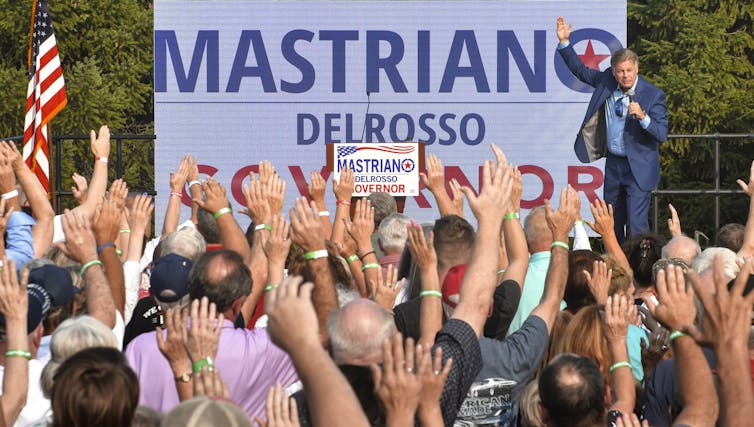
This practice often involves identifying “strongholds” of evil, around cultural issues, such as gay marriage, transgender rights and LGBTQ+ activism, and working to dismantle them. An example of this is a recent series of religious-based political rallies led by NAR leaders known as “The Courage Tour” that advocated directly for Trump’s second election.
The NAR emphasizes that Christians should expect to see miraculous signs, where extraordinary events, such as Trump’s survival of an assassination attempt, are interpreted to be explained only by divine or spiritual intervention.
The movement’s adherents also believe in faith-based healing and supernatural experiences, such as prophetic utterances and speech.
Trump as divinely ordained
Many NAR leaders and followers support Trump, viewing him as a divinely appointed figure who would facilitate NAR’s goals for societal reconstruction, believing he was chosen by God to fulfill a prophetic destiny.
They position Trump as a warrior against a so-called demonically controlled – and therefore corrupted – “deep state,” aligning with NAR’s emphasis on spiritual warfare and cultural dominion as outlined in the “Seven Mountains” mandate. NAR leaders followed Trump’s understanding of a corrupt government.
The NAR led a “Million Women” worship rally on Oct. 12, 2024, to Washington, D.C., in which the organizers sought to encourage 1 million women NAR adherents to come to pray, protest and support Trump’s campaign. The event was promoted as a “last stand moment” to save the nation by helping Trump win the election as a champion against dark, satanic forces.
Several prominent politicians, legislators and members of the judiciary, such as House Speaker Mike Johnson and Supreme Court Justice Samuel Alito, have flown the NAR-based “Appeal to Heaven” flag.
For NAR evangelicals, the presidential election is interpreted through a Christian apocalyptic rhetoric. In this rhetoric one candidate is a force for good, a warrior for God – Trump – and the other is led by demonic forces such as Harris. Trump’s 2024 win is seen as a critical moment of spiritual warfare where the forces of God defeat the forces of evil.
Criticism from many Christian denominations
Despite its growing popularity, NAR faces substantial criticism. Many mainstream Christian churches argue that the movement’s teachings deviate from traditional Christian orthodoxy.
Critics highlight abuse of authority by people who claim God is directing their actions and the potential for abuse of authority by those claiming apostolic roles. The embrace of Trump raises concerns about blending evangelical faith and political ambition.
Critics argue that the NAR’s support for Trump compromised the integrity of the gospel, prioritizing political power over spiritual integrity. The events surrounding the Jan. 6, 2021, attack on the U.S. Capitol further complicated this relationship, exposing the potential dangers of conflating religious beliefs with partisan politics.
Moreover, the NAR’s emphasis on spiritual warfare and the idea of taking control over society has raised other Christian groups’ concerns about its potential to foster an “us versus them” mentality, leading to increased polarization within society.
The New Apostolic Reformation represents a significant development, blending charismatic practices with a strong emphasis on politics and cultural transformation.
However, a large majority of Americans disagree that society should be remade based on religious theology. Thus, for now, the NAR movement’s fundamental views about religion and government are starkly at odds with most Americans.

This article is republished from The Conversation under a Creative Commons license. Read the original article.