

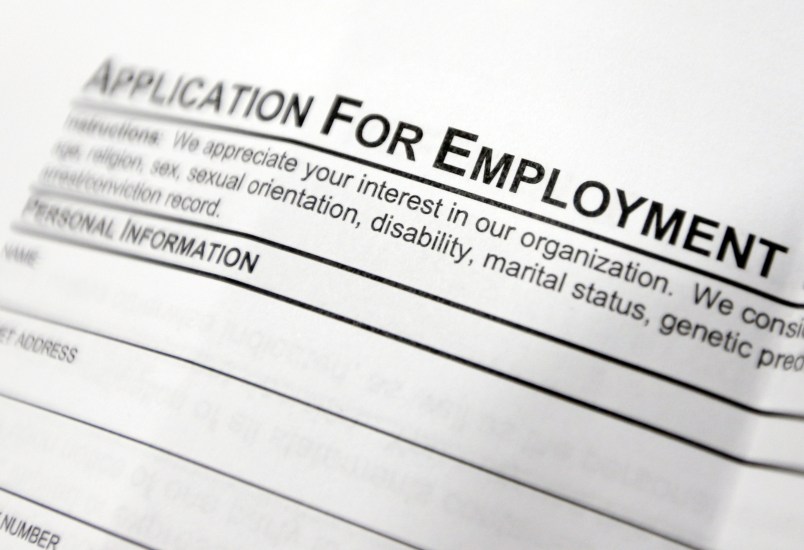
WASHINGTON (AP) — U.S. employers stepped up hiring modestly in April, and the unemployment rate fell to 3.9 percent, evidence of the economy’s resilience amid the recent stock market chaos and anxieties about a possible trade war.
Job growth amounted to a decent 164,000 last month, up from an upwardly revised 135,000 in March. The unemployment rate fell after having held at 4.1 percent for the prior six months largely because fewer people were searching for jobs.
The overall unemployment rate is now the lowest since December 2000. The rate for African-Americans — 6.6 percent — is the lowest on record since 1972.
Many employers say it’s difficult to find qualified workers. But they have yet to significantly bump up pay in most industries. Average hourly earnings rose 2.6 percent from a year ago.
The pace of hiring has yet to be disrupted by dramatic global market swings, a recent pickup in inflation and the risk that the tariffs being pushed by President Donald Trump could provoke a trade war.
Much of the economy’s strength, for the moment, comes from the healthy job market. The increase in people earning paychecks has bolstered demand for housing, even though fewer properties are being listed for sale. Consumer confidence has improved over the past year. And more people are shopping, with retail sales having picked up in March after three monthly declines.
Workers in the private sector during the first three months of 2018 enjoyed their sharpest average income growth in 11 years, the Labor Department said last week in a separate report on compensation. That pay growth suggests that some of the momentum from the slow but steady recovery from the 2008 financial crisis is spreading to more people after it had disproportionately benefited the nation’s wealthiest areas and highest earners.
The monthly jobs reports have shown pay raises inching up. At the same time, employers have become less and less likely to shed workers. The four-week moving average for people applying for first-time unemployment benefits has reached its lowest level since 1973.
The trend reflects a decline in mass layoffs. Many companies expect the economy to keep expanding, especially after a dose of stimulus from tax cuts signed into law by Trump that have also increased the federal budget deficit.
Inflation has shown signs of accelerating slightly, eroding some of the potential wage growth. Consumer prices rose at a year-over-year pace of 2.4 percent in March, the sharpest annual increase in 12 months. The Federal Reserve has an annual inflation target of 2 percent, and investors expect the Fed to raise rates at least twice more this year, after an earlier rate hike in March, to keep inflation from climbing too far above that target.
The home market, a critical component of the U.S. economy, has been a beneficiary of the steady job growth. The National Association of Realtors said that homes sold at a solid annual pace of 5.6 million in March, even though the number of houses for sale has plunged. As a result, average home prices are rising at more than twice the pace of wages.





Thoughts on how all this very positive job news will play out in November? The Republican ads just seem to write themselves.
We need a more thorough analysis. In previous months, people going through the data have reported that it’s mostly urban areas benefiting from the improvement. And that the drop is still in significant part due to fewer people in the job market. And, of course, there are the recent woes of the stock market. So we have no idea what this will all look like to voters in a few months.
Huh, weird coincidence.
I’ll go on record and say that this jobs report isn’t that great when you look past the headline. It’s a mixed bag.
On the one hand, you can’t use this report to say the economy is faltering. If HRC were President, you’d look at these numbers and say…‘not bad on the surface, but let’s look behind to see if this translates to anything meaningful for the American people’.
On the other hand, I think if you take this report combined with some other factors, you can see signs that there is a real ceiling on growth, and a higher cost of living being imposed on American workers, so there’s a risk of the ground slowly shifting.
First, the unemployment rate went down for the wrong reasons. It went down due to lower labor force participation. So although the headline of 3.9% looks great, it’s really a function of math and not what we would normally associate with lower unemployment.
Second, wage growth is flat and inflation is creeping up. We’re seeing signs in terms of gas prices. Also, we’re seeing anecdotal evidence that the tariff war is taking a bite out of certain businesses that are tied to trade.
Third, long-term interest rates crept up over 3% and then dropped to 2.9%. That 3% number is a key factor. The housing inventory has also dropped. The tax cut is taking a bite out of the housing industry. Trumpism has taken a bite out of the tourism industry.
Fourth, there is the tax cut itself as a political matter. The Tax cut has made it difficult for Trump/GOP to take credit for the Obama economy. People view it as an unnecessary giveaway to the wealthy, and they’re wary that the GOP bagman is coming for their benefits to pay for it as the debt and interest rates spiral upward. Voters want the Democrats in to check GOP excess to keep them from messing up the economy. That sentiment right there (which was reflected in PA-18 and other elections) demonstrates that voters inherently assume that the economy the GOP is running right now was inherited, not created, by them.
So we have an environment in 2018 where the cost of money is higher, the stock market is flatter, wage growth is flat, the debt is higher, inflation is higher, and employment growth is a little soft as compared to the 2016-17 baseline. That’s kind of a meh message to take into the 2018 elections, especially when you promised that the tax cut would result in a ‘roaring 20’s’ style growth or what people remember of the Reagan recovery in 1983-84.
In other words, Dems should ignore this report, focus on health care, wage growth, education, Trump and go win 100 seats in the House and a net gain of 3 or 4 in the Senate.
Dems should even date to be as dismissive as a Tea Partier in heat in 2010: ‘This is an economy for rich, old, conservative men. Not for you.’
Thanks. I hadn’t thought about the urban-rural split.