

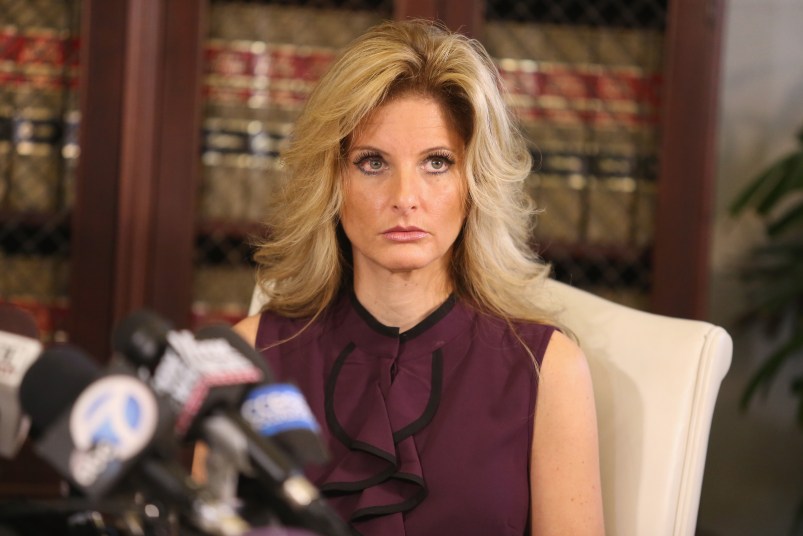
NEW YORK (AP) — A judge set deadlines that could make President Donald Trump answer questions under oath by early next year in a former “Apprentice” contestant’s defamation suit, while Trump’s lawyers pushed back Tuesday on demands for information on his campaign’s discussions about other women who also accused him of sexual misconduct.
Trump’s legal team continues to try to get Summer Zervos’ defamation lawsuit dismissed or delayed until after his presidency. But at least for now, it’s moving into an information-gathering phase that could involve key disclosures — and put both Trump and Zervos under questioning by each other’s lawyers.
Zervos accuses Trump of slurring her by calling her a liar. Already, her lawyers have issued subpoenas seeking a range of information, including any records concerning his 2016 campaign’s responses to Zervos’ and other women’s accusations of inappropriate sexual behavior. Trump has vehemently denied them all as made-up.
At a court hearing Tuesday, Trump lawyer Marc Kasowitz said the campaign shouldn’t have to turn over any material about other women.
It’s “irrelevant,” he said.
Not so, said Zervos’ attorney, Mariann Wang.
“It’s a defamation case, so we are required to prove the falsity of the statements, and his statements include statements about other women,” she said outside court.
Manhattan state Supreme Court Justice Jennifer Schecter didn’t settle that dispute Tuesday but began setting various deadlines, including Jan. 31 for any depositions of Trump and Zervos. Lawyers for each have indicated they want to depose the other’s client.
If they do, each side will have up to seven hours.
Presidential depositions have a memorable history: During a 1998 deposition in a sexual harassment case filed by Paula Jones, then-President Bill Clinton denied a sexual relationship with White House intern Monica Lewinsky. Clinton’s denial eventually led to his impeachment by the House of Representatives for perjury and obstruction of justice; the Senate ultimately acquitted him.
Despite the deadline, it’s too soon to say for sure when Trump might have to submit to questioning. His lawyers plan to argue to a state appeals court this fall that a sitting president can’t be sued in a state court, and Kasowitz indicated Tuesday that the question could end up at the U.S. Supreme Court.
He also said Trump might seek extensions on various case deadlines because of the “significant attendant duties” of the presidency.
Zervos, a California restaurateur, appeared in 2006 on Trump’s former reality show, “The Apprentice.” She says he subjected her to unwanted kissing and groping when she sought career advice in 2007.
She was among more than a dozen women who came forward late in the 2016 presidential campaign to say that Trump had sexually harassed or assaulted them.
The Republican denied all the claims, saying they were “100 percent fabricated” and “totally false” and his accusers were “liars.” He specifically contested Zervos’ allegations in a statement and retweeted a message that included her photo and described her claims as a “hoax.”
Zervos says his words hurt her reputation, harmed her business and led to threats against her. She is seeking a retraction, an apology and compensatory and punitive damages.
Trump’s attorneys have said his statements were true, and also that his remarks were “non-defamatory opinions” that came amid the heated public debate of a national political campaign.
Besides the campaign records, Zervos’ lawyers have subpoenaed other information including any “Apprentice” material that features Trump talking about Zervos or discussing other female contestants in a sexual or inappropriate way.
Trump’s lawyers, meanwhile, are seeking a court order to keep some documents and information private. The details are yet to be worked out.
Such confidentiality agreements, meant to facilitate the exchange of information between opposing sides, aren’t uncommon. Wang said Trump’s lawyers initially signaled they wanted to seal a swath of filings in the case, but Kasowitz said Tuesday they would narrow their request.
But Kasowitz said they are mindful of media interest and might seek additional protections if it “intrudes on the interests and rights of the litigants or looks like it would impair the ability to have a fair trial.”




It is absolutely certain that Trump will lie under oath, so bring on the deposition post-haste. I guess he can plead the 5th, but that’s clearly an admission of guilt (even if people say it’s not). Get this POS under oath and then charge him with perjury. Why the hell does it have to wait until next year? Could it have a little something to do with a midterm election?
Oh FFS please make the deposition available worldwide on PPV and we could wipe out the national debt in one day.
De P.O.S. ition, more like.
I can’t wait for the howling.
Can he plead the 5th in a civil case? He’s not at risk of going to jail here, just having to write a big check. I just hope Michael Cohen has the defamation slush funds handy.
And he’ll definitely perjure himself. As Guliani infamously said, “our recollections keep changing.”
Yes, one can plead the Fifth Amendment in a civil case, or in testimony before Congress, or in any other forum. Even if the case is not criminal, one could refuse to testify out of fear that the admissions made in the case could be used in a subsequent criminal proceeding.
Of course, pleading the Fifth in a civil case might lead to a judgment against the defendant for not cooperating with the discovery process. Couldn’t happen to a nicer person.