


From what began as a routine traffic stop in Georgia, U.S. Army veteran Godfrey Wade was detained, transferred to a facility in Louisiana, and shipped off to a country he hadn’t known in 50 years.
Sixty-seven-year-old Roderick Johnson, a Black U.S. citizen, found himself zip-tied and left outside for hours after Immigration and Customs Enforcement agents broke down the door of his apartment and many others in a building in Chicago’s South Shore neighborhood.
And while driving in Minnesota, an American couple reportedly from Illinois endured an ICE traffic stop wherein the driver was asked to produce identification and can be heard saying he’s a U.S. citizen.
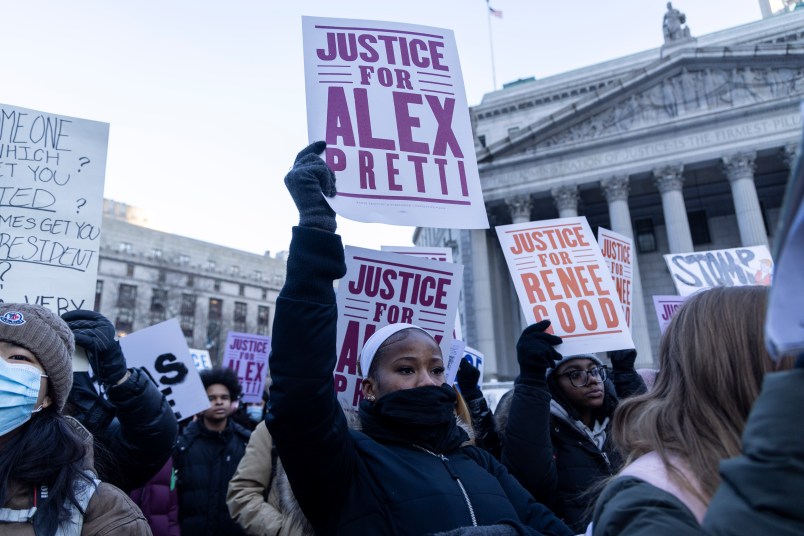
Harassment from law enforcement, traffic stops turned bad, and the use of what are essentially no-knock warrants aren’t foreign tactics to many Black people living in America. But under President Donald Trump’s sweeping anti-immigration campaign, the perpetrating officers have expanded to include Customs and Border Patrol and ICE agents. Black Americans, especially those who have been convicted of crimes or participate in political dissent, risk being swept up in Trump’s immigration dragnet. The Trump administration has even threatened its political enemies with the prospect of denaturalization. As the administration dilutes civil rights, including through Supreme Court-approved policy like “Kavanaugh stops,” which let federal immigration agents engage in racial profiling, activists and constitutional law scholars told TPM the overlap of street-level policing and immigration enforcement poses unique risks to Black Americans whose ancestors were enslaved here.
On the campaign trail, Trump and his allies pledged to execute an unprecedented and aggressive deportation agenda. Tom Homan, current White House Border Czar and Trump’s former head of ICE, bragged about the operation in July 2024.
“Trump comes back in January — I’ll be on his heels coming back,” Homan told attendees at the National Conservatism Conference. “And I will run the biggest deportation operation this country’s ever seen.”
Since then, the administration, through a dizzying flurry of action, has laid the groundwork for compromising civil rights in America, including the rights of naturalized citizens. (It has gone so far that Homan has now been sent in to control of ICE, cast as a voice of moderation.) Trump and Secretary of State Marco Rubio in February 2025 said they were weighing their ability to deport non-immigrant Americans convicted of crimes to foreign prisons. The president doubled down on his desire to deport citizens convicted of crimes in April.
“If it’s a homegrown criminal, I have no problem,” Trump told reporters during a meeting with Salvadoran President Nayib Bukele in the Oval Office. “If we can do that, that’s good. And I’m talking about violent people. I’m talking about really bad people. Really bad people. Every bit as bad as the ones coming in.”
This in particular should raise alarm bells for Black people, said Karla McKanders, the director of the Thurgood Marshall Institute at the NAACP Legal Defense Fund. Black people are around twice as likely to be searched during traffic stops as any other racial group, according to 2022 data from the Bureau of Justice Statistics analyzed by the Prison Policy Initiative. Black people are disproportionately more likely to be incarcerated than white people. And Black people are 7.5 times more likely to be wrongfully convicted of murder than white people, according to the National Registry of Exonerations.
McKanders studied what she calls the prison-to-deportation pipeline, and has shown that Black immigrants are much more likely to experience traffic stops and subsequent immigration action. With Kavanaugh stops, named after Supreme Court Justice Brett Kavanaugh and allowing for federal law enforcement to engage in racial profiling, Black Americans can be stopped just for being Black, regardless of immigration status.
“Black descendants of enslaved people should be concerned because the same kind of pipeline of disproportionately being impacted by traffic stops applies across the board to all Black people,” McKanders told TPM.
Trump has also directed federal law enforcement to investigate left-leaning advocacy groups which the administration has classified as domestic terrorist organizations, which experts told TPM was “a clear blueprint for going after political enemies.”
And the administration has also repeatedly ruminated about a denaturalization campaign, including in a June DOJ enforcement memo that imagined targeting people “who pose a potential danger to national security,” a dangerously broad classification under an administration which has widened the definitions of terrorism to punish Trump’s opposition.
“[I]f this administration can label anyone a domestic terrorist and say that a domestic terrorist is not entitled to due process, then that could erode not only that person’s rights but could put them in jeopardy,” said Timothy Welbeck, a constitutional law and African American studies professor at Temple University. “If someone is not entitled to due process, anyone could be labeled a criminal, their rights can be infringed upon, and they can be disappeared, and that should concern us all.”
Heather Wills is the deputy executive director at the Workers Center for Racial Justice in Chicago, the city where Black Americans were corralled alongside Latino immigrants by ICE agents who descended on an apartment complex in the middle of the night. She said any idea that Black community organizations have a separate fight from immigrant communities is a myth.
“Our struggles are parallel, our struggles are intersectional, and we have always been advocating for constitutional and human rights for all people,” Wills said.
D.C. is another example, said Amaha Kassa, executive director and founder of African Communities Together. This past summer, the nation’s capitol saw National Guard soldiers flood Black neighborhoods and chase residents in encounters posted to social media. Kassa said the federal law enforcement presence, whether Guard troops or ICE agents, show the intersection between issues that have long plagued Black communities, and immigration enforcement that seeks to alter the interpretation of the U.S. Constitution.
“I think what we could not have anticipated was how reckless and lawless the use of executive power has been,” Kassa said. “And certainly,” he added later, “they are aggressively seeking to denaturalize people who may have had any contact with the criminal justice system. Clearly there’s a risk of denaturalization and stripping of citizenship from people who’ve had criminal convictions.”
Trump’s attempt to revoke birthright citizenship is another looming concern for Black Americans. The Jan. 20, 2025 executive order contrasted the 14th Amendment protections against “excluding people of African descent from eligibility for United States citizenship solely based on their race” with children born to undocumented parents or parents with legal temporary residence in the U.S.
Almost as soon as Trump issued his order, it was met with an avalanche of legal challenges, eventually becoming subject to a class action lawsuit filed by groups including the American Civil Liberties Union (ACLU) and the NAACP Legal Defense Fund. The Supreme Court will hear arguments in the birthright citizenship case in April.
In response to a TPM inquiry, White House spokeswoman Abigail Jackson said the president’s executive order “would not apply retroactively” and is designed to remove the guarantee of citizenship to the children of undocumented immigrants. “This is an absurd argument made in bad faith by partisan actors seeking to attack the Administration’s efforts to safeguard American citizenship,” Jackson said. “The government’s position is that the Citizenship Clause in the Fourteenth Amendment was expressly designed to ensure that slaves and their descendants were guaranteed citizenship and that it does not guarantee citizenship to the children of illegal aliens.”
But experts said revoking any part of the 14th Amendment citizenship protections is a slippery slope for generational U.S. citizens, including Black Americans whose naturalization is guaranteed only under that amendment.
“To start to even question the supreme law of the land, which has always been what it is, raises a lot of concerns,” Minnesota-based immigration attorney Nkechi James-Gillman told TPM. “Because if that one becomes compromised, what else?”



Serious question. Have not seen any reporting of ‘Kavanaugh stops’ by law enforcement other than ICE and CBP? Is there evidence that incidents of racial profiling have spread to street-level law enforcement? This article is the first indication I have seen of concern in the legal and civil rights community that the approval of Kavanaugh stops can be interpreted as broader than immigration enforcement.
Trump quote in the article:
“If we can do that, that’s good. And I’m talking about violent people. I’m talking about really bad people. Really bad people. Every bit as bad as the ones coming in.”
… … … … … …
He must’ve really hated his Scottish immigrant mother
Or his paternal grandparents from Germany.
…or his first wife and his current wife.
Or two of his wives.
ETA. I’m late, but wife 3 should avoid stairs.