


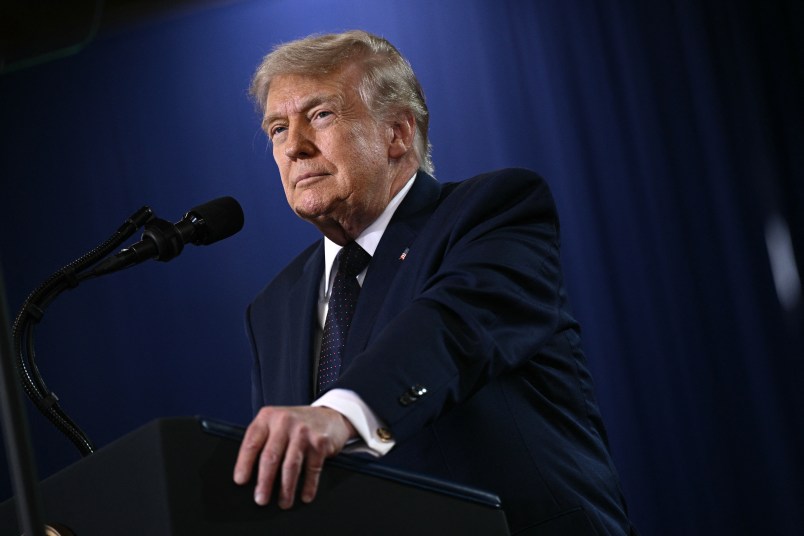
A Trump-appointed federal judge ruled early Thursday morning that the Democratic Senatorial Campaign Committee and civil rights groups lack standing to block an executive order that seeks to create a federal voter list and restrict mail-in voting.
“Given that the Executive Order does not command Plaintiffs to do anything, and that no agency has yet acted pursuant to the Order in a way that could harm Plaintiffs, they have not suffered any harm at present, much less harm that is ‘certain,’ ‘great,’ and imminent,” wrote Carl John Nichols, a district court judge for the District of Columbia.
The March executive order would require the Department of Homeland Security to create rolls of voters that are citizens, over 18 years old and reside in the state. It would also force the U.S. Postal Service to incorporate specific design elements into mail-in ballots and to only send ballots to a “state-specific mail in and absentee participation list.” It’s not clear how the various lists are meant to intersect. Experts warn that such lists are sure to be riddled with inaccuracies and could be weaponized by the Trump administration to remove eligible voters.
The Democratic and civil rights group plaintiffs argued that President Trump is overstepping his constitutional limits with the executive order, as Article 1 gives only Congress and state legislatures the power to establish rules for federal elections. They added that USPS has no power to regulate mail-in voting.
Nichols echoed the Trump administration’s argument that it’s too early to bring a lawsuit, since the agencies involved have not yet acted on the executive order. He also cast doubt on groups’ ability to challenge the executive order at all, writing that potential harms against voters and candidates are “too attenuated,” since it’s too early to know whether implementing these completely unprecedented processes when primary elections have already begun will result in major mistakes.
“It remains speculative whether the State Citizenship Lists, if and when they are initially compiled, will contain inaccuracies,” he wrote credulously.
It’s unclear from Nichols’ ruling who, under his interpretation, would actually have standing to challenge the order. If plaintiffs have to wait for voters to discover, first, that they have been excluded from the lists, then that they are unable to correct their status and then to file a lawsuit, the midterm elections will be even further underway than they already are.
A similar case is making its way through a federal court in Massachusetts, and a decision is expected as soon as early June. Multiple federal courts had separately blocked Trump’s previous executive order that required proof of citizenship to vote.
While instances of undocumented immigrants voting are vanishingly rare, Trump has fixated on the topic as a) an excuse to try to bar Democratic voters from the ballot box before the 2026 midterms, b) an explanation for his 2020 loss and c) a way to keep illegal immigration in the headlines.
Combined with Trump’s furious coercion of red states to redistrict before the midterms, the executive order is another attempt to overcome his historic unpopularity by rigging the upcoming election in Republicans’ favor.
Read the ruling here:



As many others have said on these forums and elsewhere, our only hope may be to have a blue wave election big enough that these election tampering shenanigans don’t matter. Sigh…
On another note, $250 is an expensive sheet of toilet paper, but I feel like it’s a sacrifice I could make.
Same stuff, different day.
And yet multiple Federal judges had no problem blocking this.
They’ve not had this exact order to contend with, and standing is often an issue with his EOs in a 3-branch system with 2 of them on life support. With multiple cases brought in multiple jurisdictions one or more are likely to find standing, but that’s part of DT’s litigation game - delay, whether by legal maneuvers or, as here, based on judicial dysfunction, until it’s too late to do anything.
It seems as though this is a pretty easy call at the state and local tiers of government. Just ignore the order because it is clearly unconstitutional at a basic level.