


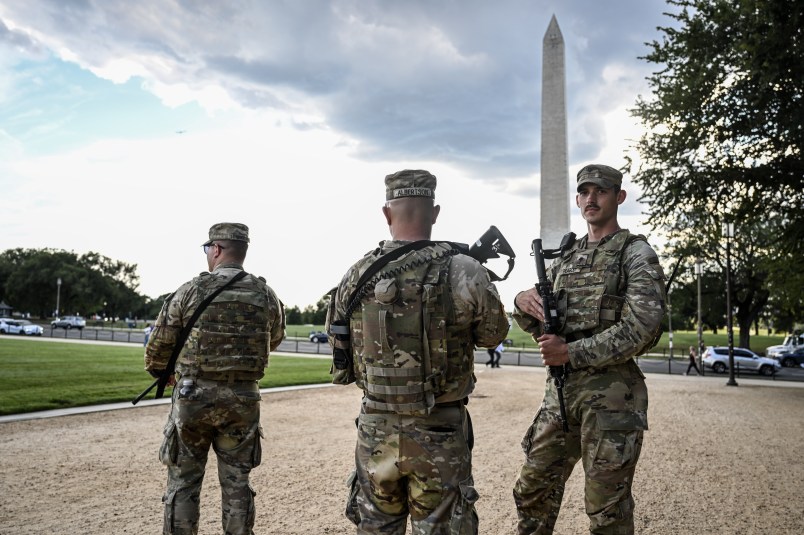
President Trump flooded Washington D.C. with armed federal law enforcement under the time-honored, fact-optional conservative pretext: The city’s leadership is incapable of governing, which has led to skyrocketing crime (it has not), rendering the nation’s capital an unlivable hellscape.
This will come as a surprise to the many tourist families ogling the gaggles of National Guard standing around at Union Station and the Mall and the Wharf.
But before Trump reached for the old D.C. standbys to justify his occupation, he and his Republican allies in Congress did everything they could to weaken the district earlier this spring. They used the district’s lack of true self-governance to withhold over $1 billion of its own money, paid by its own taxpayers, in the middle of the fiscal year.
“This was unprecedented. Congress definitely engaged in overreach,” Tazra Mitchell, chief policy and strategy officer at the DC Fiscal Policy Institute, told TPM. “These are D.C. local dollars. These are not dollars raised through the federal tax code or fee structure. This was an attack on D.C.’s budget autonomy. It didn’t save the federal government a single penny.”
That nonchalant theft came on top of the economic hobbling of the DOGE layoffs, which revised revenue projections downward by a shocking $1 billion over the next four years, driven by an expected 40,000 job losses, according to the mayor’s office.
“We knew very quickly, even as early as late February into the Trump administration, that their reckless cuts were going to throw D.C. into a mild local recession,” Mitchell added.
Blocking D.C. from spending its own money, ratcheting up its unemployment numbers, forcing district leadership to enact mass hiring freezes and to indefinitely stop programs it intended to launch all weakened the city. And worsening the district’s economy has a direct connection to its public safety through police recruitment, violence intervention programs and keeping its residents out of poverty.
“You’re asking me to operate with one hand behind my back, then when I’m not successful, you want to punish me for it,” Christina Henderson, D.C.’s at-large councilmember, told TPM.
D.C. Can’t Spend Its Own Money
At first, when Congress passed a continuing resolution to keep the government open that cut D.C.’s budget by $1.1 billion in March, it seemed like a mistake that even Republicans wanted to fix.
Trump ordered House Republicans to pass the Senate’s bill restoring the funding “IMMEDIATELY”; House Speaker Mike Johnson (R-LA) said he wanted to restore the funding “as quickly as possible,” adding that “we’re not delaying this for some political purpose.”
Months passed, and the hole in the budget remained unfixed.
Sens. Chris Van Hollen (D-MD) and Susan Collins’ (R-ME) bill to restore D.C.’s funding passed through the Senate immediately after the CR in March, but never received a vote in the House.
“It’s the height of hypocrisy for Donald Trump to abuse emergency powers in the name of improving public safety in D.C. while he and Republicans hold back over $1 billion of D.C.’s own funds that could be used for public safety,” Van Hollen told TPM.
And then, in late July, after Republicans passed Trump’s sweeping reconciliation package, Johnson sent the House home early to avoid having to keep voting on releasing the Epstein files.
“We were just as shocked as everybody else that Speaker Johnson was sending them home early because he didn’t want to do any more of the Epstein votes,” the D.C. Council’s Henderson said. “That threw us off as well — we were hoping to be in the wrap-up before recess.”
When Congress Returns
Lawmakers will return to Capitol Hill next week as their lengthy August recess comes to an end. A top priority will be funding the government to avoid a shutdown before the money runs out at midnight on Sept. 30.
Both chambers have been working on passing appropriations bills, but the process is far from complete. And with just a couple of weeks left until the federal government runs out of money, a continuing resolution will again be part of the negotiations.
Mitchell tells TPM the DC Fiscal Policy Institute is worried that the district might get hit with another round of cuts in the upcoming fight to fund the government for the next fiscal year.
“What we’re seeing with the National Guard is pretty egregious … as that’s happening, we’re also seeing a bevy of appropriation riders attached to bills in the House that would both overturn some of D.C. laws, but also restrict our spending if we don’t get in line with what Republicans want D.C. to do. So we’re seeing attacks on all fronts,” Mitchell told TPM. “I do fear that D.C. could again be put on the chopping block and be forced to spend less money — basically a repeat of what we saw in March.”
Mitchell added that another possible cut to the district’s budget could come from the recent passage of Republicans’ reconciliation package, which includes state-level cuts to Medicare and the Supplemental Nutrition Assistance Program (SNAP).
The district’s precarity, as it’s overrun with armed officers and desperately trying to fend off economic pain, is a stark reminder that Democrats had the chance to make D.C. a state four years ago. Then-Sens. Kyrsten Sinema (D-AZ) and Joe Manchin (D-WV) chose sustaining the filibuster over D.C.’s statehood, and the effort to sway them stalled out early in President Biden’s term. Both have since exited Congress.
“The necessity for true self-government through statehood for the people of D.C. has never been clearer,” Rep. Jamie Raskin (D-MD) told TPM. “The 700,000 tax-paying, draftable citizens of the Capital City are entitled to govern themselves without constant federal interference and partisan games.”


A couple of “lessons learned”, should Democratic leadership be capable of learning:
In short, what Republicans call “small government we can drown in a bathtub”.
Every Republican lies.
I would hate to be the child of a reactionary congresscritter.
I can only imagine a lot of, “When I was your age …,” threadbare clothing and gruel, Heaven save me from ever asking for more.
Hmmm…taxation without representation, armed soldiers in the streets, a mad king…why does this sound like it’s happened before?
“American carnage” was a prediction. (Or a threat.)