


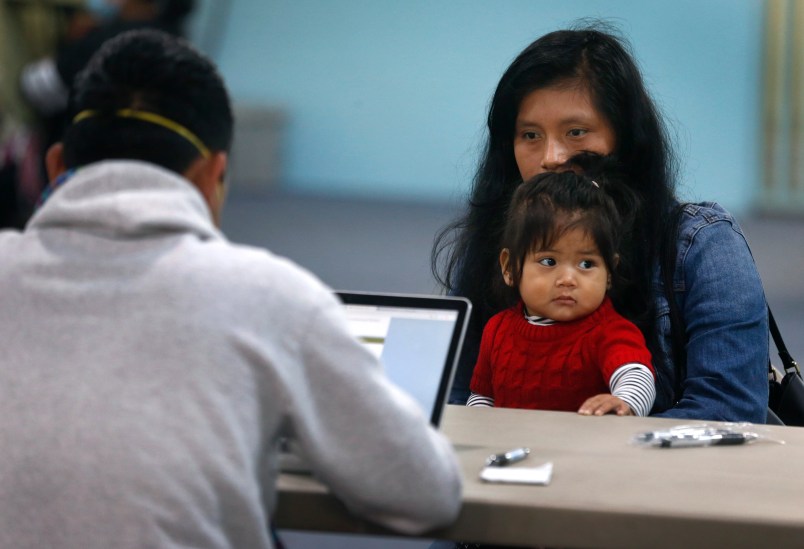
A version of a federal rule proposing to exclude certain noncitizens from being counted in the 10-year Census was published to the federal register this morning, and is more aggressive in several ways than the draft version first revealed in full last month by TPM. The final version explicitly proposes a question about immigration status on the census, excludes refugees and asylees from the count, and changes how members of the military are to be tallied.
It also narrows the list of immigrants the Census Bureau would classify as U.S. residents, as President Donald Trump’s administration seeks to wield the decennial population count to benefit Republican states.
In addition to adding a residency question to the census, this proposed rule would eliminate the collection of all race and ethnicity data for the first time since the census began in 1790. The proposal stands to threaten myriad data users, from public health researchers to billion-dollar corporations, experts told TPM.
“Race and ethnicity are just decidedly meaningful variables in the United States,” said Chris Dick, founder and president of Demographic Analytics Advisors, a private firm.
The administration is using the rule to remake how the census counts people and tracks where they live. These reams of data shape political power; they are used in congressional apportionment, determining the number of House seats for each state and a state’s power in the Electoral College. They are also often used in redistricting.
It does this in part by changing how the census defines a person’s “usual residence.” In 2020, that was where you might “live and sleep most of the time.” Under this draft, it’s narrowed to a place “consistent with, and evidenced by, their tax records.”
The rule states that the Trump administration is considering whether to add a question to the 2030 census inquiring about immigration status. “The Census Bureau welcomes comments on the inclusion of a legal-status question on the short-form decennial census questionnaire,” the final rule reads.
Thomas Saenz, President and General Counsel at the Mexican American Legal Defense and Educational Fund, told TPM that such a question would be “completely untested and potentially far worse than a citizenship question.”
Inquiring about status would add immense complexity to the process, Saenz argued, forcing the bureau to “distinguish lawful permanent residents and asylees/refugees from all other immigrants.”
Excluding anyone living in the U.S. from the population count is a violation of the Constitution’s 14th Amendment, Terry Ao Minnis, vice president of Census and Voting Programs at Asian Americans Advancing Justice – AAJC, told TPM in an email.
“The U.S Constitution requires apportionment based on the whole population in each state, regardless of citizenship status,” Minnis said, “and the Supreme Court’s recent birthright citizenship ruling undercuts the administration’s reliance on ‘allegiance’ as a basis for who counts.”
Such a rule would mount a similar version of an attack that failed under Trump I. That administration fought up to the Supreme Court to include a citizenship question on the 2020 census. The effort failed: In a 5-4 decision, Chief Justice John Roberts found the administration’s reason for adding the question was “contrived.”
The administration’s efforts then weren’t helped by an odd bequeathal: a Republican strategist’s death revealed a trove of records detailing how the GOP realized that having the census systematically undercount non-citizens could weaken blue states’ representation in Congress.
Experts expected the administration to publish this rule proposal when, on Tuesday, the government denied meeting requests filed by stakeholders under a 1993 federal regulation established by executive order, according to individuals familiar who spoke with TPM.
The administration’s flat denial of those meetings, designed to allow the public to hold listening sessions with the White House on significant regulatory proposals, was unexpected, Mary Jo H. Mitchell, director of government affairs for Population Association of America and Association of Population Centers, told TPM. As was the rule’s more stringent exclusion of a broader swath of noncitizens.
“Sure, we’re surprised, but why wouldn’t we be? We weren’t involved or consulted or informed at any stage of this in a meaningful way,” Mitchell said.
According to a draft document obtained by TPM, the Executive Office of the President deliberated with the Department of Commerce ahead of time to justify the cancellation of those meetings. The proposed rule is significant, but not economically significant, the administration wrote in the deliberation draft. That analysis was reworded and included in the published rule.
The White House and Commerce Department did not immediately reply to TPM’s request for comment.
The idea that this decision isn’t economically significant is “fantastically idiotic,” Howard Fienberg, senior vice president of advocacy at Insights Association, told TPM.
“Race and ethnicity data are a key portion of how you determine, is the sample the right — are we capturing the universe we’re supposed to capture,” Fienberg said. “If you throw that off, if you remove that benchmark, you are unmooring pretty much almost all of the insights garnered across the United States… And that’s priming the United States for an economic disaster.”
Experts are preparing advocacy appeals to elected officials and community organizations in opposition to this rule proposal.
“Congress needs to exert its oversight authority to examine not only the rationale for this proposed rule,” said Mitchell, “but also understand fully the implications and exert their authority before any of these changes take effect.”
Correction: This piece has been updated to clarify that the rule states that the Trump administration is considering whether to add a question to the 2030 census inquiring about immigration status, not citizenship.



Trump’s changes, except for “The Big Beautiful Bill,” are executive orders and will (hopefully) be undone by the next president.
One branch of my family got to N. America from France in the late 1600’s in what became Virginia. The other branch came from Ireland in 1816. Now, trump himself is a first generation American thru his mom’s side. She came from Scotland. His father’s side came from Germany. I think it was his great grandfather but I could be wrong.
I am a citizen of America. If trump has a problem with that he can go F&ck Himself sideways with cholla cactus.
I intend to vote. Trump will not keep me from casting my very legal ballot.
I ardently hope that all republicans get the boot in their painful spot and are told to clean out their offices and seek other employment.
(grumble)
Call me crazy, call me foolish, but I just do NOT trust DJT and his minions who praise and attempt to emulate dictators Vladimir Putin, Kim Jong Un, and Xi Jinping while simultaneously denigrating the elected leaders of most of our NATO allies and trading partners. Trump’s word means nothing.
Odds are he doesn’t know what his words mean anymore either.