

This story was originally reported by Shefali Luthra of The 19th. Meet Shefali and read more of their reporting on gender, politics and policy.
Republicans running for governor across the country are backing away from abortion bans they once endorsed.
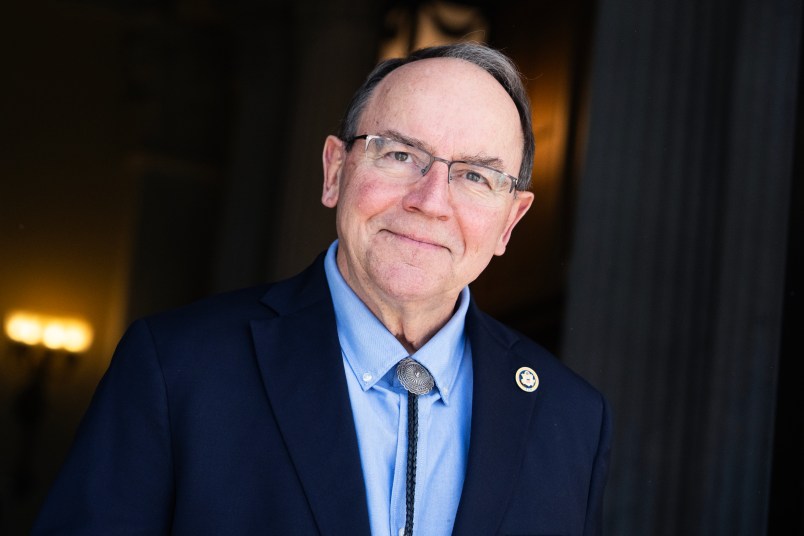
U.S. Rep. Tom Tiffany, the Republican candidate for governor in Wisconsin, calls his state’s 20-week abortion limit “settled law.” Just three years ago, he co-sponsored a bill that would have banned abortion six weeks into pregnancy.
Stacy Garrity, the GOP’s candidate in Pennsylvania, has said during her campaign that she would “respect” the state’s current law, which allows abortion until 24 weeks of pregnancy. Four years ago, she called on abortion opponents “to engage and make a difference” in state laws after the fall of Roe v. Wade.
In Kansas, where abortion is legal until 22 weeks, Republican Ty Masterson has demurred when asked if, as governor, he would support a statewide referendum to eliminate the Kansas constitution’s abortion protections. Masterson had previously spoken at protests in opposition to reproductive rights and won the backing of state and national anti-abortion groups.
The candidates’ retreat suggests that, even as reproductive rights fade from the national spotlight and polls show voters are far more likely to prioritize cost-of-living concerns, the political ramifications of pushing for new abortion restrictions remain substantial. The rhetorical distancing also moves political conversations away from an issue that overwhelmingly energizes Democrats.
“That might be their strategy there, to try to demotivate Democratic turnout in the state to take abortion off the table as a voting issue,” said Ashley Kirzinger, a pollster at KFF, a nonpartisan health policy research, polling and journalism organization. That’s especially true in tighter races such as those in Wisconsin and Kansas, she said.
Tiffany’s, Garrity’s and Masterson’s campaigns did not reply to requests for comment. The 19th contacted multiple Republican-aligned pollsters who also did not immediately respond.
About 60 percent of Americans believe that abortion should be legal in most or all cases, including about two-thirds of independents, according to a poll from The 19th and YouGov.
That said, pushing for abortion restrictions has never been broadly popular. Even before Roe v. Wade was overturned in 2022, Republicans seeking general election typically would not campaign overtly on abortion bans, said Molly Murphy, a pollster and president of Impact Research, a Democratically-aligned polling firm.
“It would get discussed in donor meeting hot mics, endorsement questionnaires, etc, but candidates wouldn’t run on the fact that they’d ban abortion,” she wrote in an email.

Voters largely don’t consider abortion to be “settled law,” said Celinda Lake, a longtime Democratic pollster, noting that the share of voters opposing abortion bans has increased since the fall of Roe. “They feel like, ‘Wait a minute, it can be taken away again.’”
In some races, Democrats and their allies are trying to push abortion rights back under the microscope — a strategy geared toward energizing liberal voters, Kirzinger said.
Wisconsin’s Democratic nominee for governor, David Crowley, has said that, if elected, he would work with the state legislature to enshrine abortion rights into the state constitution — though it’s not clear how expansive that protection would be or whether it might supplant the state’s 20-week cutoff.
Pine Tree State Prosperity, a political action committee associated with the national Democratic Governors Association, is running advertising in Maine that highlights anti-abortion remarks made by Bobby Charles, the state’s Republican pick for governor. The Democratic nominee, Hannah Pingree, has led by double digits in recent polls. Charles’ campaign did not reply to a request for comment.
Planned Parenthood’s super PAC, called Planned Parenthood Votes, has focused its resources in states such as Michigan, where the Republican candidate, U.S. Rep. John James, has said that abortion is “decided.” Four years ago, James said he opposed abortion in all cases, and he has compared the practice to genocide. His campaign did not reply to a request for comment.
James’ running mate, Jay DeBoyer, recently suggested leveraging a state constitutional convention to enact a 12-week abortion ban in Michigan, according to recordings of the remarks reported by The Detroit News and Michigan Advance. DeBoyer has since said publicly that abortion is a “settled” issue in Michigan, where voters in 2022 amended the state constitution to protect abortion before fetal viability.
Some gubernatorial candidates are still pushing for abortion restrictions, albeit far less ambitious ones.
In New Mexico, where Democrats are expected to keep control of the governor’s mansion and already control both legislative chambers, Republican candidate Gregg Hull said he was “fully committed” to working with Texas Gov. Greg Abbott to reduce the number of Texans coming to the neighboring state for abortions.
Hull has repeatedly called himself “pro-life” but also said that he would not change the state’s abortion law, which imposes no time limits on the procedure, without legislative support. His campaign did not respond to a request for comment.
Abortion opponents are trying to revive the issue in a handful of states. SBA Pro-Life America, one of the nation’s leading anti-abortion groups, is pushing ads that characterize Democratic candidates for governor as well as the U.S. Senate and House of Representatives as extreme on the issue, including in Ohio, Wisconsin and Michigan.
But generally, voters are less likely to trust conservatives on abortion, Lake said. And talking about abortion, she added, is more likely to generate enthusiasm among key Democratic voting blocs, particularly young women and college-educated women, who typically support reproductive rights.
“We have in our research people who say, ‘I used to be pro-life, I didn’t support abortion, I would never get one, but I think this is a decision that needs to be made by a woman and her doctor,’” Lake said. “People now feel this is just way too dangerous. This has gone way too far.”





Dogs trying to un-catch the car they caught.
Gee, with Tom Tiffany’s taking contrary political positions, one could characterize him as a cross dresser. Who. Would. Have. Thought?
We already know from the SCOTUS justice hearings that statements made do not necessarily reflect the reality of the beliefs of the speaker.
Tiffany will say what he has to to get elected.
Then he will do whatever in the hell he wants because he doesn’t face the voters again for four years.
One of the first “anti-Crowley” commerials put out by the right was one hammering him for his stance on data centers and dealing with Milwaukee county. Leaving out that his stance was “make them pay” for both the building of the power sources and paying the full amount for it. WE Energies is who services our SE corner of Wisconsin and their own regulation states the same.
Crowley turned around and put up Tiffany’s voting record for the TFG’s bills and support for them. The Right pulled the anti-Crowley commercials. He didn’t pull his.
The abortion issue is being run in two different ads - including one with a nurse talking about how disastrous and deadly an abortion ban is. A second commercial is a “Tiffany and his policies are too radical for Wisconsin!”