

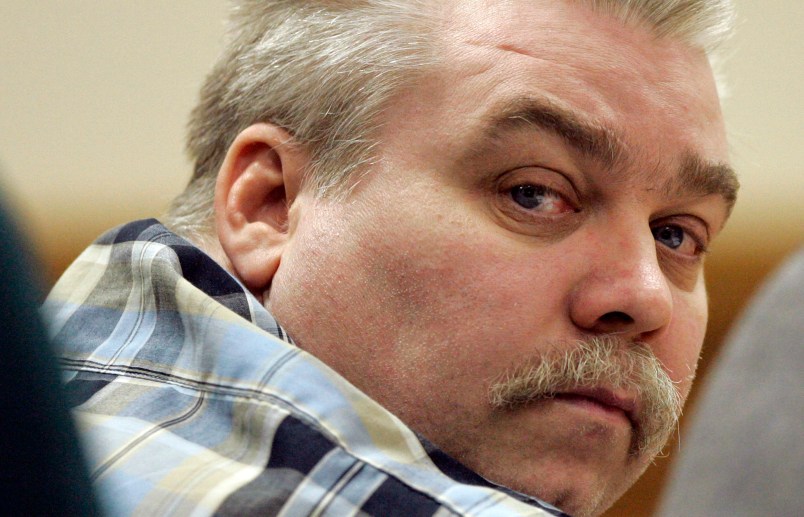
WASHINGTON (AP) — Armchair detectives hoping for a different ending for two convicts featured in “Making a Murderer” will have to look beyond the president for help.
An online White House petition urging President Barack Obama to pardon Steven Avery and Brendan Dassey has nearly 130,000 signatures, assuring an official response. Avery and Dassey are serving time for a 2005 murder, but the petition-signers say the men were wrongfully convicted. The case has attracted national attention from the hit Netflix documentary series.
The White House says under the Constitution, the president can’t pardon Avery and Dassey because they were convicted of state crimes, not federal crimes.
But the White House is using the petition to promote Obama’s support for a criminal justice overhaul, one of Obama’s top legislative priorities for his final year.
Copyright 2016 The Associated Press. All rights reserved. This material may not be published, broadcast, rewritten or redistributed.





I haven’t yet watched the series, but I have seen some article headlines claiming that the series left out important and damning details.
Has anyone here both watched the series and evaluated the critical articles? Is the series still worth watching? (I don’t want to spoil the series reading the articles, but I also don’t want to waste my time watching a series that has a deceiving conclusion.)
Apparently there was a second conviction for a subsequent murder.
And, to whom it may concern, the President would pardon for federal crimes and the Governor would pardon for state crimes
I couldn’t get past the first episode (made me too angry) so I only personally know about the attempted murder and rape that one of the men was convicted for prior to the murder issue. But there’s really no ameliorating factors for the justice system in that first false conviction, which certainly colors my impression of the overall issue. (And it just doesn’t seem likely for a man who just got out of prison for being falsely accused to murder someone.)
I do, however, know a lot of prosecutors and defense attorneys, and the consensus among my friends is that while Making a Murderer is exceptionally biased to the point where it’d be impossible to argue his innocence beyond a reasonable doubt, he and his nephew were subjected to systemic errors and ethical breaches that render it implausible to argue he received an approximation of a fair trial, or that his guilt was proven beyond a reasonable doubt (which is the actual standard).
I watched the first 6 episodes and am not sure there a point in it. Essentially the guy was convicted of rape years ago that was bogus. There was some effort to make it look like a deliberate thing on the behalf of the Manitowoc cops but it wasn’t well developed ( he was convicted on being ID’s by the victim although she may have been led to ID him ) . Then he sued of course and the gist of the second trial is they wanted to jail him because he was going to get a lot of money. Also not well developed.
There are huge holes in the thing too. One of the central arguments by his defense is that blood found in the victims car, DNA ID’d as the defendants, was planted. This is based on his defense attorney’s discovering a tube of blood that had been illegally accessed and tapped by the Manitowoc cops. But, that was a lavender top tube. An EDTA tube ( remember the OJ flap ). EDTA is added to those tubes to keep the blood from clotting. Usually for analysis if the formed elements ( cells ) in the blood. But EDTA is not naturally found in the body. Its a synthetic chelating agent. So…you test the samples of blood in the car for EDTA and if you get a hit your client is going to walk. That was instrumental in getting OJ off the hook. But there’s no mention of any of that in the series. So either all the attorneys, defense and prosecution are clowns or the results of such testing was not favorable to the film makers position ( that the defendant was framed ) and just left out.
In the 4th ( I think ) episode the defendant makes a Freudian slip and quickly glosses over it. Its a very damning one. Nothing mentioned of it.
Maybe I’ll finish it all and this will become clear. But at then end of episode 6 I get the feeling the guy did it but there was also an overzealous “investigation” of the crime as well.
I just finished watching the whole series last weekend. I came away thinking Avery was guilty, very much so. I admittedly didn’t understand the various scientific disputes about blood evidence, but I came to my opinion as to his guilt based on other evidence.
I don’t know which particular comment you felt was so damning, but I did notice his total lack of empathy for the victim. I also read a piece yesterday written by the woman he was falsely accused of raping. Not long after he was exonerated he asked her to buy a house for him. I just thought that was so sleazy.