


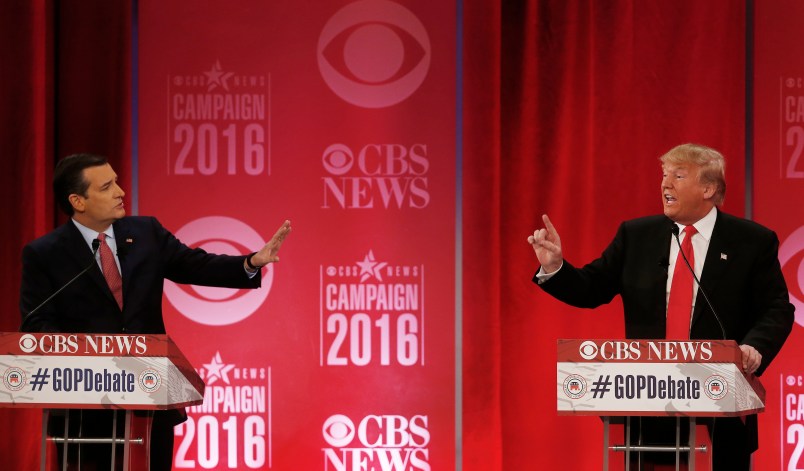
WASHINGTON (AP) — Businessman Donald Trump held his own among South Carolina’s deeply religious voters and won big among those who want an outsider as the next president, according to exit polls conducted by Edison Research for the Associated Press and television networks.
In Nevada, older women turned out in force to support former Secretary of State Hillary Clinton in that state’s Democratic caucuses, even as she continued to struggle to gain the support of younger women, according to entrance polls conducted among those arriving at caucus sites on Saturday.
A closer look at Democratic caucus-goers in Nevada and Republican primary voters in South Carolina:
___
TRUMP AND CRUZ SPLIT BORN-AGAIN CHRISTIANS
Three-quarters of voters described themselves as born-again Christians and nearly half said it matters a great deal that a candidate shares their religious beliefs — both increases from 2012. But while Texas Sen. Ted Cruz led slightly among those wanting a candidate who shares their religious beliefs, he split the vote with Trump among those who said they were born-again Christians.
Trump did especially well among men, and led Cruz and Florida Sen. Marco Rubio among those without a college degree, the exit poll showed.
___
OLDER WOMEN KEY IN NEVADA
In Nevada’s Democratic caucuses, women were more likely to support Clinton and men to support Sanders, the entrance poll there showed. Sanders gained the support of 7 in 10 caucus attendees under 45 and Clinton of two-thirds of those age 45 and over.
Seven in 10 women under 45 supported Sanders. But two-thirds of caucus-going women were 45 and over, and 7 in 10 of them supported Clinton.
A large majority of black caucus-goers supported Clinton, while whites and Hispanics were more evenly divided.
Sanders was supported by 7 in 10 caucus attendees who self-identified as independents, but they made up just 2 in 10 of all caucus attendees. Clinton was supported by nearly 6 in 10 self-identified Democrats.
___
TRUMP LEADS ANGRY VOTERS
About half of South Carolina Republican primary voters said they were dissatisfied and 4 in 10 said they were angry about how Washington is working. Trump led the angry voters, while those who were just dissatisfied split between the top three candidates.
Voters split on whether the next president should be an outsider or a member of the political establishment. Trump won the votes of 6 in 10 of those wanting an outsider, while Cruz and Rubio were tied for the lead among those wanting someone with experience.
Cruz led among voters who cared most about having a candidate who shares their values, while those looking for a candidate who can bring change preferred Trump. Those who wanted a candidate who “tells it like it is” were important to Trump — they made up a small proportion of the electorate, but he was supported by three-quarters of them. About half of those who cared about electability in November voted for Rubio.
More than 4 in 10 Republican primary voters said Trump is the candidate they trust most to handle the economy, significantly more than said so of any other candidate.
Nearly half of primary voters supporting Trump said they would not be satisfied with any other candidate as the nominee, while more than 7 in 10 Rubio and Cruz voters said they could be satisfied with a different candidate.
___
CLINTON FOR EXPERIENCE, SANDERS FOR HONESTY
As was the case for caucus-goers in Iowa and primary voters in New Hampshire, Nevada Democratic caucus attendees who cared most about voting for a candidate who’s honest and trustworthy or one who cares about people like them overwhelmingly supported Sanders, while whose looking for experience or electability overwhelmingly backed Clinton.
Clinton won a majority of those who said the economy or health care were their top issues, while those who said income inequality supported Sanders.
About half of caucus attendees said they think the next president should generally continue President Barack Obama’s policies, while about 4 in 10 said they want the next president to have more liberal policies. Among those who wanted a continuation of Obama’s policies, most came to support Clinton. Among those who want more liberal policies, most support Sanders.
___
REPUBLICANS WANT MUSLIM BAN
Just over half of South Carolina GOP primary voters said immigrants who are living in the country illegally should be offered a chance to apply for legal status, and those voters tended to prefer Rubio. More than 4 in 10 said they should be deported back to their country of origin, and they were most likely to back Trump.
There is no such division among the Republicans on the issue of allowing Muslims into the country. About three-quarters support a temporary ban on Muslims who are not American citizens from entering the country, and those voters were most likely to support Trump.
___
The surveys were conducted for The Associated Press and the television networks by Edison Research as Republican voters left their polling places at 35 randomly selected sites in South Carolina and as Democratic voters arrived at 25 randomly selected caucus sites in Nevada. In Nevada, the results include interviews with 1,024 Democratic caucus-goers and have a margin of error of plus or minus 4 percentage points. In South Carolina, the results include interviews with 2,043 Republican primary voters and have a margin of sampling error of plus or minus 4 percentage points.
___
Follow Emily Swanson on Twitter at: http://twitter.com/EL_Swan
Copyright 2016 The Associated Press. All rights reserved. This material may not be published, broadcast, rewritten or redistributed.





Well, it’s going to be Clinton vs. Trump…and long agonizing slog to November with the final results…unclear at best.
Sleep well.
Who would think we’d have two New Yorkers competing for the Presidency…
One thing about the “Born Again” vote. It’s a crude measure of religious temperament, as is “Evangelical”. Because either term ignores the split amongst those who are Pentacostal, Fundamentalist, or simply Evangelical. Cruz most likely won the first two, Trump the third.
Even though we knew it was coming for the last week, I am still dumb-founded by the idea that Donald Trump, (Trump!) is going to be the nominee of a major party. Donald Trump! There is a part of me that is celebrating because I know that Hillary will hand Trump his hair on a silver platter at every debate. She will leave him a spluttering mess.
But there is a big part of me that is worried she will lose. And that has nothing to do with Hillary. I have consistently underestimated Trump. When he first got in the race I figured he had a week before he self-destructed. I just wanted him to make it to the first debate in August. Then I thought after a couple debates that surely he must collapse because he is a lying
buffonbuffoon and has systematically insulted every single group of Americans there is other than rich white men. He has not only survived his mouth, saying things that would get any other politician thrown to the curb, he has thrived. I am genuinely afraid we may be underestimating Trump in the general. And the idea of Trump in the White House is worse than Cruz in my mind. Cruz may destroy our social fabric, but Trump will destroy our economy and might well get us blown up in the process. I am not interested in four years of unplanned war.Donald Trump!
Fascinating. I didn’t expect that at all. A new line of voters for the Donald? It remains to be seen if he goes after them in earnest. This would change the game on Super Tuesday, giving him a big leg up in both Georgia and Virginia, the two states he most needs to cut off Rubio. And if he’s siphoning off enough evangelicals, that will put Oklahoma in the bag, but Oklahoma is small potatoes (and Cruz, not Rubio, is running well there). With Cruz obviously taking Texas, the Republican establishment will go whole hog on Rubio. At that point, the Republican establishment has to do everything possible to stop Trump and Cruz, which might lead to them pissing off Trump and his supporters at the convention, and going third party.
Wait, I didn’t see the article address how the racist vote was split across the 3 leading GOP candidates. Should we conclude that racists were equally attracted to all 3 candidates??