

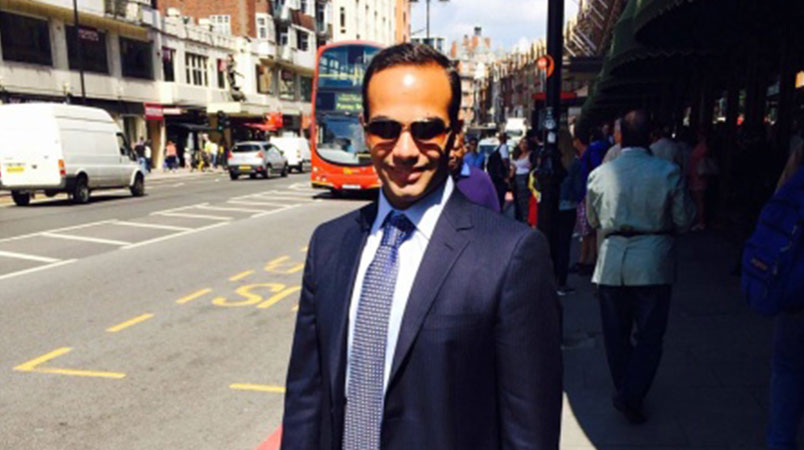
WASHINGTON (AP) — A former Trump campaign adviser should spend at least some time in prison for lying to the FBI during the Russia probe, prosecutors working for special counsel Robert Mueller said in a court filing Friday that also revealed several new details about the early days of the investigation.
The prosecutors disclosed that George Papadopoulos, who served as a foreign policy adviser to President Donald Trump’s campaign during the 2016 presidential race, caused irreparable damage to the investigation because he lied repeatedly during a January 2017 interview.
Those lies, they said, resulted in the FBI missing an opportunity to properly question a professor Papadopoulos was in contact with during the campaign who told him that the Russians possessed “dirt” on Hillary Clinton in the form of emails.
The filing by the special counsel’s office strongly suggests the FBI had contact with Professor Joseph Mifsud while he was in the U.S. during the early part of the investigation into Russian election interference and possible coordination with Trump associates.
According to prosecutors, the FBI “located” the professor in Washington about two weeks after Papadopoulos’ interview and Papadopoulos’ lies “substantially hindered investigators’ ability to effectively question” him. But it doesn’t specifically relate any details of an interview with the professor as it recounts what prosecutors say was a missed opportunity caused by Papadopoulos.
“The defendant’s lies undermined investigators’ ability to challenge the Professor or potentially detain or arrest him while he was still in the United States,” Mueller’s team wrote, noting that the professor left the U.S. in February 2017 and has not returned since.
Prosecutors note that investigators also missed an opportunity to interview others about the professor’s comments or anyone else at that time who might have known about Russian efforts to obtain derogatory information on Clinton during the campaign.
“Had the defendant told the FBI the truth when he was interviewed in January 2017, the FBI could have quickly taken numerous investigative steps to help determine, for example, how and where the Professor obtained the information, why the Professor provided the information to the defendant, and what the defendant did with the information after receiving it,” according to the court filing.
Prosecutors also detail a series of difficult interviews with Papadopoulos after he was arrested in July 2017, saying he didn’t provide “substantial assistance” to the investigation. Papadopoulos later pleaded guilty to lying to the FBI as part of a plea deal.
The filing recommends that Papadopoulos spend at least some time incarcerated and pay a nearly $10,000 fine. His recommended sentence under federal guidelines is zero to six months, but prosecutors note another defendant in the case spent 30 days in jail for lying to the FBI.
Papadopoulos has played a central role in the Russia investigation since its beginning as an FBI counterintelligence probe in July 2016. In fact, information the U.S. government received about Papadopoulos was what triggered the counterintelligence investigation in the first place. That probe was later take over by Mueller.
Papadopoulos was also the first Trump campaign adviser to plead guilty in Mueller’s investigation.
Since then, Mueller has returned two sweeping indictments that detail a multi-faceted Russian campaign to undermine the U.S. presidential election in an attempt to hurt Clinton’s candidacy and help Trump.
Thirteen Russian nationals and three companies are charged with participating in a conspiracy to sow discord in the U.S. political system primarily by manipulating social media platforms.
In addition, Mueller brought an indictment last month against 12 Russian intelligence operatives, accusing them of hacking into the computer systems of Clinton’s presidential campaign and the Democratic Party and then releasing tens of thousands of private emails through WikiLeaks.
According to that indictment, by April 2016, the Russian intelligence operatives had already stolen emails from several Democratic groups including the Clinton campaign and were beginning to plan how they were going to release the documents. That same month, according to court papers, Mifsud told Papadopoulos that he had met with senior Russian government officials in Moscow and had learned that they had “dirt” on Clinton in the form of “thousands of emails.”
___
Read the sentencing memo: http://apne.ws/tNIPFAC




Headline is misleading. OSC has a deal with Papado and they said ‘imprisonment is warranted’. They did not argue that he broke the plea deal but that he was uncooperative. Sec. 7 of his agreement states that the Judge is not bound by the deal. Nearly every statement in this sentencing memo is aimed at telling the Judge that he should feel free to ignore the plea deal and impose his own sentence within the statutory guidelines (up to 5 years).
If Papadopoulos’s lies resulted in the Special Counsel missing an opportunity to properly interview Mifsud before he fled the country never to be seen again, I’d say that’s pretty damn egregious worth much more than six months in prison. And his -and especially his wife’s -insolence after the fact should also be taken into account.
Reposting from another thread:
For anyone who thought Mueller has been sitting on his hands waiting for the jury in the EDVA trial of Paul Manafort, think again.
Mueller submitted a sentencing memorandum for George Papadopoulos. He will be sentenced on September 7, 2018. Mueller has not stated an actual sentencing, leaving it up to the judge, but that “a sentence of incarceration, within the applicable Guidelines range of of 0 to 6 months’ imprisonment, is appropriate and warranted.” However, the tone and tenor of the rest of the memo is a big hint to the judge (Randolph Moss, I believe) that he can feel free to impose his own sentence based on the crime to which he pleaded guilty.
The memo provides a recap of Papado’s crimes. He pleaded guilty to making false statements under 18 USC 1001(a). The maximum sentence for this crime is up to 5 years (8 years in terrorism and other special cases). The gov’t states,
After this introduction, Mueller then appears to unload on Papadopoulos as a cantankerous, deceptive, mendacious piece of s**t who cost the government a real shot at nabbing a key witness, Josef Mifsud.
Offense Conduct
Under the section entitled, “Offense Conduct” the government notes the following factors to consider for sentencing. Let’s just say that Papado doesn’t come off well here:
I’m a bit surprised that the FBI actually told Papado this up front. Comey didn’t tell the world about this investigation until 2 months later. What did Papado do with the information that the FBI was investigating the Trump campaign? Was he directed to tell the Russians? Mariia Butina was in town.
Did he tell the Israelis with whom he appears to have been acquainted? Did he tell ex-Israeli Intel like the Black Cube folks, some of whom are closer to Netanyahu than actual Israeli intel (who oppose him on some key positions on Iran and his treatment of the Obama Administration)? He might’ve told the Trump folks but he was also angling for a job so I have the sense that he kept his mouth shut on that piece of it. But is there a close US friend who worked with him on the campaign or someone else to whom he confided? I’d really like to know who, outside the FBI, knew about the Comey led investigation before Comey made it public.
The memo recounts how Papado met Professor Josef Mifsud, a female Russian national and a Russian connected to the RU Ministry of Foreign Affairs. It tells how Mifsud told Papado that the Russians had dirt on HRC in the form of thousands of emails. The group of 3 had several communications over a period of months to arrange a meeting between the Russians and the Trump campaign. On all of these points, Papado lied about the timing, extent and nature of communications and contacts.
The FBI appears to have confronted Papado with emails and intercepted communications to prove the dates of communication with Mifsud and others as having taken place after he had accepted an offer to join the Trump campaign.
Here, it is striking the extent to which Papado is trying to protect the Trump Campaign, and Trump specifically. His strategy was to say that he met these people but before he joined Trump and it had nothing to do with Trump. In a sense, by telling him clearly what the investigation was about, Papadopoulos developed a strategy to essentially obstruct investigators from finding out material facts about the Trump campaign’s involvement with Russians. He thought that if he could place the timeline of these communications as pre-Trump then he would take the risk to see if the FBI would prosecute for seemingly incidental contacts.
So Josef Mifsud was in the United States in early February 2017? Was he in the US for the inauguration? Did he meet other Russian spies like Mariia Butina? Did Papado meet with Mifsud or other Russian handlers? Several Russians, including Butina and Alexander Torshin, were in DC a week earlier to attend the National Prayer Breakfast and were at a dinner with Dana Rohrabacher. Did the knowledge that the FBI had met with Papadopoulos on Jan 27 reach the Russians?
It would appear from the Special Counsel’s memo that Papadopoulos ran enough cover to give Mifsud an opportunity to evade the FBI. There is a hint of a suggestion that they did locate and possibly speak with Mifsud, but that they were armed with incorrect information from Papadopoulos and could not effectively question him or develop sufficient probable cause to detain him. This to me is pretty damning, and I wonder if this paragraph was put in this memo to alert the Judge that he should feel free to consider a sentence that is higher than the Guideline because of the seriousness of the Russian attack on the US and his unwillingness to help investigators.
Over this same time period, Papadopoulos was angling for a job with the national security council (Flynn was being investigated over this same time), the State Department and the Energy Department.
Efforts to Cooperate
The OSC unloads on Papadopoulos again by stating that he did not provide “substantial assistance” and that much of the information provided came only after the government confronted him with his own communications, web searches and other information it obtained via subpoena. The OSC obtained a additional cell phone used by Papadopoulos when he was in London during the course of the campaign to communicate with Professor Mifsud.
They canceled a meeting with Papadopoulos in late December 2017 after learning that he did a media interview and it would appear that the subsequent interviews by Papadopoulos and his wife, Simona Mangiante, have not been viewed well by the OSC.
The government then states, in conclusion, that incarceration is warranted but throws in a cautionary note about unwarranted sentencing disparities which may potentially mitigate the length of the sentence. Here, I think the OSC is simply putting in a mitigating line (throwing a bone to the issue of equanimity in sentencing) but the thrust of the memo is that the judge should feel free to disregrard the sentencing recommendation of the OSC in the plea agreement and instead look at the statute. The crimes committed by Papado warrant a more serious punishment.
What I see here is that Papadopoulos did provide a lot of information to the government, but not willingly. He limited his cooperation to the extent of confirming information found by the FBI themselves, but did not volunteer extra information. This is why I think the government can’t quite state that Papado violated his plea agreement. He and his wife went to great lengths to undermine the OSC investigation in the public, but there is no indication that post-plea deal, Papadopoulos lied or withheld information from the government that was in his possession. The Mangiante interviews do seem to have irritated the OSC as there is an entire footnote devoted to debunking her spin.
Papado and Mangiante’s strategy appears to be to ‘Take the L’, take a 0-6 month jail sentence but preserve an opportunity for a pardon from Trump. The thing is that this memo seems to tell the Judge that he should feel free to consider the circumstances and perhaps use the statute as the guideline and provide a jail sentence of closer to the 5 years allowed. Recall that Section 7 of Papadopoulos’ plea deal has the heading “Court Not Bound by This Agreement or the Sentencing Guidelines”. I don’t think Papado read that part of it too well and thought he could hedge by giving some cooperation but not optimal cooperation. It will be up to the Judge (Randolph Moss), but instead of getting no jail time, Papadopoulos has now opened up the possibility that he could get up to 5 years. I think these 2 morons are gripped by pardon fever.
Update: I had said earlier in the week that the motion to seal discovery in this case was in part aimed at Mangiante. I think this memo would tend to confirm that. I also said that I thought Mangiante was a ‘wanna be spy’, trying to work with the Daily Caller to undermine the investigation and curry favor with Trumpers and Russia. That also seems to be validated by this sentencing memo, especially the footnote critiquing Mangiante’s comments and making reference to the Daily Caller. I had also said that the OSC likely warned Papadopoulos about Mangiante and that he was obliging the OSC. Here, I think I was half right, half wrong. The memo would tend to validate that the OSC had concerns about public statements, and especially those of Mangiante. However, it seems to me that Papadopoulos was partly in on Mangiante’s angle with his limited brand of cooperation. It seems doubtful that the OSC got anything useful from him since about the end of December 2017. In that sense, Papadopoulos is taking jail time based in part on the urging of his wife. Why he would make such a decision is head scratching, but it is what it is.
I think that’s what Mueller is telling the Judge in this memo. He cooperated in terms of verifying what they found on his devices, but he didn’t quite do enough to make up for the fact that he let a Russian agent get away.
Not sure what you mean. Here’s the (entire) conclusion of the memo:
And they say that after having said this: