

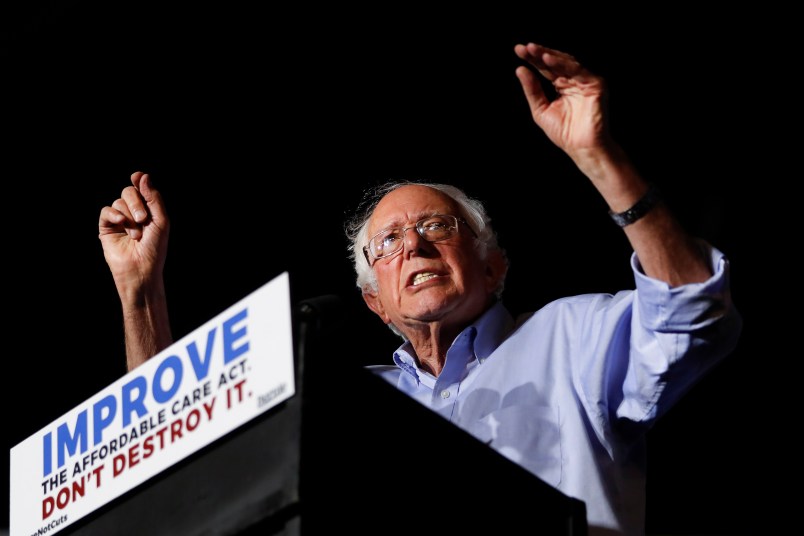
WASHINGTON (AP) — Americans would get health coverage simply by showing a new government-issued card and would no longer owe out-of-pocket expenses like deductibles, according to legislation Sen. Bernie Sanders released Wednesday.
But the Vermont independent’s description of the legislation omitted specifics about how much it would cost and final decisions about how he would pay for it.
Sanders was releasing his bill on the same day Republican senators were rolling out details of a last-ditch effort to repeal and replace President Barack Obama’s health care law.
In an interview, Sanders said Tuesday that his measure would likely be paid for in a “progressive way.” Aides said it would likely be financed by income-adjusted premiums people would pay the government, ranging from no premiums for the poorest Americans to high levies on the rich and corporations.
The measure has no chance of becoming law with President Donald Trump in the White House and Republicans controlling Congress. But it embodies a push to universal coverage that eluded Obama’s 2010 law and is a tenet of the Democratic Party’s liberal, activist base.
“I think in a democracy, we should be doing what the American people want,” Sanders said, citing polls showing growing support for the concept.
His bill would expand Medicare, the health insurance program for the elderly, to cover all Americans. It would be phased in over four years, and people and businesses would no longer owe premiums to insurers.
The progressive wing of the Democratic Party backs the bill, which would make health care less expensive and less complicated for many people and businesses. It would cover the 28 million Americans remaining uninsured despite Obama’s law.
But some Democrats fear Sanders is exposing them to a lose-lose choice.
Don’t support Sanders’ plan and Democrats risk alienating the party’s liberal, activist voters, volunteers and contributors. Back it and they’ll be accused by Republicans of backing a huge tax increase and government-run health care, and taking away employer-provided coverage for half the country that many people like.
At least 12 other Senate Democrats signed onto Sanders’ bill by late Tuesday, including four potential 2020 presidential contenders besides Sanders: Kamala Harris of California, Massachusetts’ Elizabeth Warren, New York’s Kirsten Gillibrand and Cory Booker of New Jersey.
To cover themselves, several Democrats are introducing their own bills that expand coverage without going as far as Sanders, including possible presidential aspirants Sens. Chris Murphy of Connecticut and Ohio’s Sherrod Brown. Several Democrats facing tough re-elections next year in GOP-leaning states say they want to focus on strengthening Obama’s existing law, including Montana’s Jon Tester and Missouri’s Claire McCaskill.
“We welcome the Democrats’ strategy of moving even further left,” said Katie Martin, spokeswoman for the Senate GOP’s campaign organization.
Seven weeks after the GOP drive to uproot Obama’s 2010 health care law crashed in the Senate, two Republican senators, Lindsey Graham of South Carolina and Louisiana’s Bill Cassidy, were releasing their plan for trying again.
They’ve struggled for weeks to round up sufficient support for the package. It would cut and reshape Medicaid, disperse money spent under Obama’s law directly to states and erase Obama’s penalties on people who don’t purchase coverage.
No. 3 Senate GOP leader John Thune of South Dakota said Graham and Cassidy would need “a double-double bank shot” to prevail, a joking reference to an impossible basketball shot.
Like the failed Senate GOP repeal effort in July, the Graham-Cassidy push will get zero Democratic support. That means Senate Majority Leader Mitch McConnell, R-Ky., will need 50 of the 52 Republican senators, a margin he couldn’t reach in July and is struggling to reach now.
Despite badgering by Trump that he keep trying, McConnell has expressed no interest in staging yet another vote that produces an embarrassing rejection by the GOP-controlled Senate. Conservatives are wary because the bill falls short in erasing Obama’s wide-ranging coverage requirements.
“I don’t think this bill will go anywhere,” said Sen. Rand Paul, R-Ky.
A third effort, a bipartisan attempt to shore up individual insurance markets around the country, is showing early signs that the sides are having problems reaching agreement.
Sens. Lamar Alexander, R-Tenn., and Patty Murray, D-Wash., hope to reach a deal on continuing for at least a year the federal payments to insurers that Trump has threatened to halt. Republicans are also insisting on easing the Obama law’s coverage requirements, which Democrats don’t want to do.
Alexander said Tuesday that Republicans want “real state flexibility” to let insurers offer “a larger variety of benefits and payment rules.”
Murray said she worried the GOP wants to “wind up increasing out-of-pocket costs for patients and families.” That’s something Democrats oppose.
McConnell said the Alexander-Murray talks “are underway and we’ll see where they go.”





Wow, a page out of the GOP Obamacare repeal strategery playbook?
I think Paul Ryan better check his supply of ‘magic asterisks’. There may be a few missing.
Trivial correction: I believe ‘double bank shot’ is a billiards/pool reference (a very difficult low percentage shot off of two rails) rather than a non-existent basketball shot reference.
As somebody who was sharply critical of congressional Republicans supporting meaningless “repeal and replace” votes for as long as they knew they had no chance of actually becoming law, only to demur on specifics once they were actually in a position to enact legislation, and were basically boxed into doing so because they’d been talking up a nebulous, even specious, plan for the better part of a decade…
I am less than enthusiastic about Senator Sanders’ current efforts.
The author of the article must have been coming at it from a different angle.