

This book excerpt is part of Cafe, TPM’s home for opinion and news analysis.
The census makes politics. Representatives are allocated to states based on the count of the population, and states redistrict their maps accordingly. Thus, it’s perhaps not surprising that different partisan forces work behind the scenes to make census data in their own image.
In advance of the 2030 Census, the Trump Administration has recently announced that it plans to drastically upend an esoteric set of rules known as the “residence rules.” These are the protocols that dictate who is counted where for the upcoming census. Although Congress is ultimately responsible for overseeing the census and determining the rules, it absconded with that responsibility decades ago. This has created a vulnerability that the Trump administration seeks to exploit. In changing the rules, the Trump administration is hoping to alter the political map. As TPM has reported, civil servants have been ordered to stay silent.
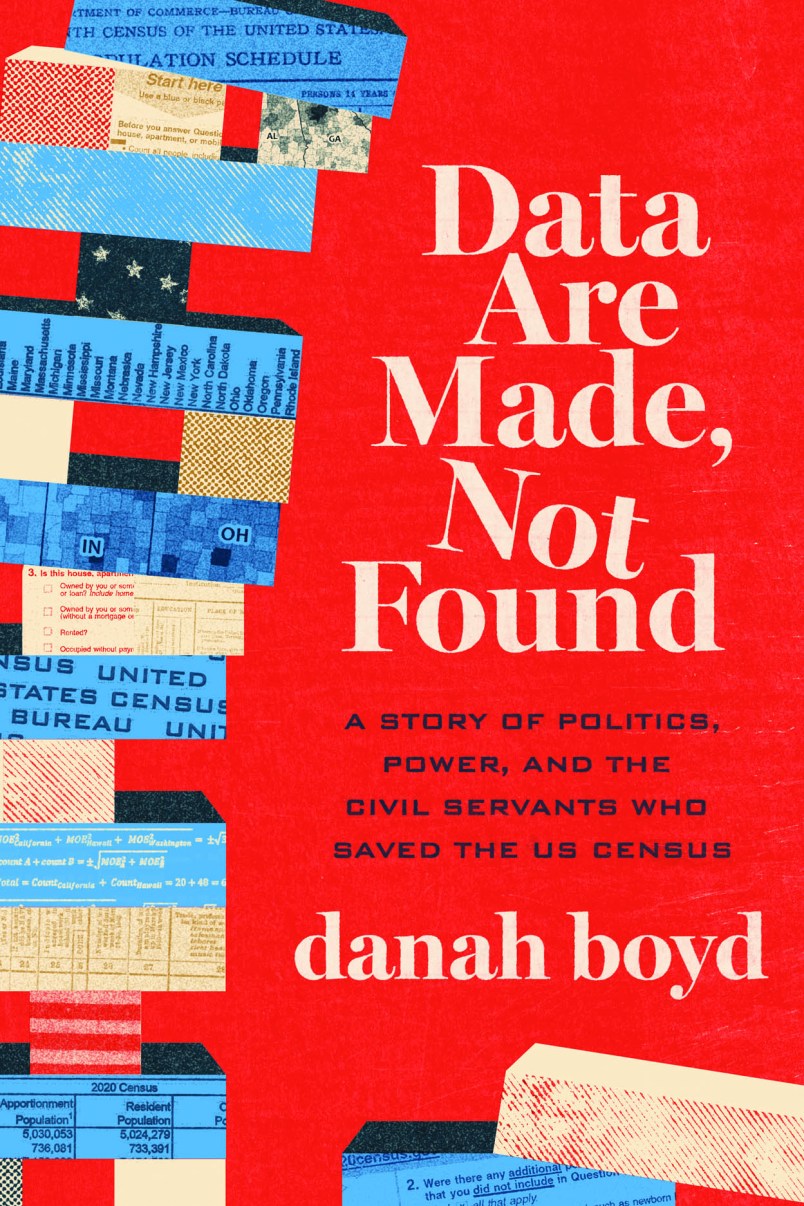
Data Are Made, Not Found: A Story of Politics, Power, and the Civil Servants Who Saved the US Census tells the story of what it took for dedicated bureaucrats to pull off the 2020 Census, despite a pandemic, natural disasters, financial constraints, and political interference. This book shows what it takes to make the census so that each and every one of us can fight to ensure that democracy’s data remain intact and legitimate. The ins and outs of who gets counted where might seem boring, but this is what makes the process so vulnerable to interference. When the public and our elected officials do not pay attention to details, technocratic moves become a form of policymaking by other means.
Despite facing widespread criticism from both the left and the right, civil servants are neither dumb nor malfeasant. They are dedicated to ensuring democracy can continue regardless of who is in the White House. But for them to be effective, we need to have their backs. And we need to understand why they make the choices they make when facing the constraints they face.
In this short excerpt from “Data Are Made, Not Found,” I describe one of many earlier partisan fights over the residence rules. Despite decades of precedent, Republicans have long aimed to count students at their parents’ homes instead of where they reside during the academic term. The Covid-19 pandemic created the perfect opportunity for Republicans to pursue this agenda without seeking congressional approval. As the book goes on to show, the civil servants executed the rules that had been delivered to Congress years earlier. As a result, depending on one’s political orientation, civil servants were deemed either heroes or villains. But in their minds, they were simply following protocol.
In the United States, eighteen-year-olds might technically be independent adults, but the vast majority of them are bureaucratically attached to their parents or guardians in many ways. College students are often still dependent on their parents for healthcare—and many parents claim their adult children as dependents for tax
purposes. Parents also tend to conceptually understand their young adult children as members of their household. After all, college students may leave their parents’ homes to attend school elsewhere, but they often return to their childhood rooms during breaks.
Needless to say, 2020 was different. Across the country, parents who had sent their children off to college suddenly had full houses again. When they received their census forms in late March and early April, they were asked to indicate if any member of their household was off at college. They honestly said no. After all, the
form did not ask if any member of their household should have been off at college.
I spoke with a few parents of college students who were notified by their children’s schools to fill out the census as though their children were still off at college. Nearly all of them were dumbfounded when I told them that their children were not supposed to be counted on their census forms. “Why wouldn’t I count him here? He comes back here every break, I pay for his tuition, his driver’s license is here, and he votes here. Of course I counted him here.” As they saw it, they had never heard otherwise. Even those who had been notified by their child’s school did not believe that that was what their child’s school meant. (For what it’s worth, they also did not believe me.)
Unbeknownst to most parents of college students, the definition of their children’s “usual place of residence” is part of a broader political fight. As both Census Bureau officials and external stakeholders told me, Republican operatives have long argued that college students should not be counted in college towns, because they tend to vote where their parents live. Some college students vote in the town where they attend college, since they’re typically there during November elections. But others choose to register at their parents’ house, where they typically lived in their senior year of high school when they first became eligible to vote. Absentee ballots have made it easier for students to vote from afar.
In recent decades, Congressional districts representing college towns have disproportionately voted for Democrats. Counting college students who live in dorms and off-campus increases the size— and thus political weight—of those districts, but the number of actual voters is disproportionately small. Republican operatives argue that this discrepancy is unfair. As they see it, the towns where college students come from are effectively “undercounted,” with liberal college student voters skewing the votes in those districts.
During the 1970 census, a group of Pennsylvania plaintiffs were so outraged over this aspect of the residence rules that they sued the Census Bureau in Borough of Bethel Park v. Stans. The litigants argued that “if an individual college student indicates that he feels a particular connection or attachment to the state of his parental
home, registers to vote in that state, and accordingly regards it as his home, the Bureau should consider these facts in determining his residence for the purpose of the census enumeration.” The Court of Appeals rejected these arguments and deferred to the Census Bureau’s judgment, arguing that the bureau should be empowered to make a “definite, accurate and verifiable standard.”
As is often the case with the census, litigation solidified the status quo, making the Census Bureau even more reticent to change the rules without an intervention by Congress. Congress could have ordered the Census Bureau to count college students at their parents’ homes, but it did not. Although conservative advocates have repeatedly pushed the bureau to change its approach to counting college students, the Census Bureau has not budged and Congress has not bothered.
This issue reemerged in advance of the 2020 census because of another politically contested part of the residence rules: where the Census Bureau counts prisoners. As with students in dormitories, the census enumerates people who are incarcerated at the jail or prison that houses them.
Civil rights groups object to this rule on principle. Given the overwhelming rise in incarceration since the 1990s, advocates argue that counting prisoners where they have been locked up gives undue political power to people who live in towns where prisons are located.
Taking up this issue in 2009 in an opinion titled “The Census: Phantom Constituents,” New York Times editorial board member Brent Staples argued, “There are many ways to hijack political power. One of them is to draw state or city legislative districts around large prisons—and pretend that the inmates are legitimate constituents.” In advance of the 2010 census, advocates pushed
states to reallocate prisoners back to their home location before proceeding with redistricting. Both Maryland and New York passed such laws in advance of the 2010 census, while nine other states were prepared to do the same for the 2020 census.
States that have enacted laws to reallocate incarcerated people don’t rely on the published census data for redistricting; they modify it first. Organizations such as the Prison Gerrymandering Project contend that the Census Bureau should supply these states with the additional data needed to follow their own laws. They further argue that the census should revise its residence rules to count prisoners at their home addresses—both to support state laws and because it is a more just policy.
Once again, the residence rule addressing incarcerated people stems from a combination of precedent and pragmatics. Counting incarcerated people is hard; having the data to reassign them elsewhere is harder, especially because prison administrators are just as reticent to provide additional data as college administrators. The bureau regularly struggles to get information beyond the “pop count” from the prisons. Officials at the Census Bureau do not believe that it is feasible for them to get home addresses—or even detailed identifying information—from prison administrators unless Congress requires them to provide such information. Moreover, census officials worry that the partisan politics around this issue undermines their ability to get any data from prisons, just as it has
with college administrators.
One longtime civil servant—whom I will call “Jack”—told me that Tom Hofeller was the key to understanding the political dramas surrounding both the prisoners and the college students. As previously noted, Hofeller was a Republican redistricter whose death inadvertently resulted in Republican strategic plans around the citizenship question being made public. Among redistricters, census advocates, and political operatives, Hofeller was known for much more. As Jack explained, “no one knows the ins and outs of the bureau better than Tom Hofeller.”
When Jack was starting out at the Census Bureau, he thought that he could avoid partisan politics when working with stakeholders. (I felt reassured that I was not alone in being naïve on this count.) Jack was surprised when Hofeller sat him down in an effort to teach him how to avoid accidentally enabling one partisan group over another. Jack described how Hofeller would grill him with questions that were commonly asked by political operatives of people in his role. When Jack tried to please Hofeller with his responses, Hofeller would interrupt him. “No, that’s not how you answer that question. You answer it like this because otherwise you’re going to get in trouble.” As Jack saw it, Hofeller didn’t train him to be apolitical, but he did train him to be neutral. Watching Hofeller operate over the years, Jack came to understand that redistricting is “an exercise in raw power by the parties.” He came to realize that his job was to be as consistent as possible so that the partisan actors could focus on each other. Or at least, Jack noted, that’s how the game used to be played.
Hofeller wanted the Census Bureau to count college students at their parents’ homes. Presumably he believed that Republicans would benefit from such a count. But I was surprised to learn that Hofeller had also been supporting the eradication of prison gerrymandering before his death. Wouldn’t Hofeller believe that reallocating prisoners benefited Democrats? I asked civil servants to help me understand this seeming contradiction. One Census Bureau official told me that Tom Hofeller’s mantra was, “Democrats can have the prisoners, I want the students.” Civil servants suspected that Hofeller had calculated that Republicans would benefit much more from the reallocation of both college students and prisoners than Democrats would—and the coordinated effort to change the residence rules for prisoners would create an opening to change the rules for college students.
Among civil rights advocates, there is no similarity between students and prisoners. College students choose to live in college towns and have the right to vote wherever they declare their residency. Furthermore, college students actively use local resources funded through formulas, from roads to social services. Prisoners cannot vote, and their absence from their homes denies their communities political power and financial resources. But for those playing partisan politics—and looking to optimize their party’s strategic advantage—contorting the residence rules in a manner that is advantageous to “their side” is the goal. Even if that means giving the “other side” a small win.
A redistricter warned me early on in my research that Hofeller was playing chess when everyone else was playing checkers. As parents told me that it was “stupid” for their kid to be counted at college when they were clearly living with them, I couldn’t help but wonder if the games that Hofeller had designed before he died were still
unfolding. He had been nurturing public opinion for decades, and the pandemic created an opening for the public to think that college students should be counted at home. The residence rules were being upended in practice, not through Congressional decision-making but through the everyday pragmatics of who could be found where.
Reprinted with permission from Data Are Made, Not Found: A Story of Politics, Power, and the Civil Servants Who Saved the US Census by danah boyd, published by the University of Chicago Press. © 2026 by danah boyd. All rights reserved.




If the GOP had is way only white men who are property owners would be able to vote, you know as the Founding Fathers intended.
Trump and his GOP have no guard rails, just like the fascists of old (not so old…).
God this is complicated. I mean in the Bible Joseph had to go back to his hometown to be counted in the census Caesar Augustus…
In the beginning a few states had property ownership as a voting requirement. Needless to say a penis was also necessary.
But no Catholics - or at least, only 1 in 55.