

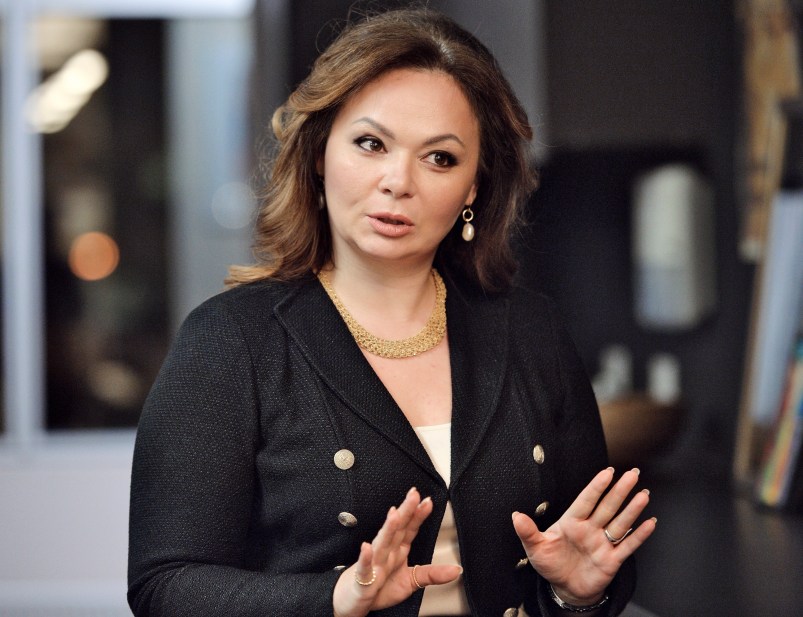
MOSCOW (AP) — The Russian lawyer who has been thrust into the spotlight following reports of her meeting with President Donald Trump’s eldest son was a largely unknown figure until she began to represent the son of a Russian official in a major money-laundering trial.
Natalia Veselnitskaya’s name has not been linked to government officials, the pro-Kremlin political party or major pro-Kremlin NGOs. The law firm where she is listed as managing partner, Kamerton Consulting, is based in a Moscow suburb and does not even have a website. A staff member at Kamerton told The Associated Press Veselnitskaya was unavailable for comment on Monday.
A New York Times story over the weekend cited advisers to the White House as saying that Donald Trump Jr., Trump’s son-in-law Jared Kushner and then-campaign chairman Paul Manafort had a meeting in June last year with Veselnitskaya, who promised damaging information about Democratic nominee Hillary Clinton.
Trump Jr. said in a statement on Sunday that he had agreed to the meeting after he was told the lawyer might have information that would be “helpful” to the Trump campaign. He said she claimed during the discussion to have information that “individuals connected to Russia were funding the Democratic National Committee” and supporting Clinton but said “it quickly became clear that she had no meaningful information.”
Russian President Vladimir Putin’s spokesman Dmitry Peskov said Monday that the Kremlin is unaware of a meeting between Trump’s senior staff and Veselnitskaya and “does not know who that is.”
Veselnitskaya does not appear to have handled any major clients in Russia until she got involved in a case defending Denis Katsyv, the son of a vice-president of state-owned Russian Railways who was slapped with money-laundering charges in the United States tied to a massive Russian tax-fraud scheme.
The case against Katsyv’s company, Prevezon, was settled in New York in May for some $6 million, three days before it was to go to trial. The U.S. Attorney’s office portrayed the settlement as a win for its anti-corruption efforts while Prevezon insisted that the settlement demonstrated that there was no wrongdoing on its behalf.
Investigators had suspected that Cyprus-registered Prevezon bought upscale New York City real estate with some of the proceeds from a $230 million Russian tax-fraud scheme brought to light by a Russian lawyer who later died in prison.
Sergei Magnitsky, a lawyer for investment advisory Hermitage Capital, accused officials of stealing the money via tax rebates. The official Russian probe into his death in a Moscow prison in 2009 insisted that he suffered a heart attack, but Russia’s presidential council on human rights found that Magnitsky was beaten and denied medical treatment.
The United States passed the Magnitsky Act in 2012 that imposed sanctions on five Russian officials involved in alleged human rights violations in the Magnitsky case.
Veselnitskaya, who represented Katsyv in Russia, in an interview with the Russian daily Kommersant last year denied that her client had any connections to the tax-fraud scheme. She insisted that the case against Katsyv’s company was based on “anonymous papers and documents of dubious character” that Hermitage Capital’s owner, Bill Browder, had shared with American investigators.
“The Prevezon case and the Magnitsky Act are based on the same lie that Bill Browder has been selling to those who want to demonize Russia and its leaders,” she said.
Veselnitskaya has also been involved in promoting a film by a Russian director that disputed the fact that Magnitsky uncovered the tax fraud or that he was beaten in jail. Its screening at the European Parliament in Brussels last year was canceled at the last moment, and human rights activists involved in the investigation of Magnitsky’s death dismissed it as an attempt to whitewash torture.
The day the settlement in the Prevezon case was announced Veselnitskya said in a Facebook post that her team appreciated “the initiative by the U.S. government to settle this insane case.”
“Whether today will mark the end of the Cold War depends on U.S. politicians and law enforcement agencies,” she added.




As all good spies should be.
"Natalya Veselnitskaya, a well-known lawyer in the Moscow region, "
Moscow Post, July 2010 :: translation
Moscow Post, June 2015 :: translation