


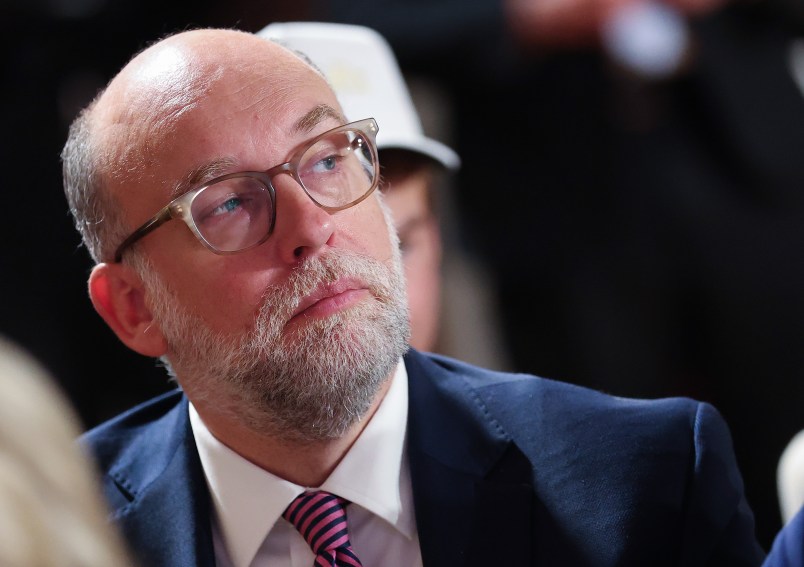
Following a failed bid by Senate Democrats to block it, President Donald Trump and Office of Management and Budget (OMB) Director Russell Vought have, once again, run roughshod over Congress’ power of the purse.
Last week — just five days before the fiscal year was set to end and federal funds allocated for that year set to expire — the Trump White House sent Congress a special message laying out its intention to once again impound congressionally approved funds through their “pocket rescissions” scheme, which a legislative watchdog agency has described as illegal.
The term “pocket rescissions” describes a loophole Vought and his allies claim they found in the Impoundment Control Act of 1974 (ICA). It, they maintain, allows the administration to declare congressionally approved funding rescinded if a rescissions package is sent to Congress close to the end of the fiscal year when funds are set to expire. In other words, it allows the administration to simply not spend funds Congress directed the executive branch to spend — one of many ways the Trump administration has sought to achieve that outcome. The administration’s impoundments have largely targeted programs it sees as helping disfavored groups such as immigrants, people of color and blue states.
Experts tell TPM that the Trump administration’s use of the supposed “pocket rescissions” loophole is more an admission of guilt.
“It’s more like a confession of a crime rather than some neat trick,” Devin O’Connor, senior fellow on the Center on Budget and Policy Priorities’ federal fiscal policy team, told TPM.
TPM has already reported extensively on the illegality of pocket rescissions.
The Government Accountability Office (GAO), a nonpartisan legislative branch agency tasked with deciding if the president is impounding funds in violation of the ICA, has previously declared that pocket rescissions violate the law. On Tuesday, GAO even reasserted that position and declared the most recent pocket rescission attempt as illegal in a letter to congressional leaders.
Congressional lawmakers, including Senate Appropriations Committee Chair Susan Collins, have said (R-ME) said the move is a “clear violation of the law.”
And when asked about White House’s renewed attempts, David Super, law professor at the Georgetown University Law School, told TPM: “There’s nothing in law that authorizes pocket rescissions.”
But O’Connor told TPM, besides the obvious illegality of pocket rescissions, the administration’s “announcement of its intention to ‘pocket rescind’ the funds is basically a public admission of wrongdoing because the Impoundment Control Act requires the administration to submit a rescission request as soon as it plans to not make full use of the lawfully provided funds.”
Other experts agreed, reiterating that the ICA requires the White House to immediately notify Congress if the executive branch decides they will not be using or pausing the use of certain funds through a rescission or a deferral request.
“Under certain circumstances they can do a special message to pause stuff through a deferral request,” Bobby Kogan, senior director of federal budget policy at the Center for American Progress, told TPM. “But, A, special circumstances need to be met for that request and, B, you need to send a special message to Congress. They never sent that message.”
“And by the way,” Kogan, who served in the Biden White House as adviser to the director of the OMB, added, “‘I hate this program’ or ‘I hate the activities in these programs’ is not one of the legally allowed reasons for a deferral.”
The Trump administration has been open about their dislike of certain programs. They have called programs “woke,” they have framed them as “waste, fraud and abuse.” The list goes on. But the reality is, neither the president nor the OMB has unilateral power to refuse to use funds congressionally appropriated for a program simply because they do not like its contents.
“They have just been sitting on this money illegally,” Kogan said.
Super agreed, saying that “nothing about what’s happening with the funds for these programs is surprising. It’s been calculated all along.”
So as Kogan puts it “all the illegal pauses they did along the way that leaves them with huge chunks of unobligated money just five days before the fiscal year is about to end — when the funds are supposed to be used up — is already a written admission that they broke budget law on their way to their illegal pocket rescission.”
The Friday special message is “them flagrantly, openly saying that they did illegal activities to get here,” Kogan said.
Big picture Super said — whether you give it the name pocket rescission or not — they’re ignoring a variety of federal laws that require them to spend the money that Congress has appropriated and that is illegal.
Kogan also called the Friday special message “a major escalation in the Trump administration’s impoundment wars.”
“Dollar wise, this one’s only $810 million,” Kogan told TPM, but “they are not just sneakily, illegally cutting 10% or even 25% of a program and arguing that it got more money than they really wanted. In a handful of cases, they are literally impounding programs to death, where they are effectively saying we’re just not going to do the activity at all.”
For example, they are pocket rescinding 99% of a Department of Education program aimed at providing “grants and fellowships to support institutions in bridging foreign students and faculty to the United States to study or teach language, conduct research, and provide professional and curriculum development.”
The administration is also impounding 96.6% of a Department of Housing and Urban Development program “that provides grants to nongovernmental organizations (NGOS) and public entities for counseling and education to individuals on a spectrum of housing matters.”
“People who study appropriations law say that there’s actually no greater power than Congress’s power of the purse. It’s actually the foremost power of Congress,” Charlie Ellsworth, adviser to Public Citizen and former budget and appropriations staffer for Senate Minority Leader Chuck Schumer, told TPM. “And the administration is taking that head on, trying to expand its reach so that they can choose what gets spent regardless of appropriations law.”




We all know it’s illegal and Ron Johnson is a tool. But what is the solution?
I’m not picking on this article. It’s a great piece of the puzzle, @emine
Vote Blue next month!
Replace the clowns.
Here’s hoping for a new Congress that actually stands up for itself and its constitutionally designated responsibilities. But that doesn’t help us for this fiscal year.
Correct me if I’m wrong, but didn’t this turd swear to “preserve, protect, and.defend the Constitution twice? And also seem to recall something about faithfully executing the law. Guess he thinks it means putting a bullet in them (figuratively, of course.) 86 47
To be fair, he thought he was swearing to defend his constitution, and he does that by letting the doctors regularly prescribe him all sorts of new medications, and he does look at quite a few of the pictures Natalie shows him. I mean, what else can he do?