


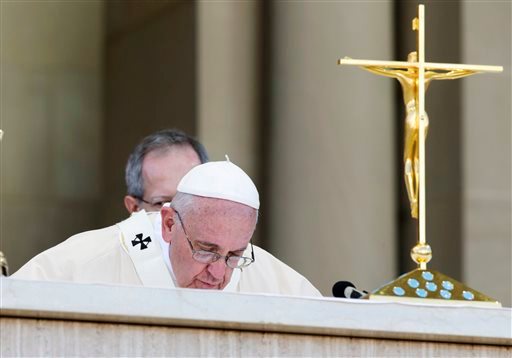
WASHINGTON (AP) — An 18th-century missionary who brought Catholicism to the American West Coast was elevated to sainthood Wednesday by Pope Francis in the first canonization on U.S. soil.
Francis canonized Junipero Serra during a Mass outside the Basilica of the National Shrine of the Immaculate Conception, the largest Catholic church in North America.
Serra was a Franciscan friar who marched north from Baja California with conquistadors from his native Spain, establishing nine of the 21 missions in what is now California. The pope announced in January that Serra would be canonized.
The decision was polarizing. Serra is revered by Catholics for his missionary work, but many Native Americans in California say he enslaved converts and contributed to the spread of disease that wiped out indigenous populations.
In his homily, Francis defended Serra, characterizing him as a kind and open-hearted man who protected Native Americans from colonizers.
“He was excited about blazing trails, going forth to meet many people, learning and valuing their particular customs and ways of life,” Francis said. “Junipero sought to defend the dignity of the native community, to protect it from those who had mistreated and abused it. Mistreatment and wrongs which today still trouble us, especially because of the hurt which they cause in the lives of many people.”
During a visit to South America in July, Francis offered a broad apology for the sins, offenses and crimes committed by the church against indigenous peoples.
Many Latinos in the U.S. view the canonization of a Spanish-speaking missionary as a badly needed acknowledgment of the Hispanic history of the American church, and as an affirmation of Latinos as a core part of the U.S. Catholic future. Latinos make up about 38 percent of U.S. Catholics, but are well above the majority in several dioceses. The Archdiocese of Los Angeles, the largest U.S. diocese, is about 70 percent Latino.
The pope’s apology did little to quiet those who oppose the canonization. Serra’s critics say he was carrying out a Vatican policy by treating indigenous people as inferior.
“We believe that this canonization is going to backfire,” said Valentin Lopez, chairman of the Amah Mutsun Tribal Band. “This has woken up the outrage of indigenous people around the world.”
Francis spoke in his native Spanish, and Latino Catholics from California were among the 25,000 people who got tickets to the outdoor Mass. Before the Mass, the pope entered the basilica to raucous cheers and applause from more than 2,000 men and women studying to become priests and nuns.
Joe Moyhanan, 28, of Portsmouth, New Hampshire, who is studying for the priesthood at St. John’s Seminary in Boston, said bearing witness to the first canonization on U.S. soil was inspiring and showed what could be accomplished during a life devoted to Christ.
“God wants all of us to be saints,” Moyhanan said. “It’s attainable.”
As Serra was canonized, a bell tolled at the historic mission where he was buried. Dozens of faithful sitting in folding chairs watched on a giant TV screen in the mission courtyard, while Native Americans opposed to his becoming a saint gathered in the cemetery to protest.
___
This story has been corrected to show that Serra founded nine missions, not eight.
___
AP Religion Writer Rachel Zoll in New York and Associated Press writer Gillian Flaccus in Santa Ana, California, contributed to this report.
___
Follow Ben Nuckols on Twitter at https://twitter.com/APBenNuckols
Copyright 2015 The Associated Press. All rights reserved. This material may not be published, broadcast, rewritten or redistributed.





It looks like this headline is missing a few words: surely it was supposed to read “Pope Francis Declares 18th-Century Psychotic Sadomasochistic Missionary a Saint During First Mass in U.S.”, right?
I dunno. Seems to me that enslaving people should be a deal breaker when it comes to sainthood; kind of sin, I’m told.
Believe it or not I used to sing in an Episcopal Church choir many years ago, before losing my religion. I had taken several years of voice lessons in my younger days and was a passable tenor. There was a horrible little hokey hymn we used to sing on All Saints day - “I Sing a Song of the Saints of God.”, the words of which, a few of us jerks in the tenor section would parody. For example in two stanza’s off the top of my head
The original words were,
Where the second line became:
“And one was a man with a busted spleen”
And
became
“And one was slain by a fierce wild beast;
And there’s not any reason, no, not the least,
Why I shouldn’t be a beast too.”
Sometimes I think that if only comedians and very silly tenors served on the canonization guilds, we’d get better, and no doubt, fewer, saints.
On the plus side, at least all the natives who were killed went to heaven. Right?
In his homily, Francis defended Serra, characterizing him as a kind and open-hearted man who protected Native Americans from colonizers.
Good grief! He was the flippin’ colonizers. I’d like to know what miracles Serra performed. Aren’t saints supposed to have performed miracles? Also, the article doesn’t say in which mission Serra is planted. I’m guessing San Francisco. Have to look it up.