

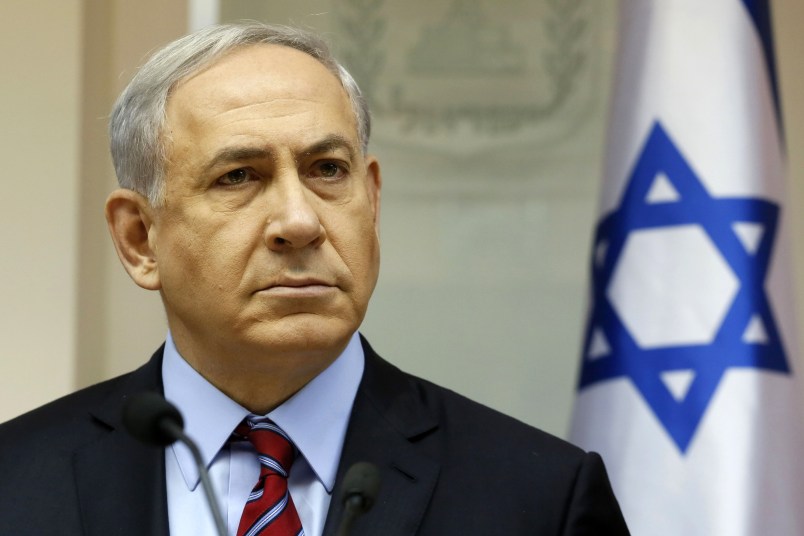
JERUSALEM (AP) — A national leader’s appearance before the U.S. Congress is usually a source of pride and unity. But Prime Minister Benjamin Netanyahu’s planned trip to Washington — opposed by the White House and many Democrats — has Israel in uproar.
The Israeli leader faces growing calls to cancel the visit as rivals accuse him of risking Israel’s relations with the United States in hopes of winning extra votes in next month’s Israeli parliamentary election.
But Netanyahu has shown no signs of backing down, saying Sunday he would “do everything” to prevent U.S.-led international negotiators from reaching a “bad and dangerous agreement” with Iran over its nuclear program.
The U.S. is Israel’s closest and most important ally. While ties remain strong between the nations, relations between Netanyahu and President Barack Obama are another matter. The two have long had strained personal relations and differ on many policy issues, with Netanyahu favoring a more confrontational approach to his foes over Obama’s inclination toward diplomacy and compromise.
The differences are especially glaring when it comes to the Iranian nuclear issue. Netanyahu has identified a nuclear-armed Iran as the single greatest threat to his country and says its nuclear program must be dismantled. Israeli pressure, featuring barely veiled threats to attack Iran if necessary, is credited by many here as having focused world attention on the issue and spurred economic sanctions against Iran.
Obama has vowed to prevent Iran from developing a bomb but has signaled he’s willing to tolerate certain activities, such as uranium enrichment, a technology that Israel fears could quickly be diverted for weapons use. The U.S. and five global partners hope to reach a preliminary deal with Iran by March.
Cabinet Minister Yisrael Katz, a member of Netanyahu’s Likud Party, acknowledged differences between Netanyahu and Obama over Iran. “Netanyahu feels that he has been fighting for years and now we are nearing a critical moment,” Katz told Channel 2 TV.
Fearful that Obama is about to reach a “bad deal,” Netanyahu jumped at the opportunity to address a joint session of Congress on March 3, two weeks before Israel’s general election. The invitation was issued by the Republican speaker of the House of Representatives, John Boehner, and engineered by Netanyahu’s ambassador to Washington, Ron Dermer, a former Republican operative.
The decision has triggered an outpouring of anger in both countries.
The White House views the planned visit as a breach of protocol, because it was not coordinated well ahead of time with the U.S. administration, which learned about it just before it was made public. The White House also cited the close proximity of the election as the reason Obama wouldn’t meet Netanyahu, saying the president wanted to avoid the appearance of taking sides.
U.S. officials also fear that the speech could upset the delicate talks with Iran. Several Democrats have said they would skip the speech, while others, including House Minority Leader Nancy Pelosi, have suggested that Netanyahu should postpone it.
Biden’s office said the vice president would miss the address. Despite the stated American intention to stay out of Israeli domestic politics, Biden found the time to meet Netanyahu’s chief rival, Israeli opposition leader Isaac Herzog, on the sidelines of a security conference in Germany.
Abe Foxman, director of the Anti-Defamation League, a leading Jewish American group, has urged Netanyahu to call off the visit. The pro-Israel lobby group AIPAC also has reservations because it is turning into a partisan event, according to a person involved in U.S.-Israel relations. He spoke on condition of anonymity because he was not authorized to discuss the matter with the media.
Israeli leaders across the political spectrum almost universally support Netanyahu’s tough line toward Iran. But many opposition figures, including Herzog, have criticized Netanyahu’s handling of the congressional speech, describing it as a cheap election stunt that would only undermine support for Israel in Washington.
Herzog’s running mate, former Foreign Minister Tzipi Livni, said Netanyahu was damaging ties with the U.S. “for the sake of an election speech.” Yair Lapid, leader of the centrist Yesh Atid party, said Netanyahu was causing “serious damage” to American ties and urged him to stay home.
Even some of Netanyahu’s sympathizers are saying he’s misjudged the situation.
“You’re right, but don’t go,” said the headline in a front-page commentary by columnist Ben-Dror Yemini in the Yediot Ahronot daily. “Obama is wrong and you’re right. But if there is any chance of budging him from his position, then you are making every possible mistake and turning him into an adversary.”
Michael Oren, who served as Netanyahu’s ambassador to Washington until 2013, said that if he were still in the post, he would have advised his boss not to address Congress.
“The last thing you want is for support of the Jewish state to become the monopoly of one party,” said Oren, who is now running for parliament with a newly formed centrist party. He said Netanyahu would do better to deliver his speech to the annual conference of AIPAC, which is attended by many members of congress. “You get the same effect without running the same risk,” he told The Associated Press.
Alon Pinkas, a former Israeli consul-general in New York, called the planned visit a “horrendous idea” that demonstrated how poor Netanyahu’s relationship with Obama has become.
Yet he argued that the uproar did serve Netanyahu’s ambition to remain prime minister by focusing public debate on Iran — and away from domestic bread-and-butter issues that hurt his party’s chances of retaining power. Recent polls predict a tight race.
“This is not about Iran,” he said. “This is 100 percent about elections.”
Copyright 2015 The Associated Press. All rights reserved. This material may not be published, broadcast, rewritten or redistributed.






Pressure that he should heed. He really made a mess of this, didn’t he? My hope would be that the day he speaks, Obama announces a good deal with Iran…that would really take whatever wind there is out of Netanyahu’s sails back in Israel.
I heard some GOP shill this morning saying that the “ONLY” thing Israelis want in a leader is someone who can ‘articulate to the world how much Israel is under attack.’ What an absolutely asinine thing to say. And from the mouth of bomb-crazy Netanyahu??
You know things are bad when Abe Foxman at ADL turns on you. Josh has an excellent article on this subject. If AIPAC is also worried about the fall out the win/lose ratio has tipped decidedly against Netanyahu in the US. Netanyahu’s ego has cost Israel and the costs are mounting.
BibI put himself in quite a pickle. He thought the political clout of pro-Israel sentiment would cover his ass, He overplayed that hand. When an unabashedly pro-Israel group like the ADL speaks out against you things aren’t good. Unfortunately, he’s in somewhat of a catch-22. If he backs down he’ll look weak; if he goes through with it he will damage the American-Israel relationship – at least until this president leaves office.
Yes, Prime Minister Netanyahu seems to have misplayed this. First we heard that the White House was not looped into this, then that Democratic Congress members were also taken by surprise, and then an Israeli official’s statement that it was Speaker Boehner – and not Amb. Dermer – who was supposed to have contacted the White House before the announcement, implying that Bibi was misled.
One thing, however, was clear: it was imperative for Boehner to take the fall for this to avoid this from escalating into an international incident that could have derailed the Iran talks and hurt US-Israeli relations.
Also, if Dermer would have taken the blame, it could have raised the kind of “puppeteer” conspiracy theories about undue Jewish and Israeli influence on the US that continually surround the topics of Jews and Israel.
Iran’s hardliners could have claimed that the incident was evidence that the US is not an honest broker.
Boehner had to fall on his sword over this.
Chalking this clumsy move to a bumbling Boehner dissipates some of the paranoia of many who claim that Israel enjoys undue influence over America.
I believe this unfortunate incident originated in the desires of both Bibi and Boehner to exploit the Iran situation for their own ends, and I believe that both men misread the President’s resolve to broker what could be a historic deal, one that might defuse tensions in the Middle East and set the stage for an eventual Israel-Palestine peace deal.
And I am gradually becoming more sanguine about this incident, as I think the Obama administration can exploit the tension and play the “good cop/bad cop” game, using pro-sanctions Congressmen and Bibi as foils. Obama and Kerry can exploit the tensions over this situation and convince the Iranians that this is their only chance to get a deal, and that time is running out.
Boehner has not fallen on his sword, unless I have missed something. I agree if he did it might defuse some of the animosity. Netanyahu and Boehner have both made major errors in judgment and it appears they are unwilling to take the steps necessary to correct the blunder.