

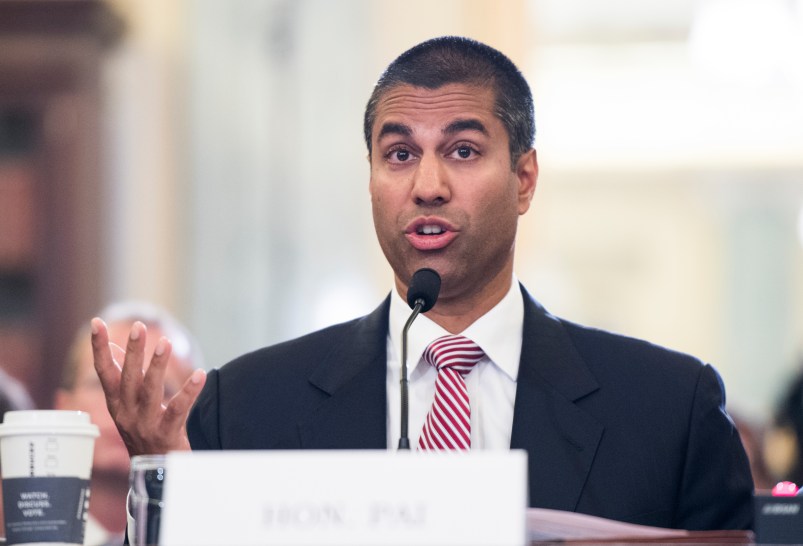
NEW YORK (AP) — President Donald Trump has picked a fierce critic of the Obama-era “net neutrality” rules to be chief regulator of the nation’s airwaves and internet connections.
In a statement Monday, Ajit Pai said he was grateful to the president for choosing him as the next chairman of the Federal Communications Commission. Several reports last week had said he was the pick.
Pai had been one of the two Republican commissioners on a five-member panel that regulates the country’s communications infrastructure, including TV, phone and internet service.
There are currently just three members on the panel. The Republicans’ new majority at the FCC, along with their control of Congress and the White House, is expected to help them roll back policies applauded by consumer advocates that upset many phone and cable industry groups, including net neutrality rules that bar internet service providers from favoring some websites and apps over others.
Pai, an active Twitter user, posted Monday that “there is so much we can do together to bring the benefits of the digital age to all Americans and to promote innovation and investment.”
AN INDUSTRY-FRIENDLY FCC
Pai has long maintained that the FCC under former Chairman Thomas Wheeler had overstepped its bounds, suggesting that he would steer the agency in a direction more favorable to big phone and cable companies. In a December speech, he expressed confidence that the 2015 net neutrality rules would be undone and said the FCC needed to take a “weed whacker” to what he considered unnecessary regulations that hold back investment and innovation.
Consumer advocates have been concerned that a deregulation-minded FCC could potentially allow more huge mergers, overturn new protections for internet users and lead to higher costs for media and technology companies that rely on the internet to reach consumers.
Pai opposed online privacy regulations that force broadband providers to ask consumers for permission before using their data, saying they are more onerous than the requirements for internet companies like Google and Facebook.
He voted against approving Charter Communication’s $67 billion takeover of Time Warner Cable and a smaller company, Bright House — not because he opposed the merger, but because he thought some of the conditions required by the FCC, like barring data caps on home internet service, amounted to government meddling in business.
PAI VS. THE ZERO RATING
Pai also criticized an FCC report on “zero rating” earlier this month, characterizing it as a meaningless document that won’t influence the FCC under Trump. The report, issued in the last days of the Obama administration, took issue with the way companies like AT&T and Verizon exempted their own video services from wireless data caps, effectively making them cheaper to stream on phones and tablets than rival services such as Netflix.
Future big media and telecom mergers may get a friendlier review under a Pai-led FCC. Pai voted to approve AT&T’s 2015 acquisition of DirecTV. And while he told The Wall Street Journal in December 2013 that the Obama administration was likely to oppose Comcast’s failed effort to acquire Time Warner Cable — he was right — he added that a Republican administration would be more likely to approve it.
The FCC currently has a 2-1 Republican majority and two empty seats, which will be filled by one Republican and one Democrat.
Pai, an Indian-American from Kansas, has been an FCC commissioner since 2012. During his roughly 15 years in government, he’s been a Senate staffer and worked at the FCC and the Justice Department. He was also a lawyer for Verizon and an attorney at the law firm Jenner & Block.
Copyright 2017 The Associated Press. All rights reserved. This material may not be published, broadcast, rewritten or redistributed.




Maybe we should just start a list of where we the American people are getting fcked and see how long it is at the end of the year. Anyone who voted for Rump will realize they totally fcked themselves over and he is not for them but for the corporations only.
Don’t want the Trump supporters yet.
I want the ones who either sat out, voted 3p, didn’t vote top ballot, etc.
Those people are the future.
High-speed lanes for the wealthy. Self-surgery for the poor.
Welcome to the Trump Years.
There are two points I’m trying to better understand:
Pai will require senate confirmation, at some point, though I think he is head of the FCC effective immediately? Not entirely sure how that works. (See: 1)
The second point is that any change to net neutrality may (or may not …) take months – for hearings, public comment, etc. Since this isn’t so much breaking new ground, I’m skeptical there will be much happening here though …
Obviously, this is not good, but I think there’s time to contact senators.
Oh, so if it’s okay for Google and Facebook to do bad shit, we’d better allow other companies to do bad shit. As opposed to stopping Google and Facebook from doing bad shit. The GOP: always so fair-minded.
Fair-minded until they start throwing out those grand ol’ party grand ol’ policies for individual people, that is, as opposed to incorporated “people”. After all, we all know that companies are people too, and therefore deserve all the same rights and protections (duh, why would anyone think that should not be the case?). Except that they’re more important than individual people, cause they make rich people richer, so therefore they actually deserve more protection because rich people are just… better! They’re the JOB CREATORS after all. That’s why trump put so many in his cabinet - JOB CREATORS will help make america great again!