


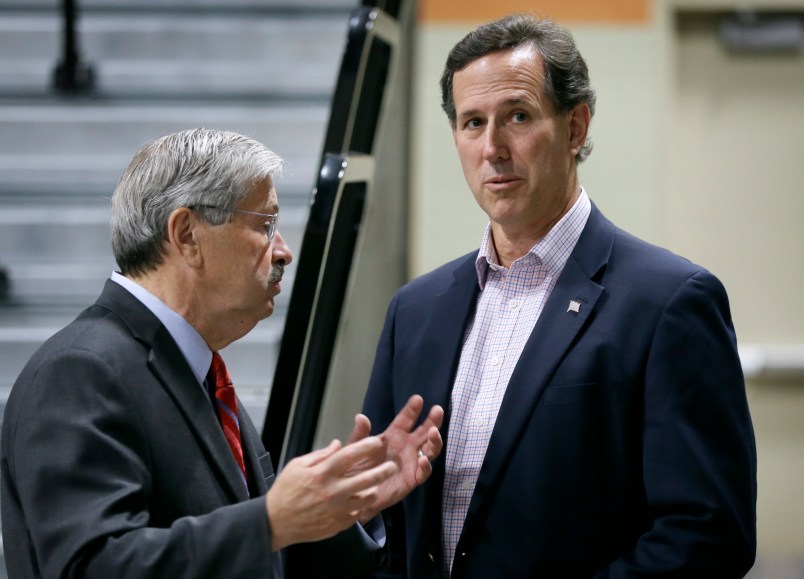
DES MOINES, Iowa (AP) — Iowa’s Republican Gov. Terry Branstad has
spent the past year leading an effort to seize control of his state
party, hoping to send a message that the kickoff presidential caucuses
will be welcoming to all 2016 GOP hopefuls.
But as conservative prospects flood the state for a major annual gathering of evangelical Christians this weekend, it’s not clear whether the party makeover will make Iowa more attractive to a mainstream GOP contender. Evangelicals, tea partiers and libertarians remain strong in Iowa, which has been difficult terrain for more moderate Republicans in recent presidential cycles.
The lineup for the Family Leadership Summit in Ames — a daylong event expected to draw more than a 1,000 conservative Christians — features Texas Sen. Ted Cruz, Texas Gov. Rick Perry, Louisiana Gov. Bobby Jindal and former caucus winners Rick Santorum and Mike Huckabee. Kentucky Sen. Rand Paul has also been touring the state this week.
Meanwhile, appearances in Iowa by the more pragmatic options have been sparse.
New Jersey Gov. Chris Christie came once in his role as chairman of the Republican Governors Association. Former Florida Gov. Jeb Bush has not been seen since 2012. Wisconsin Gov. Scott Walker, busy with a re-election campaign, last came in May 2013.
Still, Branstad insists he is confident the state will get plenty of candidate attention.
“My advice is always come to Iowa early, spend a lot of time here,” said Branstad, who is running for his sixth non-consecutive term and said his efforts are also geared at making 2014 a strong year for Republicans in Iowa.
The recent party shake-up came after veteran Iowa Republicans grew concerned that the party’s more conservative factions were displacing traditional Republicans. The victory by Huckabee, a former Arkansas governor, in the caucuses in 2008 showed the power of the conservative vote.
Iowa Republicans are also still reeling from the debacle in 2012 when the state GOP initially declared Mitt Romney the winner and then admitted three weeks later that the conservative Santorum had received more votes. Shortly after that, supporters of libertarian U.S. Rep. Ron Paul took over the party leadership. The chairman then openly disagreed with Branstad on political and policy matters and fundraising languished.
Above all else, Branstad and his allies want to preserve Iowa’s first-in-the-nation caucuses, which have given the state — with just 3 million residents — an outsize influence on presidential politics.
Without new steps to assure the caucuses’ stability, “it would limit the number of candidates willing to take part in the caucuses and it could harm the caucuses,” said Jeffrey Boeyink, former chief of staff to Branstad.
Sen. John McCain skipped Iowa in his 2000 campaign and limited his time in the state in 2008.
The Iowa GOP now has a new chairman and new professional staff. Branstad supporters got involved in early party meetings this year so they had greater say in picking the leaders.
“There’s obviously a strong social conservative base to our party and that’s not changed,” said Branstad ally Doug Gross. “The traditional Republicans, those folks have sat out. Those folks have now re-energized and are back in the party.”
Supporters of these changes note that the party is now raising money again after several years of limited fundraising success. In addition, some note the wide range of Iowa candidates this year — Senate candidate Joni Ernst, a Branstad-backed conservative, and U.S. House nominee David Young, a former Capitol Hill staffer who defeated more vocally conservative candidates.
But, Chuck Laudner, a former executive director of the state GOP, said it would be hard to significantly increase the number of caucus participants — meaning a conservative may still have a leg up in 2016.
“Nothing’s changed on that front. The Iowa caucus turns out around a 150,000 on caucus night and they’re going to be the same 150,000,” he said.
Still, Sara Fagen, former political director for President George W. Bush, said this shift matters outside the state.
Candidates, she said, want to know that “you’re not going to have party officials undermining your effort.”
Copyright 2014 The Associated Press. All rights reserved. This material may not be published, broadcast, rewritten or redistributed.



Makes me wonder - if this is the case, will SC be the start of the GOP season? If the saner folks abandon Iowa, and I would expect lower effort in NH with Paul running. He should be pretty strong there assuming he can draw on daddy and Libertarian support.
It’s a very risky proposition to skip Iowa. Not because of the actual caucus results so much, but because the Iowa primary is THE only focus of campaign coverage for about 3 months. Very few candidates can afford to surrender that type of coverage to all their competitors for the first three months of the election cycle.
That being said, Iowa milks it for every penny, every four years. The straw poll, for example, is nothing but a transference of wealth to the state GOP, where candidates can and do, literally buy the votes.
NH is always an oddball with regards to primary results. Paul could do well there (and probably will have to), assuming his libertarian cred isn’t tarnished by then…and in my opinion, that’s a pretty big if. Paul lacks any actual convictions and is now entering into what is for him, new territory. He has to pander to all sorts of people, many of which have conflicting views. And not to suggest that Romney’s etch a sketch strategy was successful, but by comparison, Romney looks like a genius with the etch a sketch compared to Paul.
“Kentucky Sen. Rand Paul has also been touring the state this week.”
…really fast. And by foot.
100 likes, especially for that last sentence. Paul’s behavior and comments in the past few days are really surprising in terms of their political ineptness and, of course, lack of consistent principles.
Especially when someone says “immigration” anywhere near!