


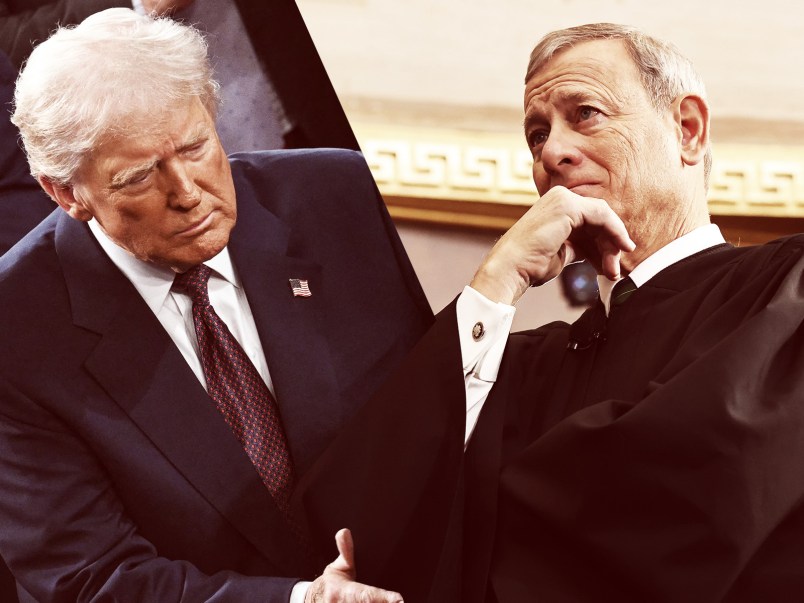
On Tuesday, a federal judge advanced the ball in a challenge to President Donald Trump’s order to overhaul mail-in voting, an important step in what will be a furious few weeks of litigation critical to the 2026 midterms.
The Supreme Court handed down an order Monday in which the unsigned majority declared that a group of blue states had filed its lawsuit against the executive order too early, when the resulting actions agencies would have to take were still hypothetical. The Supreme Court’s Monday order was clearly written before last Friday, when the U.S. Postal Service promulgated a final rule that would force states to hand over voter data to the federal government, as well as impose new standardization requirements on mail-in ballots themselves.
The Supreme Court majority said nothing about the constitutionality of the executive order itself — merely, that the plaintiffs complained too early. Now that a final rule has been produced, the Court shouldn’t be able to raise the same issues with a newly filed or amended complaint.
Now, zoom into one of the fights over the executive order in Massachusetts. In League of Women Voters of Massachusetts v. Trump, a voting rights group was pushing U.S. District Judge Indira Talwani to punish the government for violating her injunction. Under that injunction, the government was not allowed to proceed to the final stage of rulemaking.
Talwani wrote Tuesday that she agreed with the plaintiffs: The government, in producing the USPS rule, did violate her order.
“Despite the Defendants’ protestations that ‘[t]he United States takes its obligation to comply with court orders very seriously,’ the court finds that Defendants violated the preliminary injunction in this case,” she wrote.
But she won’t take any action on the violation, because it wouldn’t change the status quo, she added. The plaintiffs want, as punishment for the feds breaking the rules, an injunction that prevents the administration from enforcing the final rule. But they already have that, while Talwani’s old injunction stands.
Even though the government disobeyed her order, she wrote, having a final rule to challenge will likely actually work in the voting group’s favor — now the Supreme Court can’t dismiss it out of hand because it’s too early in the process.
“Defendants’ violation of the court’s order may ultimately inure to Plaintiffs’ benefit, where, now that a Final Rule has issued despite the pendency of the injunction, Plaintiffs could choose to file an amended complaint reasserting their current, nonAPA claims, but noting that the issuance of a Final Rule is no longer hypothetical,” she wrote.
She’s choosing not to litigate the old fight because what happens next is much more important. The Supreme Court majority (to the liberal justices’ dismay) wriggled out of ruling on the contents of Trump’s chaos-invoking order by focusing on procedural grounds. Talwani is nudging the voting group to lodge an amended complaint, free of those procedural issues, which will inevitably make its way back up to the Supreme Court.
It’s never safe to assume that the Court will rule against Trump’s interests, even with an order that likely has unconstitutional components and would require an unworkably massive lift by the USPS on the eve of an election. But Talwani is at least speeding up the proceedings that will lead to that final decision.
Read the order here:




“The Supreme Court majority said nothing about the constitutionality of the executive order itself — merely, that the plaintiffs complained too early. Now that a final rule has been produced, the Court shouldn’t be able to raise the same issues with a newly filed or amended complaint.”
Next they will say the new appeal was filed too late.
Thank you, Kate Riga, for keeping us up to date on this emerging story.
Agreed - this was super helpful. I also found this to be a pretty good explainer of the SCOTUS decision.https://www.youtube.com/watchis=OVRLXfZ4PipKLo2n&v=fyR0OYHQyNw&feature=youtu.be